Puff adder
Bitis arietans
 AI-generated
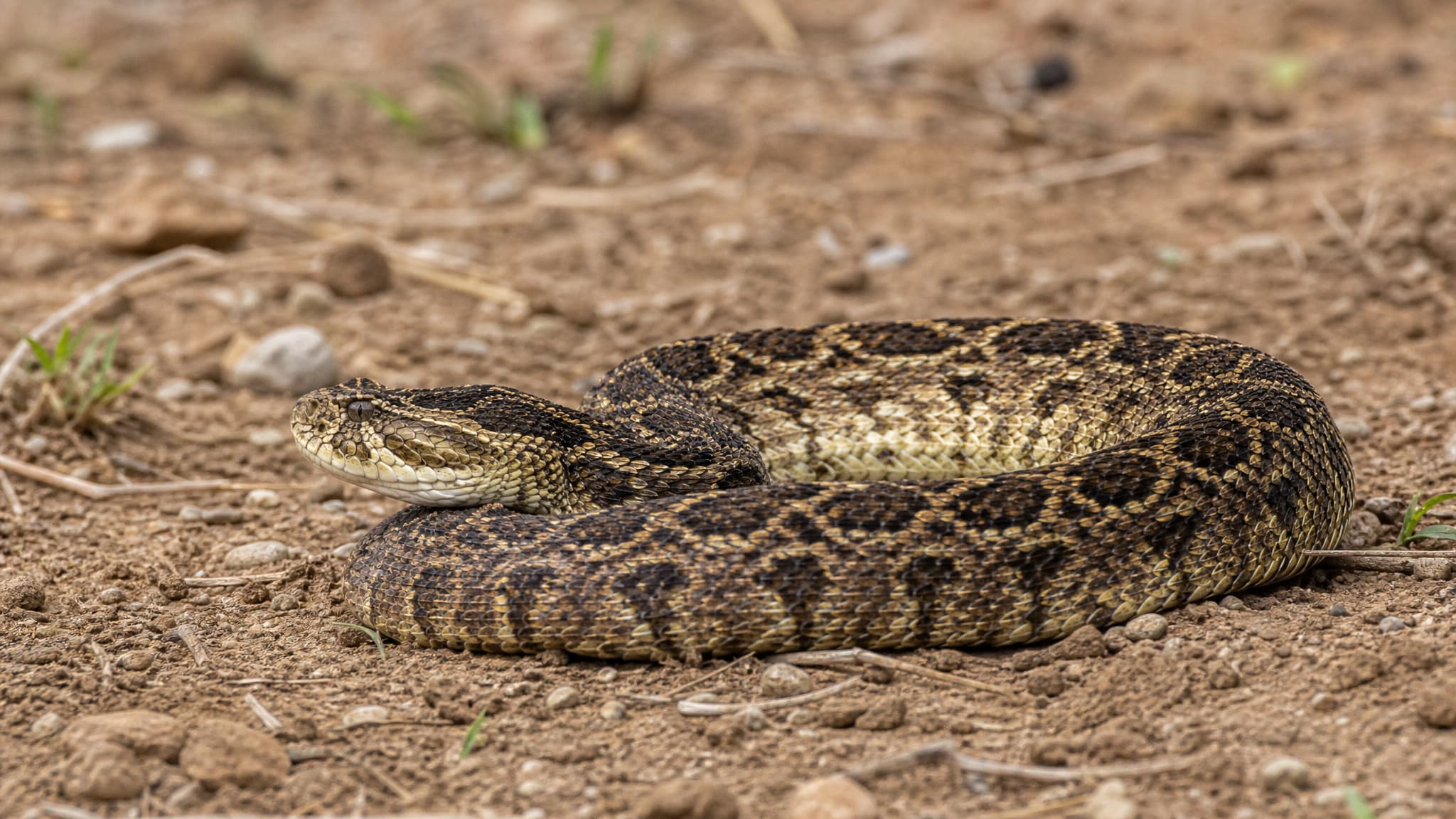
A puff adder rests tightly coiled on bare, stony soil, with its broad head slightly raised and facing left. Its heavy body, keeled scales, slit pupil, and dark-and-tan patterned markings are clearly visible.
The puff adder is a large, strongly built terrestrial viper with a broad, triangular head, keeled scales, and a conspicuous series of pale and dark chevrons across its back. Its colors range through buff, brown, reddish, and occasionally very dark tones, providing excellent camouflage against soil, leaf litter, grass, and scrub. Adults commonly measure around 80 cm, although substantially larger individuals have been recorded.
This species has one of the broadest distributions of any African snake. It occurs widely across Africa south of the Sahara, reaching parts of North Africa, and is also found in southwestern Arabia. It occupies varied warm habitats where shelter and water are available, including savannas, grasslands, open woodland, forest edges, semi-arid country, and some rainforest settings; records extend to about 3,500 m in elevation.
A solitary, mostly ground-dwelling ambush predator, the puff adder often remains motionless for long periods until prey comes within striking range. Rodents make up much of its diet, but it also eats birds, amphibians, lizards, other snakes, and occasionally larger vertebrates; young snakes additionally take insects. Its cryptic coloration and low-movement hunting strategy make it difficult to notice. When disturbed, it may inflate its body and produce the forceful hiss that inspired its common name. It is venomous and should always be observed from a safe distance.
Puff adders give birth to live young rather than laying exposed eggs. Mating is seasonal in studied southern populations, and litters commonly contain about 20–40 offspring; newborns are independent immediately. Captive animals have lived nearly 16 years, whereas wild longevity is not well documented. By preying heavily on rodents, puff adders contribute to food-web balance and may help limit agricultural pest populations; they are also prey for snake-eating birds, mammals, and other snakes. The species is assessed as Least Concern, reflecting its extensive range, though local animals can be harmed by persecution and habitat change.