Pygmy Killer Whale
Feresa attenuata
 AI-generated
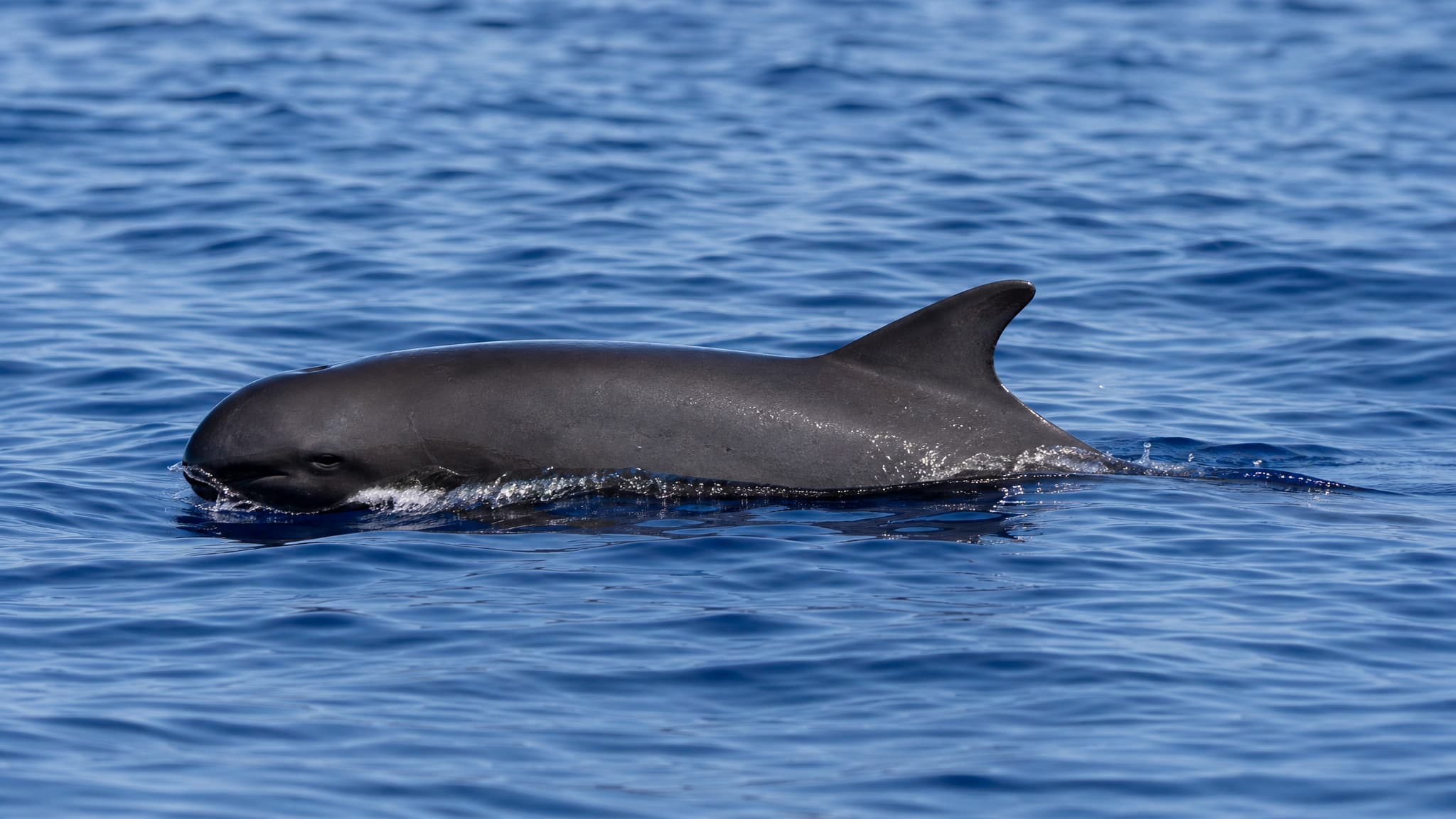
A dark gray pygmy killer whale swims at the ocean surface in side profile, with its rounded head and tall, curved dorsal fin clearly visible. Water partially obscures the lower body and other fins.
Pygmy killer whale
The pygmy killer whale is a small, dark-bodied oceanic dolphin—not a miniature form of the killer whale. Adults can reach about 2.6 m (8.5 ft) in length and have a blunt, rounded head without a distinct beak, a tall curved dorsal fin, and comparatively long flippers with rounded tips. Its body is generally charcoal gray to black, often with paler gray or whitish areas around the lips, face, and underside. At sea it can be difficult to distinguish from the melon-headed whale and false killer whale, especially in brief or distant sightings.
This species occurs widely, though patchily documented, in tropical and subtropical waters of the Atlantic, Indian, and Pacific oceans. It is usually associated with deep offshore water, but it may occur near islands and occasionally closer to shore. Sightings are uncommon, partly because the animals can be elusive and avoid vessels; consequently, much of what is known has come from strandings and a few long-term field studies, particularly around Hawai‘i.
Pygmy killer whales are social toothed whales. Groups commonly contain a few to several dozen animals, although much larger aggregations have been reported. They communicate and orient in an acoustic environment, as do other dolphins, and underwater noise can disrupt activities dependent on sound. Evidence from stomach contents shows a carnivorous diet including fishes and cephalopods such as squid and octopus; some records also indicate predation on small cetaceans. By feeding on mid-water fishes and cephalopods, they function as upper-level predators in warm-water pelagic food webs.
Reproduction remains incompletely documented. Females give birth to a single calf, reported at roughly 0.8 m long, but gestation length, breeding timing, and parental-care duration are not well established. Wild lifespan is also unknown; however, photo-identification research in Hawai‘i recorded at least one individual over a 21-year interval, showing that individuals can be long-lived. The species is globally assessed as Least Concern, yet important uncertainties remain because abundance and population trends are poorly known. Entanglement or capture in fishing gear, deliberate hunting in some regions, and anthropogenic ocean noise are recognized threats.