Burmese Python
Python bivittatus
 AI-generated
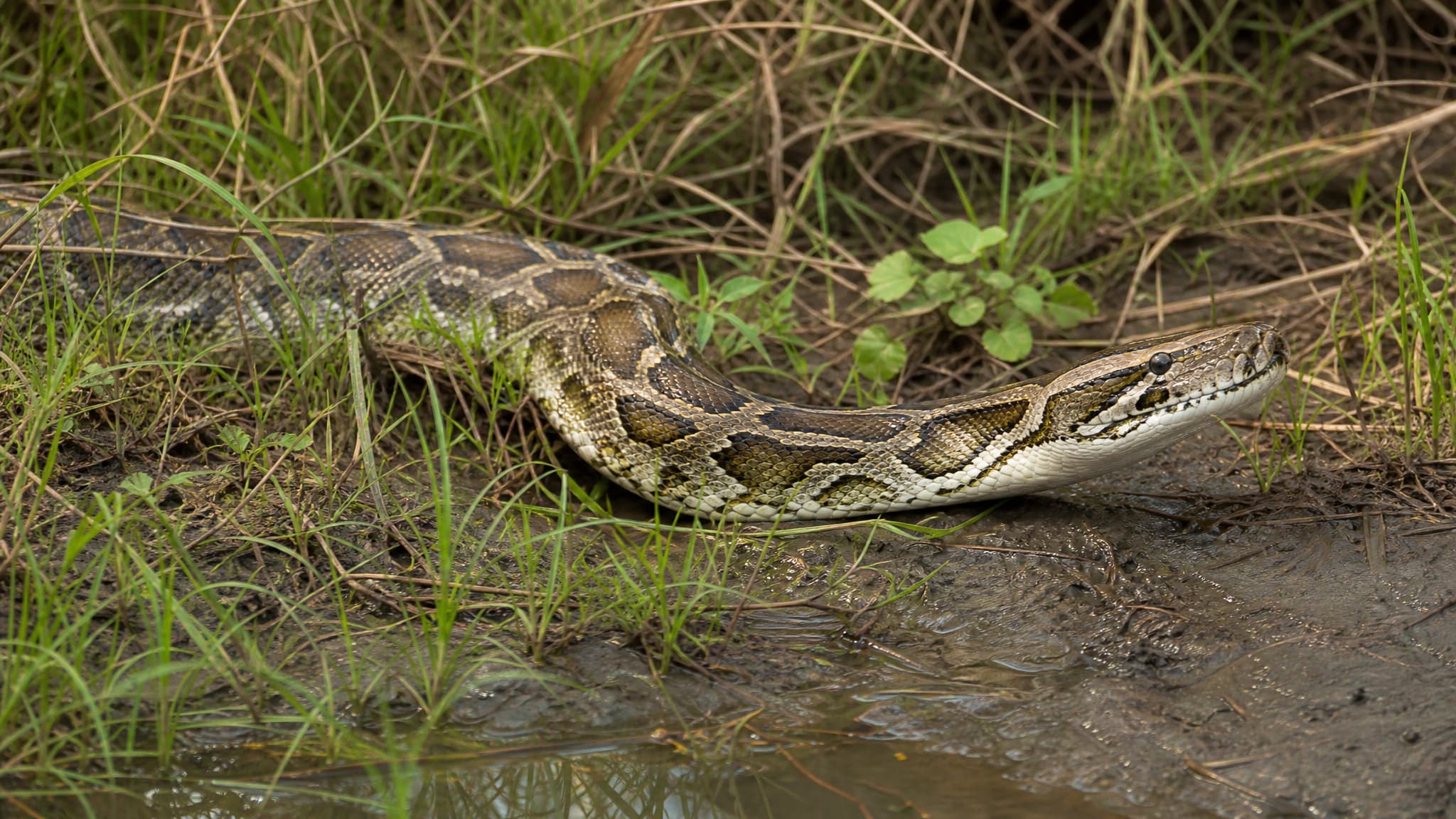
A large Burmese Python is shown with its body extended in an S-shaped curve beside a shallow muddy stream, its head raised slightly above the water. Its tan-brown body has dark, pale-edged blotches, and the broad head shows a pale underside and closed mouth.
Burmese python
The Burmese python is a huge, heavy-bodied, nonvenomous constrictor. Its ground color is usually tan, gray, or yellowish brown, overlaid with broad dark brown to olive blotches edged in cream or gold. These irregular markings often resemble connected puzzle pieces. A dark arrow-like marking on the head is another useful field character. Adults commonly measure about 3–4.9 m (10–16 ft), with females generally larger than males; exceptional individuals may be longer.
Native populations occur across parts of South and Southeast Asia, including northeastern India, Nepal, Bhutan, Bangladesh, Myanmar, Thailand, Laos, Cambodia, Vietnam, southern China, and parts of Indonesia. The species uses rainforest, grassland, marsh, swamp, rocky foothills, and agricultural landscapes, and is especially associated with wetlands and other water-rich habitats. It is a capable swimmer and is often described as semi-aquatic.
A patient ambush predator, the Burmese python detects prey with chemical cues, vision, and heat-sensitive pits around its mouth. It grips prey with backward-curving teeth, coils around it, and constricts before swallowing the animal whole. Mammals, birds, and reptiles all form part of its diet. By consuming rodents and other vertebrates, it can influence food webs and may contribute to natural rodent control in its native ecosystems.
Breeding generally occurs in early spring. Females mature at roughly four to five years of age and lay clutches commonly numbering 30–60 eggs, though larger clutches are recorded. Unlike many snakes, the female remains coiled around the eggs and can generate warmth through muscular contractions during incubation. Hatchlings are independent immediately after hatching. Wild longevity is poorly known; individuals in human care commonly live about 20–25 years.
The species is assessed as Vulnerable. Native populations face pressure from hunting for skin and meat, killing by people, and habitat loss. In sharp contrast, released or escaped animals have established an invasive population in southern Florida, where Burmese pythons prey on native wildlife, including species of conservation concern. This difference underscores that a species may be threatened in its native range while causing serious ecological harm where introduced.