
Spider tortoise
Pyxis arachnoides
 AI-generated
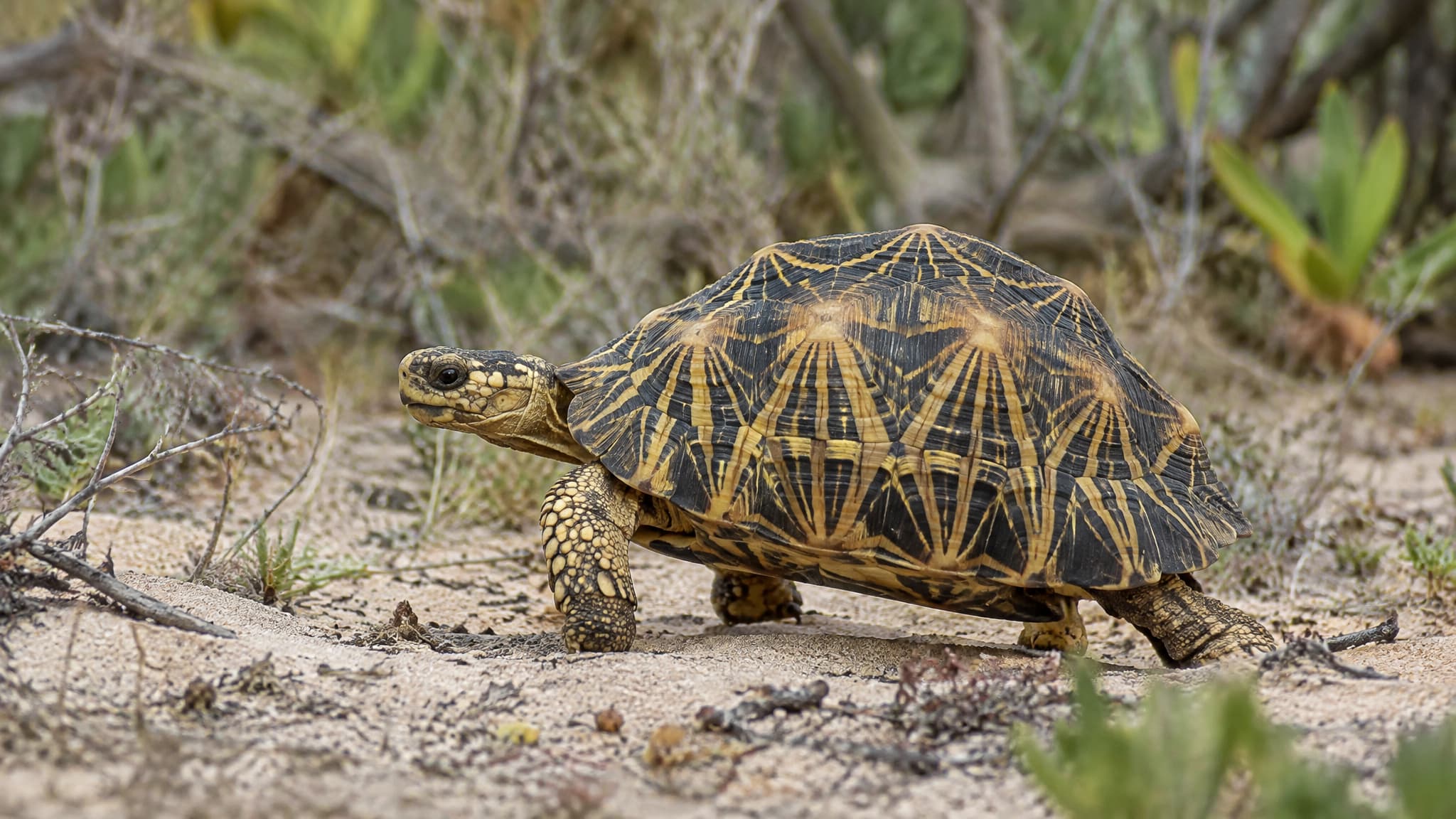
A tortoise walks left across sandy, sparsely vegetated scrub. Its domed shell shows bold yellow radiating lines on a dark background, with the head and sturdy, scaled legs visible.
The spider tortoise (Pyxis arachnoides) is one of the smallest tortoises in the world. Its high-domed carapace is dark brown to black, crossed by a web of yellow lines that gives the species its common and scientific names. The head is dark with yellow spots, and the yellow plastron is partly hinged, so the animal can draw its head and front legs inside. Females are slightly larger than males, averaging about 12 cm against 11 cm; the largest recorded shells measure 15.7 cm in females and 14.4 cm in males. Males have longer, thicker tails. Adults usually weigh under 1 kg.
The species lives only in Madagascar, in a narrow belt of dry spiny forest and coastal scrub along the southwestern and southern coast. It favours sandy ground with succulents and shrubs and about 30 to 50 percent canopy cover. Three subspecies are recognized: the common (P. a. arachnoides), northern (P. a. brygooi) and southern (P. a. oblonga) spider tortoises, which genetic work has confirmed as distinct lineages. Its range overlaps with that of the much larger radiated tortoise.
In the wild it feeds mainly on grasses, young leaves and roots, and also takes insects and cow dung that contains insect larvae. It is most active in the wet season, from November to April, and shelters under vegetation during the hottest hours. In the dry season it may aestivate, burying itself in the sand.
Little is known about its breeding. Mating begins when the rains return and dormancy ends. Females usually lay a single egg, occasionally two, in a shallow nest in sandy soil, and incubation lasts about 220 to 250 days. The species is thought to live up to 70 years, although there is no firm data.
The spider tortoise is Critically Endangered on the IUCN Red List and has been on CITES Appendix I since 2005. Its spiny forest habitat is disappearing at about 1.2 percent a year through fires set for grazing land, charcoal production and invasive plants. It is also poached for the international pet trade and, as radiated tortoises become scarcer, hunted locally for meat.



