Red-footed tortoise
Chelonoidis carbonarius
 AI-generated
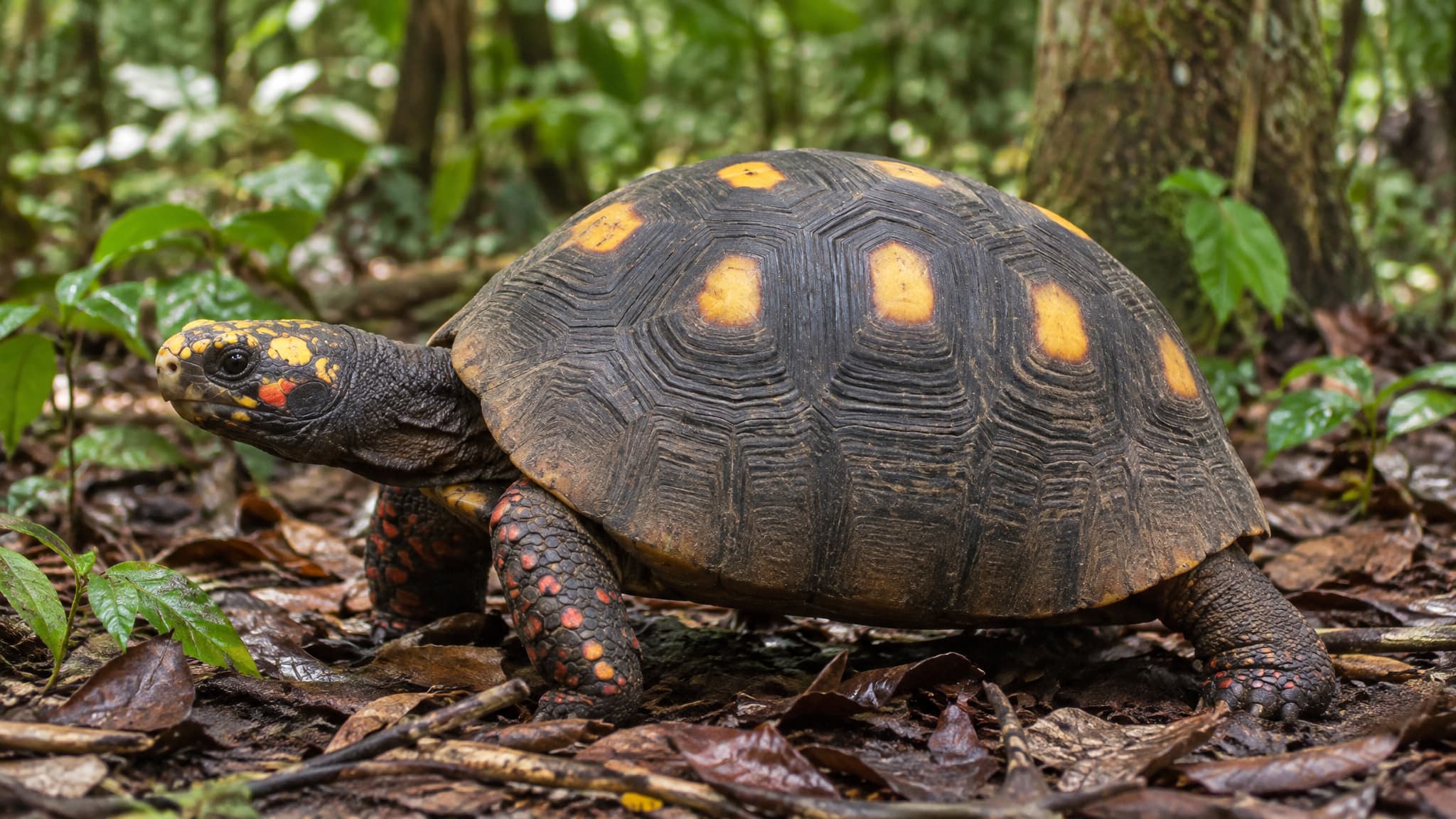
A red-footed tortoise walks in side profile across a damp, leaf-littered tropical forest floor. Its domed dark shell has yellow-orange markings, and its head and sturdy legs show vivid red and yellow scales.
The red-footed tortoise (Chelonoidis carbonarius) is a medium-sized South American land tortoise of the family Testudinidae. Adults usually have a carapace of about 30 to 35 cm, individuals of 45 cm are fairly common, and the largest recorded specimen, from Paraguay, measured 60 cm and weighed more than 28 kg. The shell is dark brown to almost black, with a paler central patch on each scute, while the thick scales of the legs and tail range from yellow to deep red, the feature behind its common name. Males are on average slightly larger than females and have a more developed rear plastron and a wider angle between the anal scutes, which leaves the tail more mobile.
The species lives east of the Andes, from southeastern Panama through Colombia, Venezuela and the Guianas to Ecuador, Peru, Bolivia, Brazil, Paraguay and possibly northern Argentina, with populations on several Caribbean islands, some probably introduced by people. In Brazil it is confirmed in 18 states and in the Amazon, Caatinga, Cerrado, Atlantic Forest and Pantanal biomes. It uses humid and dry forests, savannas and forest-savanna transitions, favoring humid, densely wooded ground and avoiding muddy areas.
Although often called omnivorous, it feeds mostly on plants. In the wet season about 70% of the diet is fruit and 25% leaves and shoots; in the dry season fruit falls to about 40% and flowers make up about 23%, alongside leaves, fungi and a little animal matter such as carrion. Tortoises share shelters in fallen trees, hollow logs and burrows dug by armadillos and agoutis, mark them with scent trails, gather at food sites without defending territories, and may aestivate when food runs short in the south of the range.
Sexual maturity comes at around 5 years of age. Each clutch holds 2 to 15 eggs, and a female may lay several clutches in a season. Incubation lasts 105 to 202 days, about 150 on average, and sex is set by temperature: females develop at or above 29 °C. Hatchlings measure 39 to 45 mm and weigh 22 to 30 g, and receive no parental care. Many wild individuals live 30 years or more, but precise data are lacking.
By swallowing whole fruit and passing intact seeds, including those of figs and bromeliads, the red-footed tortoise is an important seed disperser. Jaguars are its main natural predator as adults. The species is listed on CITES Appendix II. Its global IUCN Red List assessment, submitted by the Tortoise and Freshwater Turtle Specialist Group, classifies it as Endangered, and in 2026 Brazil's national list classified it as Vulnerable. Habitat loss and fragmentation and heavy collection for food and the pet trade are the main threats.