
Red Panda
Ailurus fulgens
 AI-generated
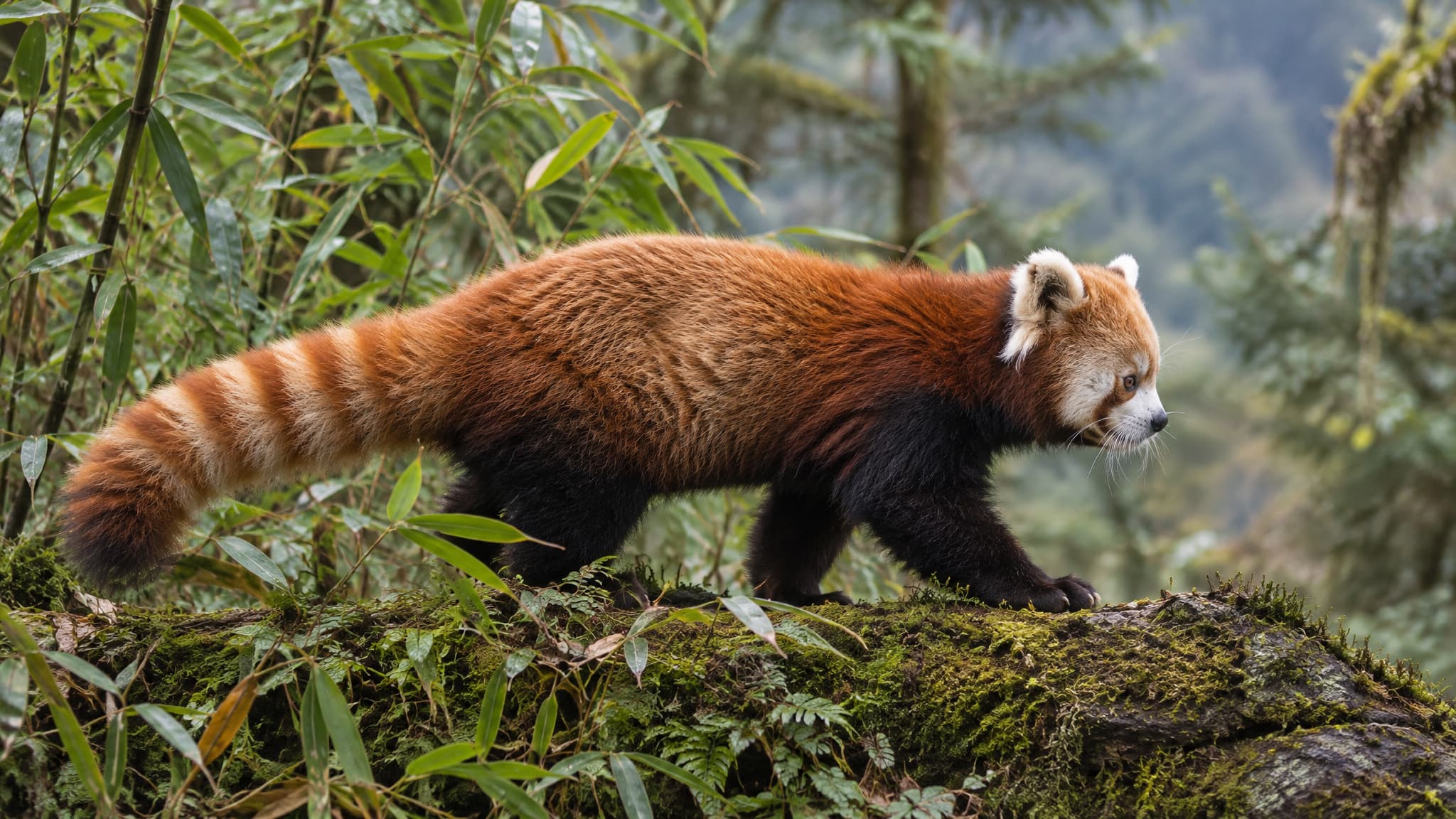
A red panda walks to the right along a moss-covered log in a lush bamboo forest, showing its reddish coat, dark legs, pale facial markings, and broad ringed tail.
The red panda (Ailurus fulgens), also called the lesser panda or firefox, is a small tree-dwelling mammal. It is the only living member of the family Ailuridae. It has thick rusty-red fur, black legs and belly, a white face with reddish tear marks, and a long bushy tail with ringed bands. The tail helps it balance and keeps it warm in cold weather. Adults are roughly the size of a large house cat.
Red pandas live in cool, damp mountain forests with a dense bamboo understory in the eastern Himalayas and southwestern China. They are found in Nepal, India, Bhutan, Myanmar and China, usually at high elevations. The IUCN treats it as a single species with two subspecies: the Himalayan red panda (A. f. fulgens) and the Chinese red panda (A. f. styani).
Although it belongs to the order Carnivora, the red panda eats mostly bamboo leaves and shoots. It also eats fruit, acorns, roots and sometimes eggs or small animals. A wrist bone has grown into a false thumb that helps it grip bamboo. Bamboo is poor in nutrients, so the red panda has a slow metabolism and spends long hours resting. It is mostly solitary and most active at dawn, at dusk and at night.
Mating happens in winter. After a pregnancy of about 134 days, the female gives birth to a small litter in a nest inside a tree hollow or rock crevice. The cubs stay with their mother for months. In the wild red pandas live for about 8 to 10 years, and zoo animals often live longer.
Red pandas eat huge amounts of bamboo and also spread seeds from the fruit they eat, which shapes the forest understory. Their health reflects the condition of temperate Himalayan forests. IUCN lists the species as Endangered. The main threats are habitat loss and fragmentation, livestock grazing, poaching, the pet trade, and diseases spread by domestic dogs.



