
Rough-toothed dolphin
Steno bredanensis
 AI-generated
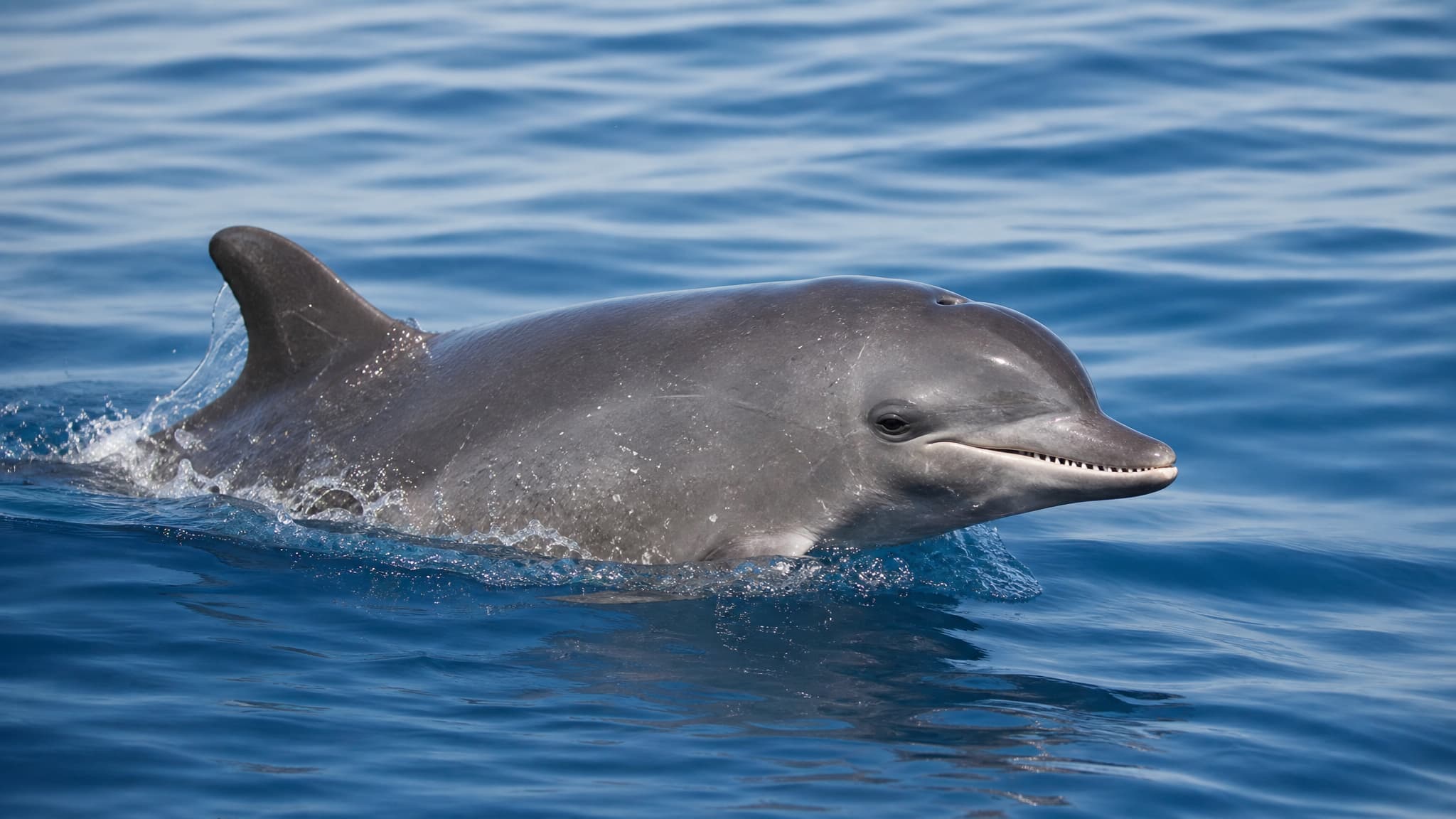
A rough-toothed dolphin surfaces side-on in open blue water, with its rounded forehead, long slender snout, visible teeth, eye, and tall dorsal fin above the surface.
The rough-toothed dolphin is a streamlined oceanic dolphin recognized by its long, gently tapering head. Unlike many dolphins, it has no sharp boundary between the rounded forehead (melon) and beak, giving the head a notably conical profile. Its body is generally dark gray above, paler below, often with pale mottling; the lips and much of the lower jaw can appear white or pinkish. Large pointed flippers and a prominent, moderately curved dorsal fin are further useful field marks. The name refers to fine vertical ridges on its teeth.
This species occurs around the world in tropical, subtropical, and warm-temperate seas, broadly between about 40° north and 35° south. It is principally associated with deep offshore water, though it may also occur nearer coasts in some regions. In Brazil it is known as the golfinho-de-dentes-rugosos and has been recorded along the coast.
Rough-toothed dolphins usually travel in close social groups, often numbering roughly 10–20 animals, though group sizes differ among populations. They may associate with other cetaceans and rely on sound for communication, orientation, and echolocation. Their food includes fishes, squid, and octopus. As active mid-level marine predators, they help transfer energy from schooling fish and cephalopods through ocean food webs.
Knowledge of reproduction remains limited. Individuals reach sexual maturity at approximately 10–14 years, and documented longevity is at least 36 years. The species is assessed globally as Least Concern, but its total worldwide population is unknown. Entanglement in fishing gear, deliberate killing in parts of its range, chemical contamination, and underwater noise are important concerns. Like other marine mammals, it is vulnerable to disruption where vessel traffic, industrial activity, or fisheries overlap with its habitat.



