
Saiga
Saiga tatarica
 AI-generated
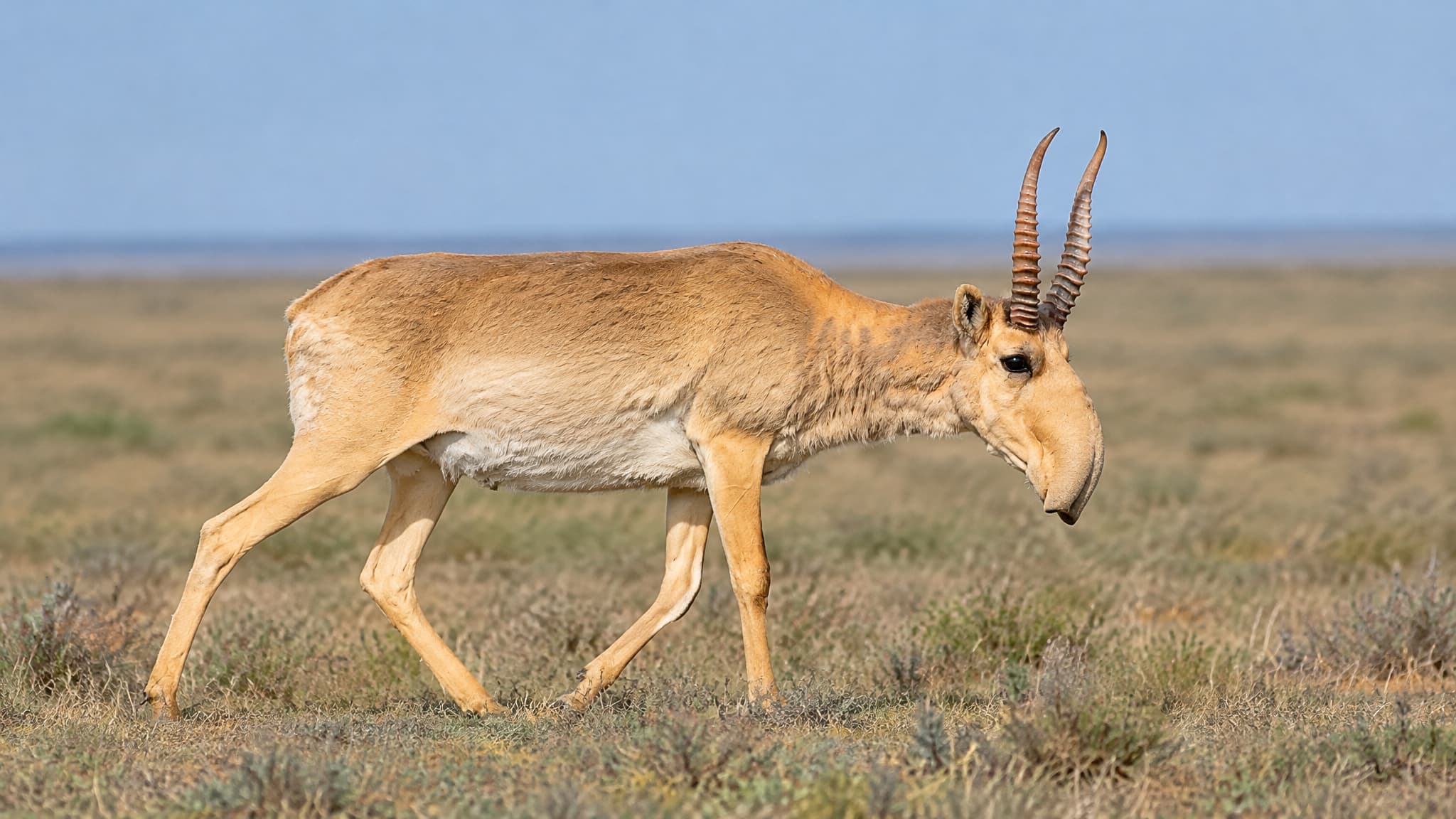
A horned saiga walks in profile across sparse, low vegetation on an open steppe, with its distinctive enlarged, trunk-like nose and ringed horns clearly visible.
The saiga is a medium-sized antelope of the Eurasian steppes, instantly recognisable by its swollen, drooping nose with closely spaced, downward-pointing nostrils. Adults measure 100 to 140 cm from head to rump, stand 61 to 81 cm at the shoulder and weigh 26 to 69 kg. Only males carry horns: waxy, pale and ringed with 12 to 20 ridges, reaching 28 to 38 cm in the western form. The summer coat is short and yellowish red with a paler belly; in winter it grows thick, long and dull grey.
Kazakhstan holds about 99% of the world's saigas, in populations on the Ustyurt Plateau, in Betpak-Dala and along the Ural River. Smaller groups live in Kalmykia and Astrakhan in Russia and in western Mongolia, and Ustyurt herds winter in Uzbekistan. The species prefers flat, open dry steppe and semi-desert and avoids hills and rugged ground. It has disappeared from Romania, Ukraine, Moldova and China.
Saigas are grazers that feed on more than 100 plant species, mainly grasses, forbs, saltworts, sagebrush, prostrate summer cypress and steppe lichens, including some plants that are poisonous to other animals. They travel long distances between seasonal ranges, swim across rivers and move to escape snowstorms and droughts. Outside the rut they gather in herds of 30 to 40, grazing by day and resting at night in shallow scraped beds.
The rut runs from late November to late December. Males defend harems of 5 to 10 females and fight hard, and in some years male mortality reaches 80 to 90%. After a gestation of about 4.6 to 5.1 months, females gather in large groups in spring to give birth, usually to twins. Calves begin grazing at 4 to 8 days old and are weaned at 2.5 to 4 months. Females can breed at 7 to 8 months, males at about 2 years. Average lifespan in the wild is about 10 to 12 years.
As abundant grazers, saigas shape steppe vegetation and are prey for wolves, while foxes, eagles and ravens take calves. The species is listed as Near Threatened by the IUCN. Hunting for meat and for horn used in traditional Chinese medicine cut the Kazakh population to about 21,000 animals in 2003. In May 2015 more than 120,000 saigas died within weeks from infection by the bacterium Pasteurella multocida. Strict protection then allowed a dramatic recovery, with an estimated 3.9 million adults counted in Kazakhstan in spring 2025.



