
Sand cat
Felis margarita
 AI-generated
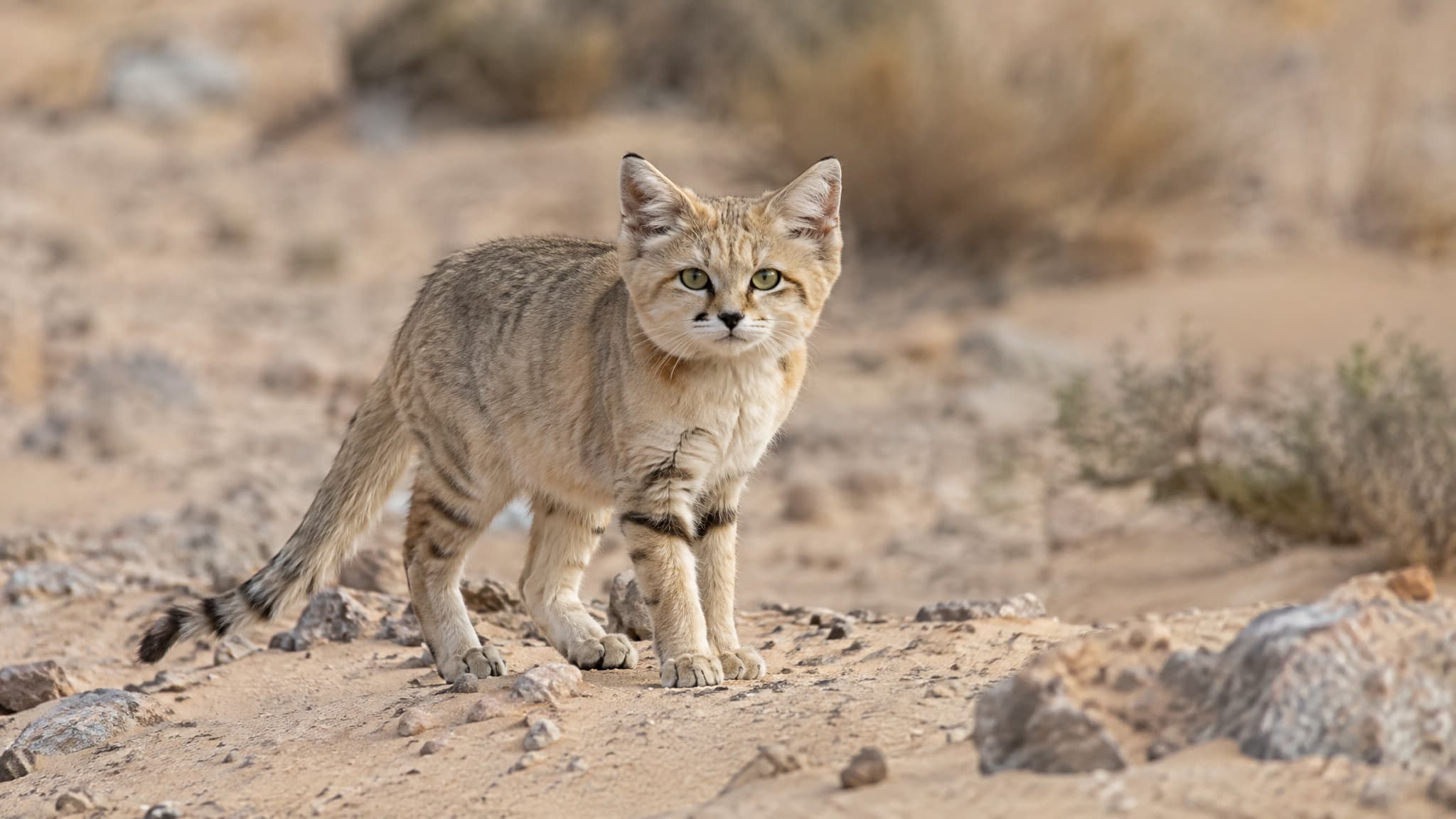
A sand cat stands alert on a rocky, sandy desert slope, showing its pale striped coat, large upright ears, and dark-tipped tail.
The sand cat is a small, pale-coated wild cat specially adapted to true desert. It has a broad head, conspicuously large low-set ears, short legs, and a long tail marked with dark rings and a black tip. Its fur is sandy yellow to gray-brown, with faint darker markings on the limbs and face, providing camouflage against desert ground. Dense blackish hair covers the footpads, insulating them from hot or cold sand and helping the cat move over loose surfaces with little trace.
It occurs discontinuously across North Africa, the Arabian Peninsula, and parts of Southwest and Central Asia. Rather than occupying all deserts, it favors extremely dry sandy or stony plains and valleys with sparse vegetation and ground suitable for digging. It shelters in shallow burrows during severe heat or cold. Large ears and highly developed hearing help it detect prey moving beneath the surface.
Primarily solitary and nocturnal or crepuscular, the sand cat is an opportunistic carnivore. Its prey includes gerbils and other small rodents, hares, birds, reptiles, insects, spiders, and sometimes venomous snakes. It can obtain much of its water from prey, an important adaptation where open water is scarce. By hunting small vertebrates and invertebrates, it helps shape desert food webs; it may itself be preyed upon by owls, jackals, and snakes.
Breeding timing differs among regions and appears linked to climate and food availability. Gestation lasts roughly 59–67 days, and litters commonly contain two to four kittens, although larger litters have been recorded. Young become independent at about six to eight months and may mature during their first or second year. Wild lifespan is poorly known, while cats in human care may live to about 13 years. The IUCN lists the species as Least Concern globally, but habitat degradation, declining prey, trapping, disease and predation associated with domestic animals, and limited population data remain important concerns.



