
Satanic Leaf-tailed Gecko
Uroplatus phantasticus
 AI-generated
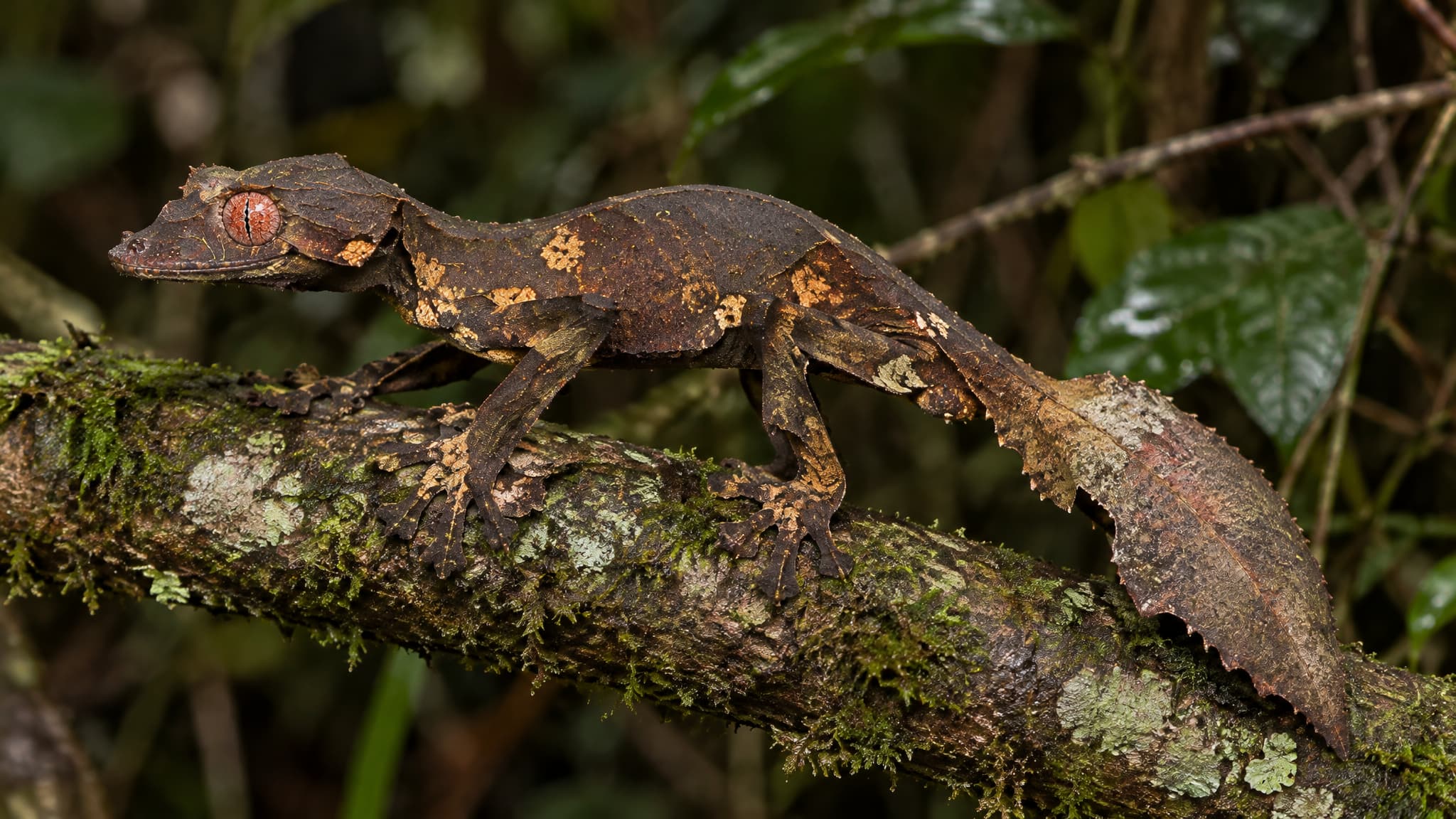
A Satanic Leaf-tailed Gecko (Uroplatus phantasticus) rests horizontally on a moss-covered branch in a leafy forest setting. Its flattened, bark-mottled body, large eye, splayed toes, and broad ragged leaf-like tail are clearly visible.
The satanic leaf-tailed gecko (Uroplatus phantasticus) is a small gecko from Madagascar, described by George Albert Boulenger in 1888. It is one of the smallest members of its genus, measuring about 7.5 to 10 cm including the tail. Its flattened tail has the outline of a withered leaf, often with notches that look like decay, and a spiny projection above each eye gives it the horned look behind its common name. Colour varies among individuals and can shift between light brown, grey, yellow, green and pink tones, usually with a mottled pattern.
The species is endemic to Madagascar, where the Reptile Database places it in the east, southeast and south of the island, including the Andasibe (Perinet) area. It lives in tropical rainforest, spending its life among branches, twigs and dead leaves in the understorey. Females are slightly larger than males: males usually weigh 4 to 6 g, while females can reach 8 to 9 g.
It is nocturnal and spends the day motionless, hidden by its camouflage among dry foliage. At night it hunts insects, with moths and crickets among its usual prey. Like other geckos it has no movable eyelids; a clear membrane covers each eye and the animal cleans it with its tongue. When threatened it flattens its body against the perch, raises its tail, opens its mouth to show a bright red lining and may give a loud whistle. It can also shed its tail to escape a predator.
The species is oviparous. Breeding begins at the start of the rainy season, and females lay clutches of two spherical eggs hidden in leaf litter or dead leaves. In captivity eggs are laid about every 30 days and take 90 to 120 days to hatch, and hatchlings weigh less than 1 g. Captive animals are capable of living longer than 10 years; no wild lifespan has been published.
As a nocturnal insect hunter of the forest understorey, it depends on intact forest and on its camouflage and defensive displays to avoid predators. The IUCN Red List assesses it as Least Concern, but it is listed in CITES Appendix II. Deforestation and habitat degradation threaten it, and it is collected for the international pet trade, sometimes illegally inside protected areas.



