
Short-beaked Echidna
Tachyglossus aculeatus
 AI-generated
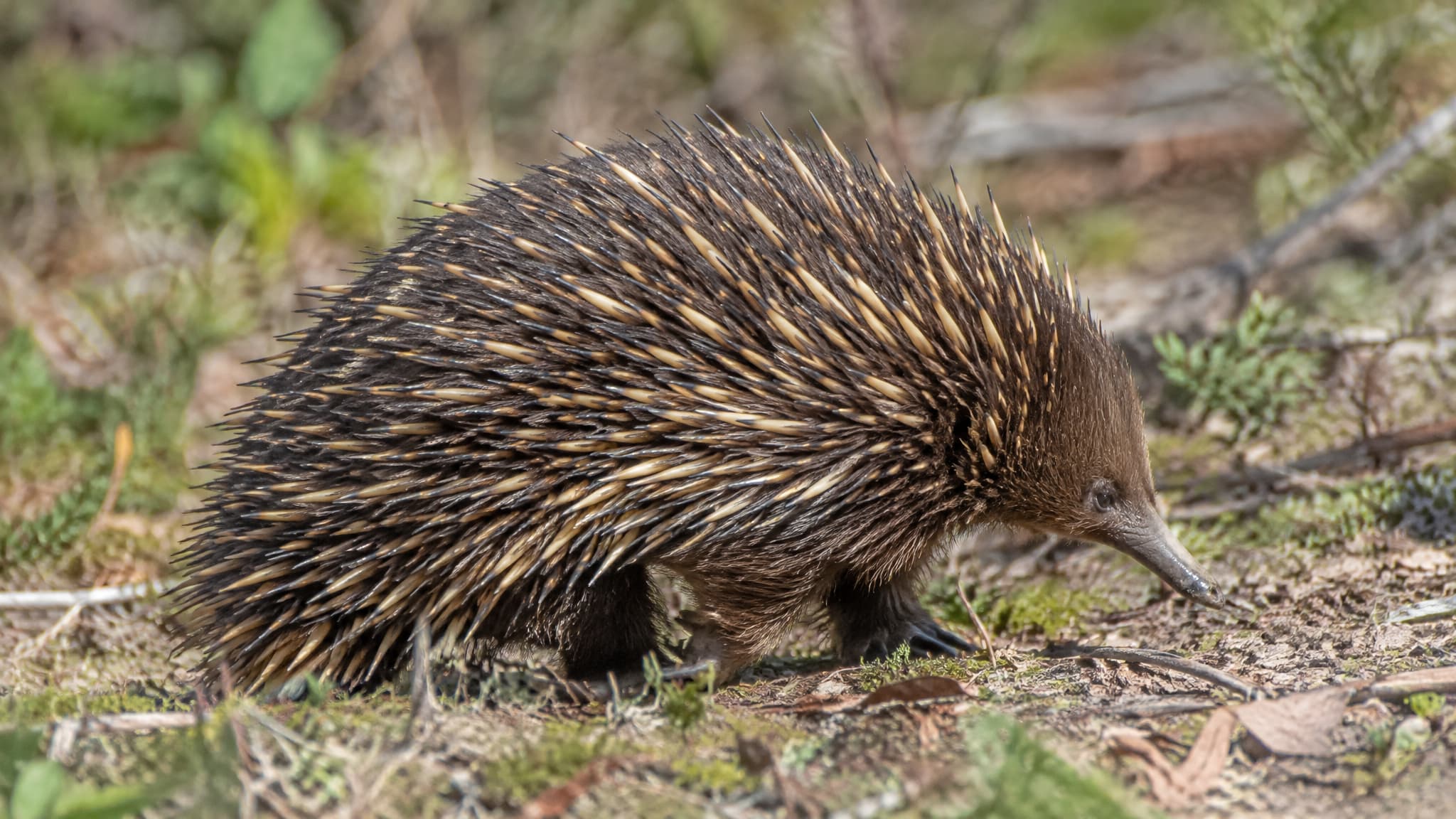
A short-beaked echidna walks in profile across a mossy, leaf-strewn forest floor, showing its dense coat of dark-and-cream spines, furry underside, and tapered snout.
The short-beaked echidna is one of the few living monotremes, the egg-laying mammals. Adults usually measure 30 to 45 cm long and weigh 2 to 7 kg. Sharp spines cover the back and the stubby tail, mixed with fur that in the Tasmanian subspecies can be longer than the spines. It has a tubular snout, a long sticky tongue, no teeth and no external ears, and strong front claws built for digging. Males carry a non-venomous spur on each hind ankle, and females develop a pouch.
It is the most widespread native mammal in Australia, found across the mainland, Tasmania and offshore islands such as Kangaroo Island, and it also lives in coastal and highland areas of eastern and southern New Guinea. It uses an unusually wide range of habitats, from forests rich in fallen, termite-filled logs to open woodland, savanna, grassland, arid country, farmland scrub and even outer suburbs.
The echidna feeds mainly on ants and termites, and also takes beetle larvae and other invertebrates. It finds prey by smell and by electroreception in its snout, then breaks into nests and logs with its claws and laps up the insects with its tongue. Mostly solitary, it has overlapping home ranges rather than defended territories. In cold months it can enter torpor or hibernation, letting its already low body temperature fall sharply. When threatened it curls into a ball or digs in until only its spines show.
During the breeding season several males may follow a single female in a line known as an echidna train. The female lays one soft-shelled egg directly into her pouch, where it hatches after about 10 days. The tiny hatchling, called a puggle, drinks milk secreted through pores, as monotremes have no nipples. It leaves the pouch at about two to three months, when its spines grow, and is weaned at about six months after being left in a nursery burrow. Echidnas live about 10 years on average in the wild, with records of around 40 years, and about 50 years in captivity.
By digging foraging pits, echidnas turn and aerate the soil, trap leaf litter and help cycle nutrients, which is especially important in semi-arid landscapes. Their predators include dingoes, goannas, feral cats, red foxes and birds of prey, and most victims are young animals.
The species is listed as Least Concern by the IUCN. In Australia, the main threats are road traffic and habitat destruction, while hunting has reduced numbers in parts of New Guinea.



