South American snake-necked turtle
Hydromedusa tectifera
 AI-generated
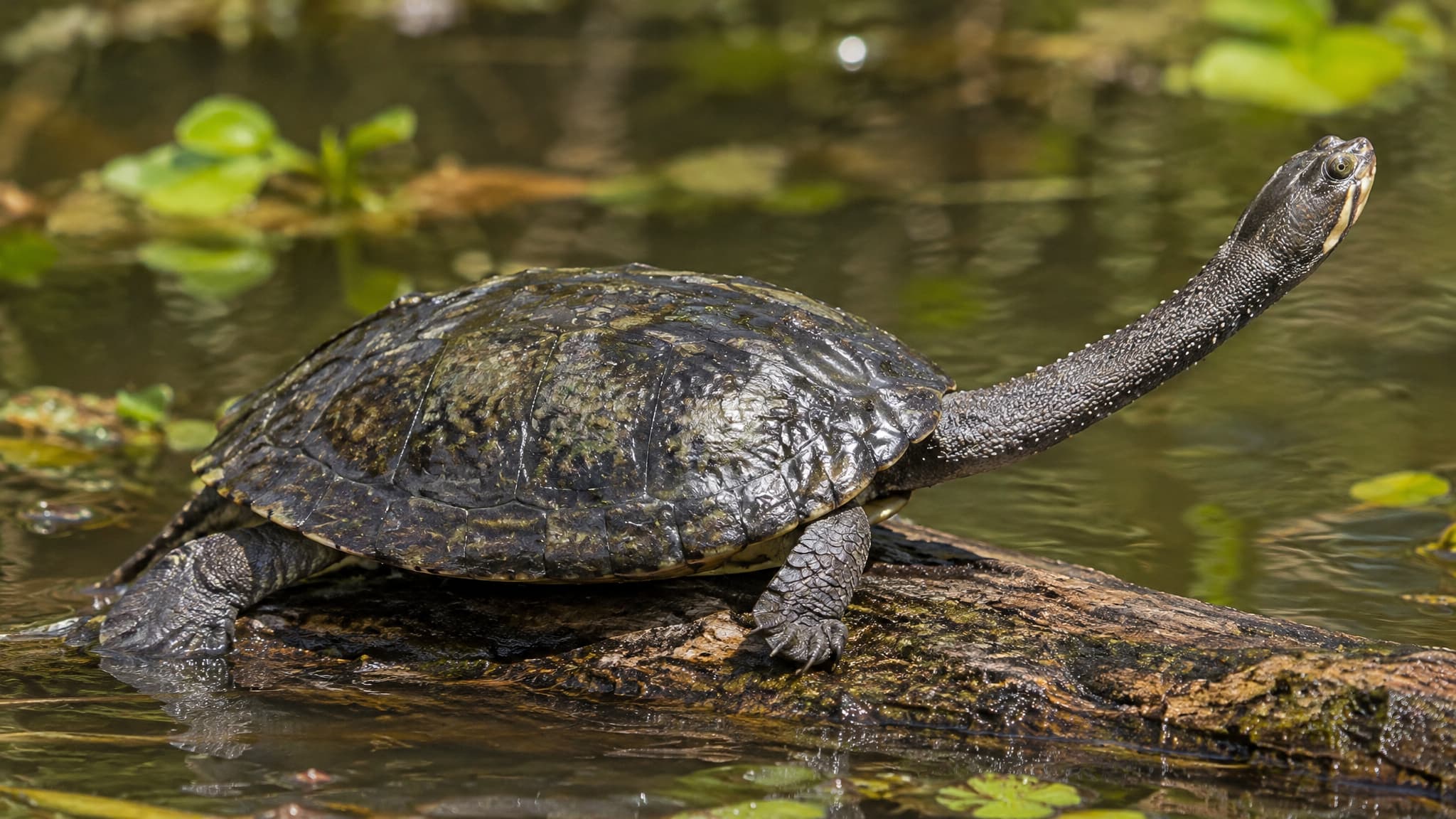
A South American snake-necked turtle raises its head above a dark, algae-flecked shell while standing on a submerged log in shallow, plant-dotted water. Its elongated, finely scaled neck, pointed head, and clawed feet are clearly visible.
The South American snake-necked turtle (Hydromedusa tectifera), also called the Argentine snake-necked turtle, is a medium-sized side-necked turtle of the family Chelidae. Its very long neck folds sideways under the edge of the shell rather than pulling straight back. The maximum recorded straight carapace length is 30.6 cm in females and 28.4 cm in males, although most adults stay under 25 cm. The adult carapace is brown with dark brown to black spots, and in young animals the scutes are rough and ridged like a roof, which is what the name tectifera ("roof-bearing") refers to. The head, neck and limbs are dark grey, with a pale whitish band running back from the angle of the jaw on each side.
The species lives in central and northeastern Argentina, most of Uruguay, southeastern Paraguay and southern and southeastern Brazil, from Rio Grande do Sul north to Minas Gerais and Rio de Janeiro. It is found from near sea level up to nearly 1,500 m. It uses streams, rivers, creeks, ponds, lagoons, marshes and dams, including man-made and polluted waters, and it also enters coastal estuaries, where some individuals carry barnacles on the shell.
This is a highly aquatic and secretive turtle that rarely leaves the water and is thought to bask underwater. It breathes by pushing only the tip of its snout above the surface. It is carnivorous and feeds mainly on aquatic invertebrates such as snails, insect larvae and other arthropods, and also takes small fish and amphibians. It ambushes prey with a fast, harpoon-like strike of the neck combined with suction, a technique also seen in the mata mata. In the cold months it falls into a partial torpor but keeps feeding on warmer days.
Mating has been seen in shallow water from late winter to early spring, and nesting takes place in late spring and early summer, mainly from November to January, on banks near the water. A clutch holds 5 to 15 elongated, white, brittle-shelled eggs, and reported incubation times range from 70 to 128 days. Hatchlings measure about 35 to 37 mm in shell length and grow slowly. Lifespan in the wild is unknown; zoo records reach 9 years and 6 months, and one captive female was still alive at 14 years or more.
The turtle is not on the IUCN Red List, but the Tortoise and Freshwater Turtle Specialist Group considers it provisionally Least Concern. It tolerates polluted water better than its only living relative in the genus, Hydromedusa maximiliani, although urbanisation, industrial and agricultural pollution and the loss of wetlands affect some populations. Small numbers enter the international pet trade, and an adult has been recorded being eaten by a giant otter.