
Southern brown brocket
Subulo gouazoubira
 AI-generated
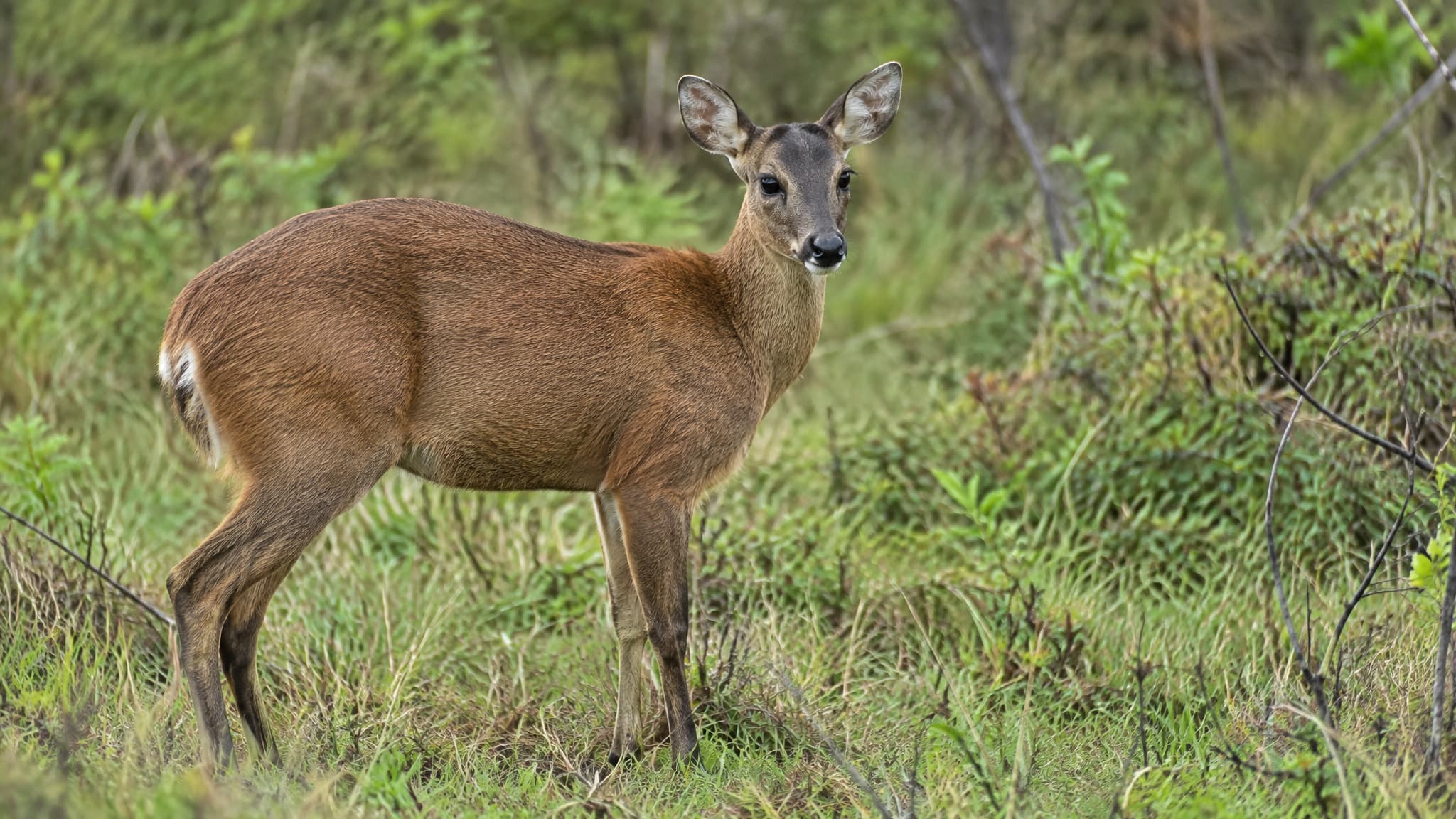
A small brown brocket deer stands alert in grassy scrub, facing mostly forward with its head turned slightly toward the camera. Its large ears, dark muzzle, slender legs, and white underside of the tail are visible; no antlers are apparent.
The southern brown brocket, also called the gray brocket, is a small-to-medium New World deer with a compact body, relatively short legs, and a straight-backed silhouette. Its coat ranges from grayish brown to reddish brown; paler underparts and the conspicuously white underside of the tail are useful field marks. Adult males carry simple, unbranched antlers. Adults are typically about 85–105 cm in head-and-body length and commonly weigh roughly 8–25 kg, although dimensions vary across its extensive range.
It occupies a broad variety of Neotropical landscapes, including woodland edges, savannas, scrub, Chaco, wetlands, transitional forest, and cultivated areas that retain patches of cover. It usually relies on forest, thickets, or other dense vegetation for shelter even where it feeds in more open ground. Geographic limits reported under the older name Mazama gouazoubira require care, because taxonomic work has separated or reassessed some populations formerly assigned to this deer.
This is generally a shy, mostly solitary deer, most active around dusk, at night, or in sheltered daytime cover. It is a flexible herbivore and browser: fruit can be a major seasonal food, while leaves, shoots, buds, flowers, twigs, bark, roots, and—in dry places—cactus or bromeliad fruits supplement its diet. By consuming fruit as well as browse, it participates in plant–animal food webs and may contribute to the movement of seeds.
Females can breed throughout the year, though births may peak outside the coldest or driest months in some regions. Gestation lasts about 206–220 days and nearly always produces one spotted fawn, which remains hidden early in life; weaning occurs at about six months. Wild longevity has been estimated at up to 13 years. Habitat conversion and fragmentation, hunting, vehicle strikes, fire, and contact with livestock or domestic animals can threaten local populations. It is generally assessed as Least Concern under its former name, but local declines and differing regional listings make habitat protection important.



