
Southern muriqui
Brachyteles arachnoides
 AI-generated
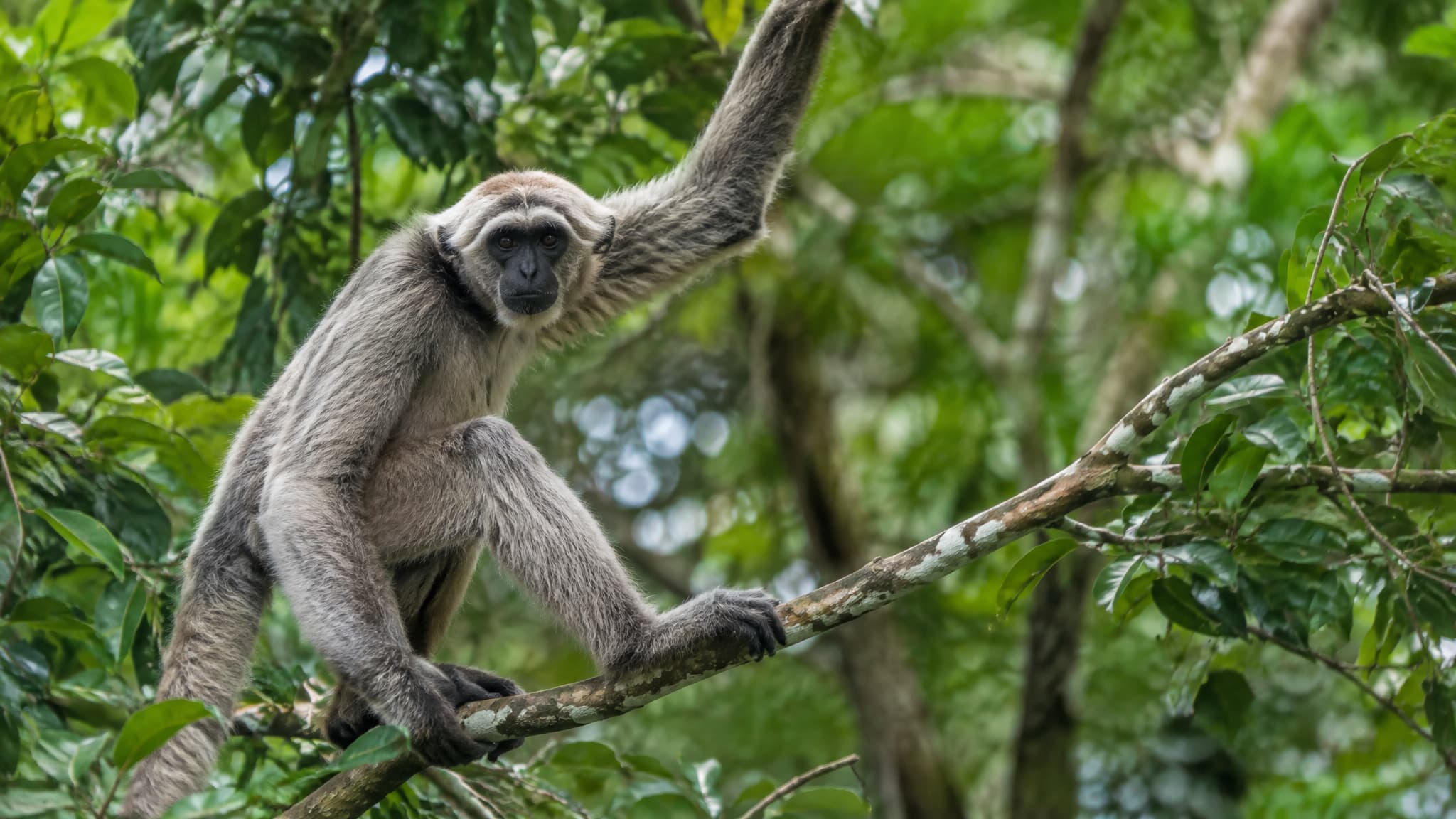
A Southern muriqui sits on a branch in dense green forest, facing the camera with one long arm raised. Its shaggy pale-gray coat, dark face, and partly visible long tail are prominent.
The southern muriqui (Brachyteles arachnoides), also called the woolly spider monkey, is a large New World monkey found only in Brazil. It has thick, soft fur ranging from beige to yellowish brown, a rounded head and dark bare skin on the face, hands, feet, and underside of the tail tip. Its elongated arms, hook-like hands, and exceptionally long prehensile tail are adaptations for an almost entirely arboreal life. It is among the largest living platyrrhine primates.
This species is endemic to the Atlantic Forest of southeastern Brazil, occurring in Rio de Janeiro, São Paulo, Minas Gerais, and Paraná. It uses forest canopy in evergreen, semideciduous, and disturbed Atlantic Forest remnants, but fragmentation isolates populations and makes movement between forests difficult.
Southern muriquis are diurnal and highly social. Their diet is mainly fruit, supplemented by young leaves, flowers, seeds, bark, lianas, and epiphytes; leaf feeding becomes more important when ripe fruit is scarce. By swallowing and transporting seeds, they act as important primary dispersers for canopy trees, contributing to the regeneration of mature forest.
They have a generally tolerant, low-aggression social system. Females commonly disperse from their birth group, whereas males tend to remain with it. Gestation lasts about seven to eight months and usually produces one infant; births are spaced roughly three years apart. Reported longevity is up to 32 years. The species is globally Critically Endangered, principally because of habitat loss, degradation and fragmentation, hunting and capture, disease outbreaks such as yellow fever, and climate-related habitat change.



