
Southern right whale dolphin
Lissodelphis peronii
 AI-generated
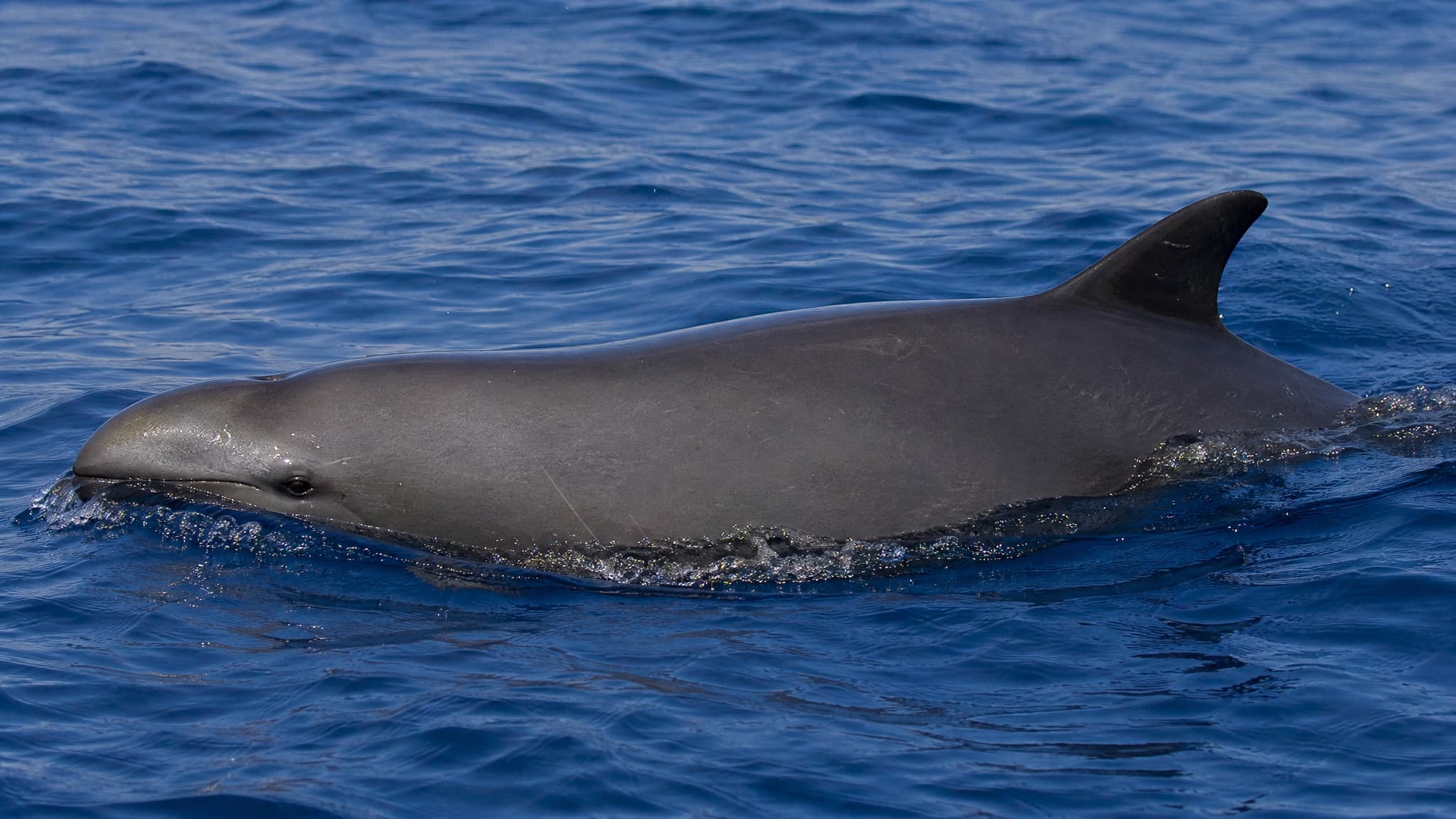
A dark-gray dolphin surfaces in blue open water, with its eye and rounded snout visible and a prominent tall dorsal fin above the waterline.
The southern right whale dolphin is a sleek oceanic dolphin of the Southern Hemisphere and one of the few dolphins with no dorsal fin or dorsal ridge. Adults have a strongly contrasting pattern: the back is black, while the front of the head, underside, flanks, and much of the flippers are white. The boundary between dark and light forms a distinctive sweeping curve along the body. Calves are less sharply patterned, often showing gray or brown tones before acquiring the adult coloration.
It is a circumpolar species of cool-temperate and subantarctic seas, generally associated with the waters between subtropical and Antarctic convergence zones. It is principally pelagic, occurring far offshore over deep water, though it may approach coasts where deep water lies close to land. Records extend around southern South America, southern Africa, Australia, New Zealand, and the Southern Ocean; cold currents can carry it unusually far north along western continental coasts.
Southern right whale dolphins are active, rapid swimmers. They usually travel in social groups, from small parties to very large schools that can exceed 1,000 animals, and may associate with dusky dolphins and pilot whales. Fast-moving groups make low, clean leaps and can slap their flukes or bodies on the surface. Their prey includes fishes and squid, especially lanternfishes, making them predators in the offshore food web.
Scientific knowledge of reproduction remains limited. Sightings of calves are more frequent in winter and early spring, but a definite calving season, mating system, gestation period, and parental-care pattern have not been established. Published evidence is also insufficient to give a reliable lifespan in the wild. This lack of basic life-history information is important when interpreting population trends.
The species is globally assessed as Least Concern, reflecting its broad distribution and the absence of evidence for a severe range-wide decline. Nevertheless, it is infrequently studied because it lives mainly offshore. Documented and potential pressures include incidental capture in fishing gear—particularly gillnets—and direct takes reported in parts of Peru and Chile. Continued monitoring of bycatch, strandings, and offshore populations is needed to detect threats that could be obscured by limited observations.



