Southern Tamandua
Tamandua tetradactyla
 AI-generated
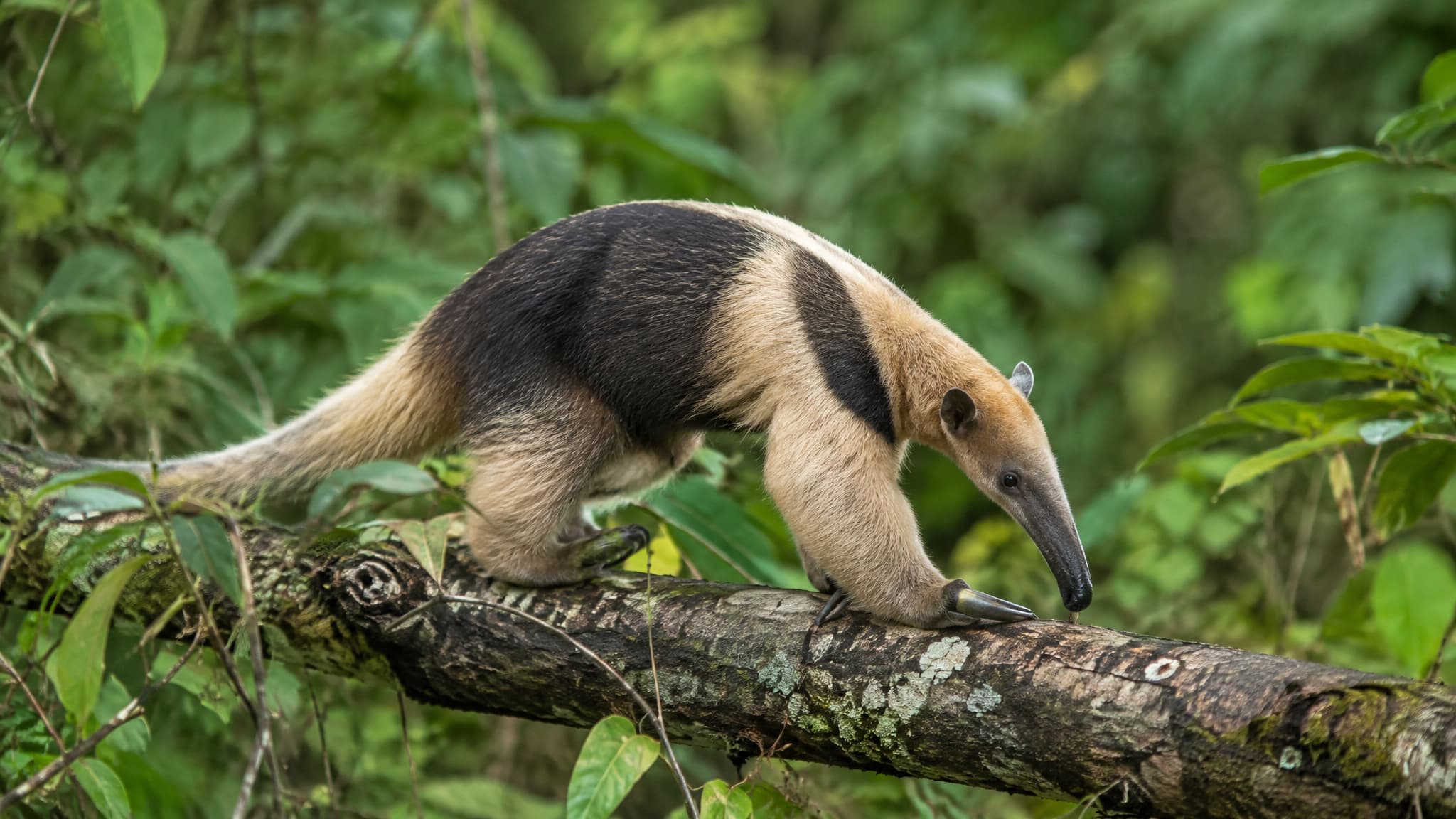
A Southern Tamandua moves along a moss-covered tree branch in dense green forest, with an arched posture, long tapered snout, prominent claws, and a dark vest-like shoulder and torso marking visible. Its long tail extends behind it along the branch.
The southern tamandua, also called the lesser or collared anteater, is a medium-sized South American anteater. It has a narrow, elongated snout, no teeth, powerful forelimbs with prominent claws, and a long prehensile tail whose underside is largely bare for gripping branches. Adults usually have a body length of about 53.5–80 cm, plus a 40–59 cm tail, and weigh roughly 4.5 kg. Coat color varies geographically: many southern animals show a bold black “vest” over the shoulders and back, while northern and western populations may be paler or nearly uniform in color.
This species occurs east of the Andes across much of South America and on Trinidad, ranging from Colombia and Venezuela south to northern Argentina and Uruguay. It uses rainforest, other humid and dry forests, savannas, scrub, mangroves, and habitats near watercourses; records extend to about 2,000 m elevation. Although it can travel on the ground, it is an adept climber and often rests in tree hollows.
Southern tamanduas are usually solitary and chiefly nocturnal, though they may also be active by day. They locate prey largely by smell, tear into nests with their claws, and use a sticky tongue that may reach 40 cm to gather ants and termites. Bees and honey are also eaten. Their specialized feeding helps regulate colonies of social insects, while their claws and tail make them well suited to moving through both trees and terrestrial cover. When threatened, an individual may brace itself against a tree or rock and strike or grasp with its strong forelimbs; it can also hiss and release a strong odor.
After a gestation of approximately 130–150 days, the female generally gives birth to one young. The infant rides on its mother’s back during its early months and remains associated with her for around a year. Reported captive lifespan is about nine years. The species is assessed as Least Concern globally, reflecting its broad distribution, but local populations can be affected by habitat loss and degradation, wildfires, road mortality, hunting, and capture for the pet trade.