
Southern Tiger Cat
Leopardus guttulus
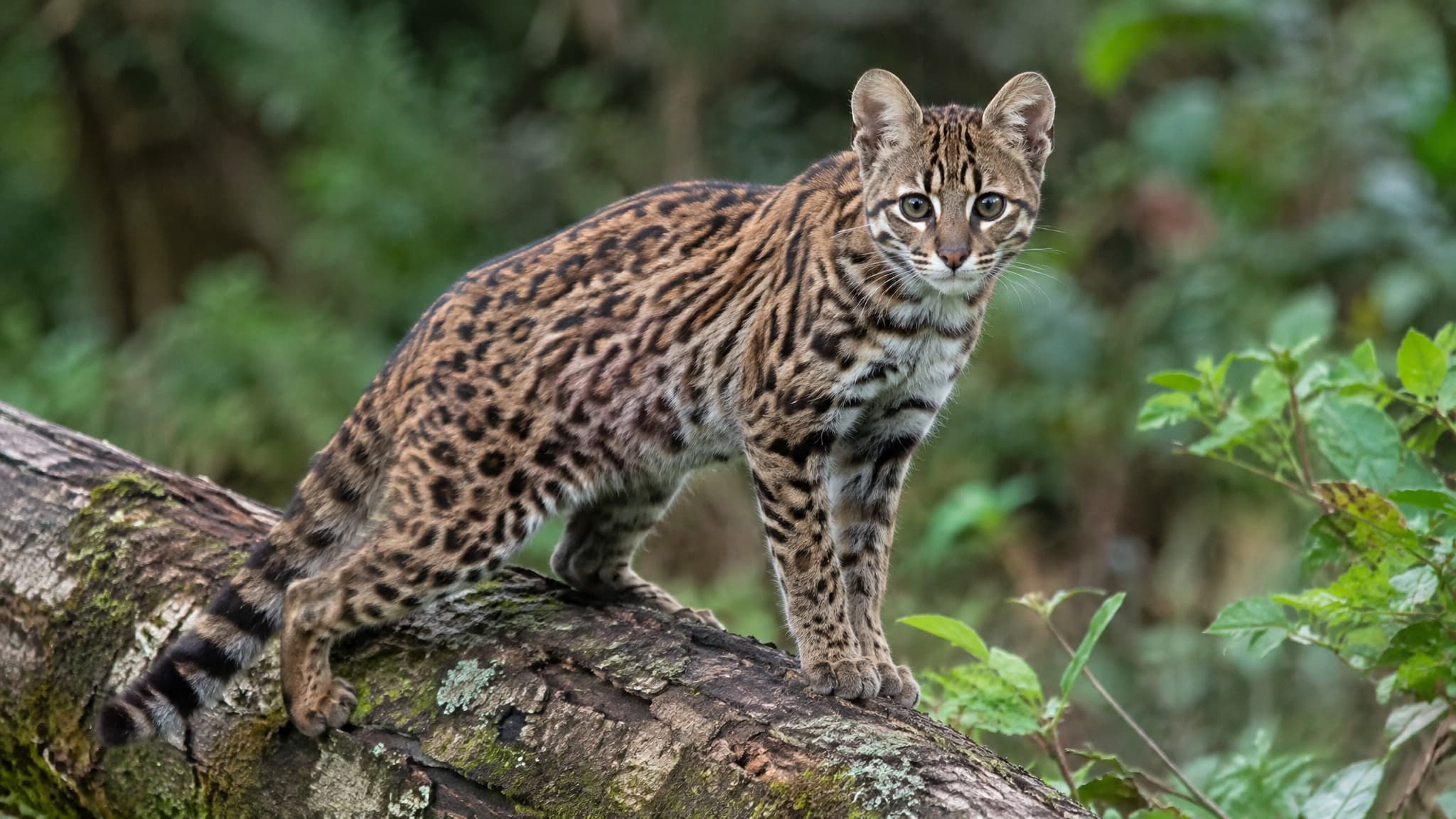 AI-generated
A spotted small wild cat stands on a moss-covered fallen trunk in dense forest, facing the viewer. It has rounded ears, dark facial striping, a pale throat, boldly patterned legs, and a ringed tail.
Southern Tiger Cat
The southern tiger cat, Leopardus guttulus, is a small South American wild cat with a compact, domestic-cat-sized build. Its coat varies from pale yellow to yellowish brown and carries dark, often rounded rosettes; the underside is paler and spotted. The tail is relatively short, thick, and frequently ringed. Rounded ears are black on the back with a pale central spot, and melanistic—almost entirely black—individuals are relatively common.
It occurs primarily in southern and southeastern Brazil, with records extending into Paraguay and northeastern Argentina. It uses an unusually broad range of terrestrial settings, including Atlantic and subtropical forests, deciduous and mixed pine forests, savannas, coastal vegetation, and some disturbed landscapes. Even where it occurs beside agriculture, it depends on retained natural cover and tends to hunt along habitat edges rather than deep inside cropland.
This is mainly a solitary, secretive predator, most active at night and around dawn or dusk, although it may also move during daylight. Small mammals, birds, and lizards make up much of its prey, usually animals under 100 g but sometimes larger prey. By hunting these small vertebrates, it functions as a small-predator component of forest and savanna food webs. Documented home ranges vary widely, about 2–25 km², and may be enlarged where the cat avoids larger competing felids such as the ocelot.
Females usually produce one kitten per litter, occasionally two. A reliable maximum lifespan in the wild has not been established; the IUCN assessment instead estimates a generation length of about 4–5 years. Genetic evidence recognized L. guttulus as distinct from the northern tiger cat, L. tigrinus, in 2013. The global IUCN assessment lists it as Vulnerable with a decreasing trend. Habitat loss and fragmentation are major pressures, compounded in some areas by road mortality, conflict, disease risks associated with domestic animals, and hybridization with Geoffroy's cat.



