Spinner Dolphin
Stenella longirostris
 AI-generated
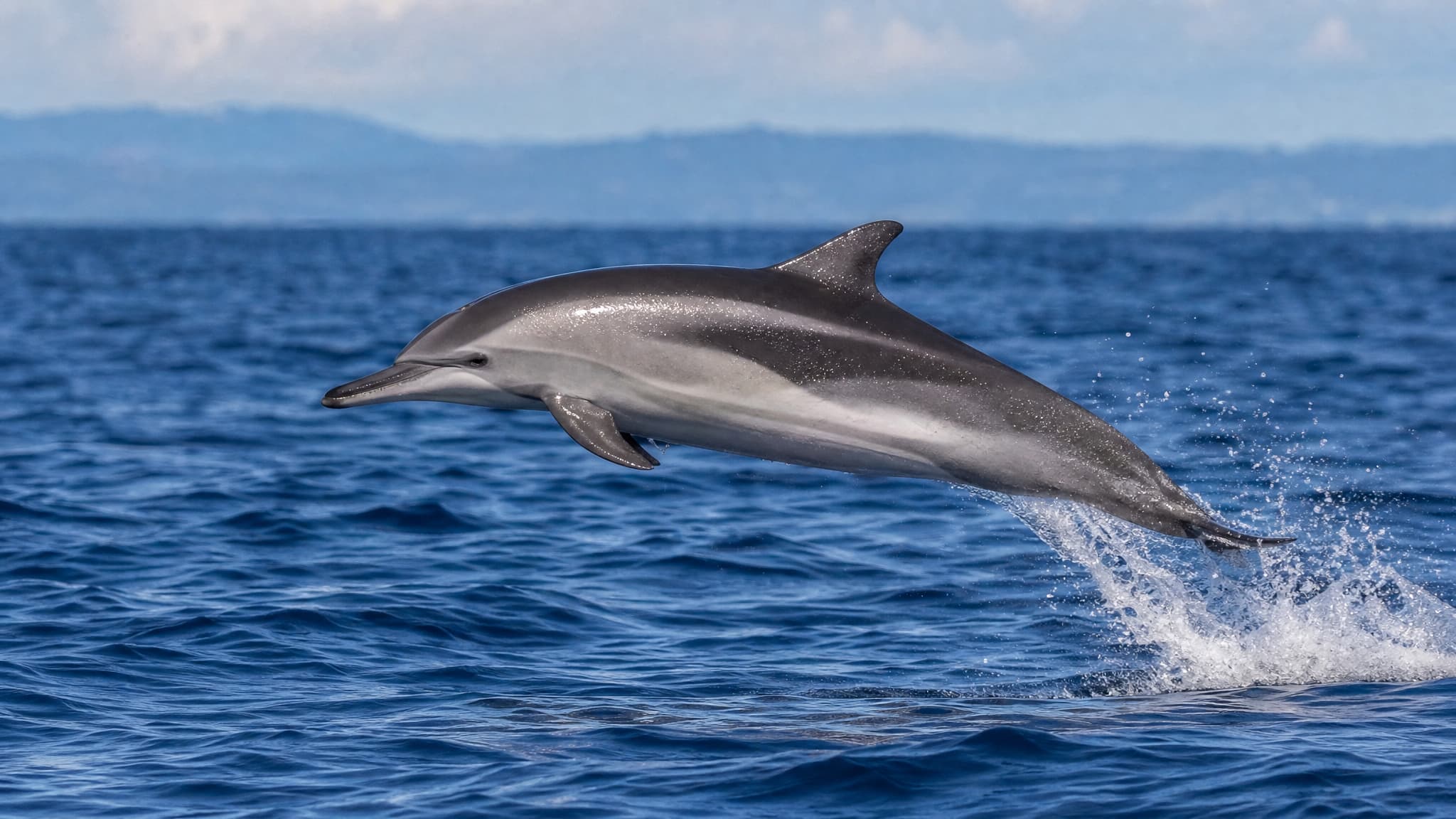
A Spinner Dolphin is captured airborne above the open ocean, angled forward with its long, narrow beak, curved dorsal fin, and one visible pectoral flipper clearly shown.
Spinner Dolphin
The spinner dolphin is a slim, small-to-medium oceanic dolphin recognized by its long, narrow beak, recurved flippers, and highly variable dorsal fin. Many individuals show a three-part color pattern: dark gray across the back, paler gray on the sides, and a light belly. Adult size differs among geographic forms, but the species is commonly about 1.2–2.1 m long. Its famous aerial displays—leaping clear of the water while rotating—gave it its English name; a single leap may involve several revolutions.
This dolphin occurs widely in tropical and warm-temperate waters of the Atlantic, Indian, and Pacific oceans. It is often associated with deep water and productive oceanographic features, yet island-associated populations may use sheltered, shallow bays and reefs as daytime resting habitat. Four subspecies are generally recognized: Gray’s or Hawaiian spinner dolphin, eastern spinner dolphin, Central American spinner dolphin, and dwarf spinner dolphin. Their form, coloration, and coastal or offshore habits vary across this broad range.
Spinner dolphins are social and form fluid schools. In many populations they forage principally at night, following the vertical migration of prey from deeper water toward the surface and sometimes diving to roughly 400 m. Their food includes mesopelagic fishes—especially lanternfishes—along with squid, shrimp, and other crustaceans. Clicks support echolocation, while splashes, spins, and other aerial behaviors are important components of communication; spinning may also help dislodge external hitchhikers.
Females bear a single calf after a gestation of about 11 months, usually at intervals near three years. Nursing often continues for one to two years, and lifespan is around 20 years, with some wild animals recorded beyond 25 years. As mid-level marine predators, spinner dolphins link deep scattering-layer prey with larger predators and are often associated with tuna in the eastern tropical Pacific. Globally the species is Least Concern, but entanglement and bycatch, vessel strikes, noise, marine debris, habitat degradation, and intensive wildlife-viewing pressure can threaten local populations. The eastern subspecies, S. l. orientalis, is of particular conservation concern.