
Sunda pangolin
Manis javanica
 AI-generated
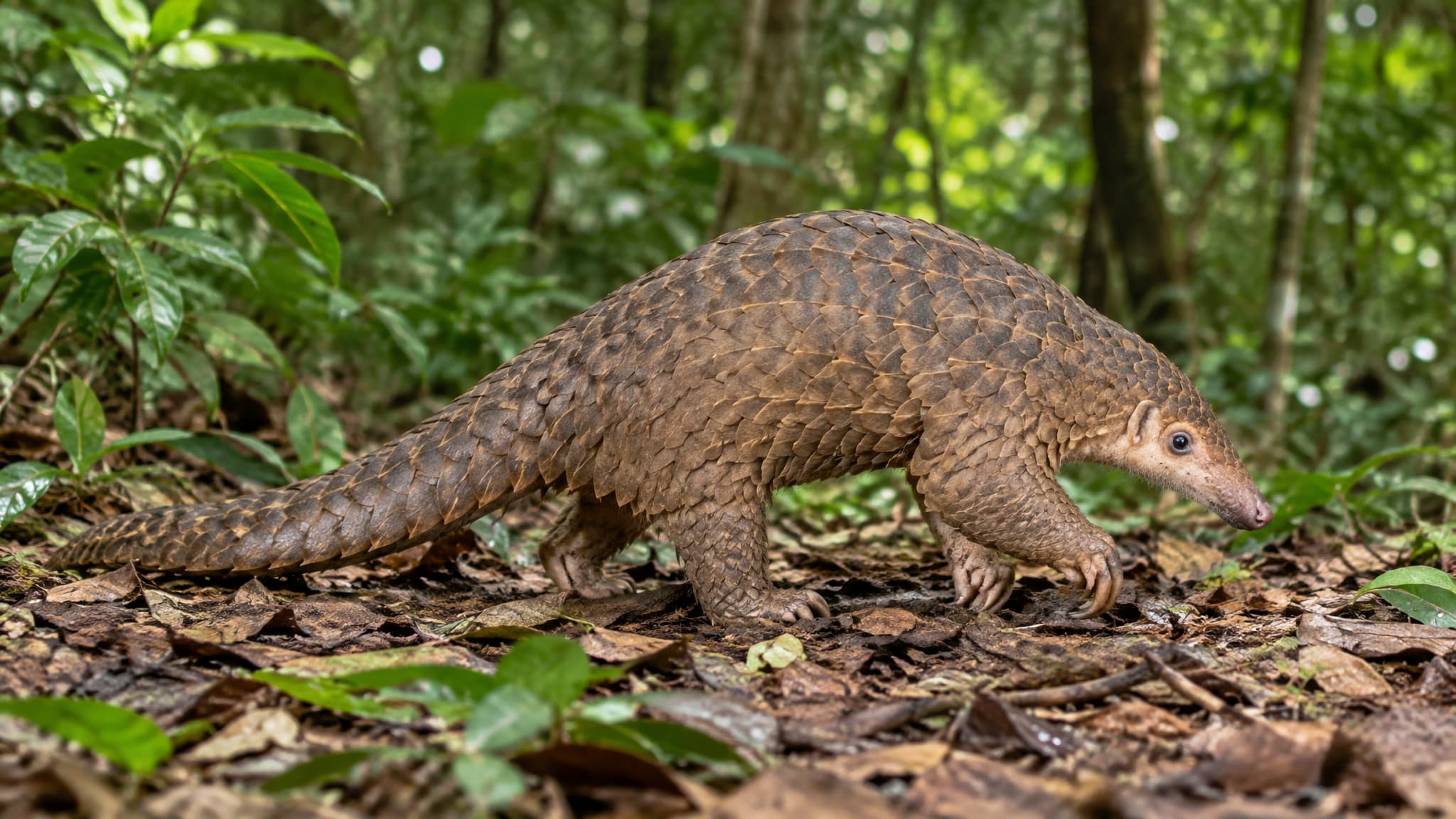
A Sunda pangolin walks across the leaf-littered floor of a dense tropical forest, showing overlapping protective scales, a long tapering tail, stout limbs, and curved claws.
The Sunda pangolin, also called the Malayan pangolin, is a scaly mammal of Southeast Asia and one of eight living pangolin species. Its body is covered in overlapping keratin scales arranged in 17 to 19 rows across the midsection, with more than 20 rows along the tail. Adults measure 40 to 65 cm from head to rump, with a tail of 35 to 56 cm, and weigh up to 10 kg. Males are larger than females. Instead of teeth it has a long, sticky tongue that can reach about 25 cm.
The species ranges through Myanmar, Thailand, Cambodia, Laos, Vietnam, Malaysia and Singapore, and across the islands of Sumatra, Java, Borneo and the Lesser Sunda Islands. It lives in primary and secondary forest, scrub and cultivated land such as gardens and rubber or oil palm plantations, from sea level up to about 1,700 m. It shelters in burrows it digs and in tree hollows, and it climbs well, using a prehensile tail.
The Sunda pangolin is an extreme specialist that feeds only on ants and termites. It is nocturnal, shy and usually solitary, though pairs are sometimes seen. It travels on average 0.7 to 1.8 km per day while foraging. One radio-tracked female in Singapore used a home range of 6.97 ha. When threatened it rolls into a tight ball so that only its scales are exposed.
Breeding is thought to take place in autumn, and young are born in a burrow during winter after a gestation of about 130 days. A female usually has a single young, rarely two, weighing 100 to 500 g at birth. The mother cares for it for about three months before weaning, and both sexes reach sexual maturity at about one year. There are no long-term studies of its lifespan.
By eating huge numbers of social insects, an adult may consume about 70 million insects per year, which helps keep ant and termite populations in check. Its digging also aerates the soil.
The Sunda pangolin is listed as Critically Endangered by the IUCN. It is heavily hunted for its scales, used in traditional medicine, and for its meat and skin, and more than 185,000 skins entered international trade between 1980 and 1985. Habitat loss and road traffic add to the pressure. Since 2016 all pangolins have been listed on CITES Appendix I.



