
Tayra
Eira barbara
 AI-generated
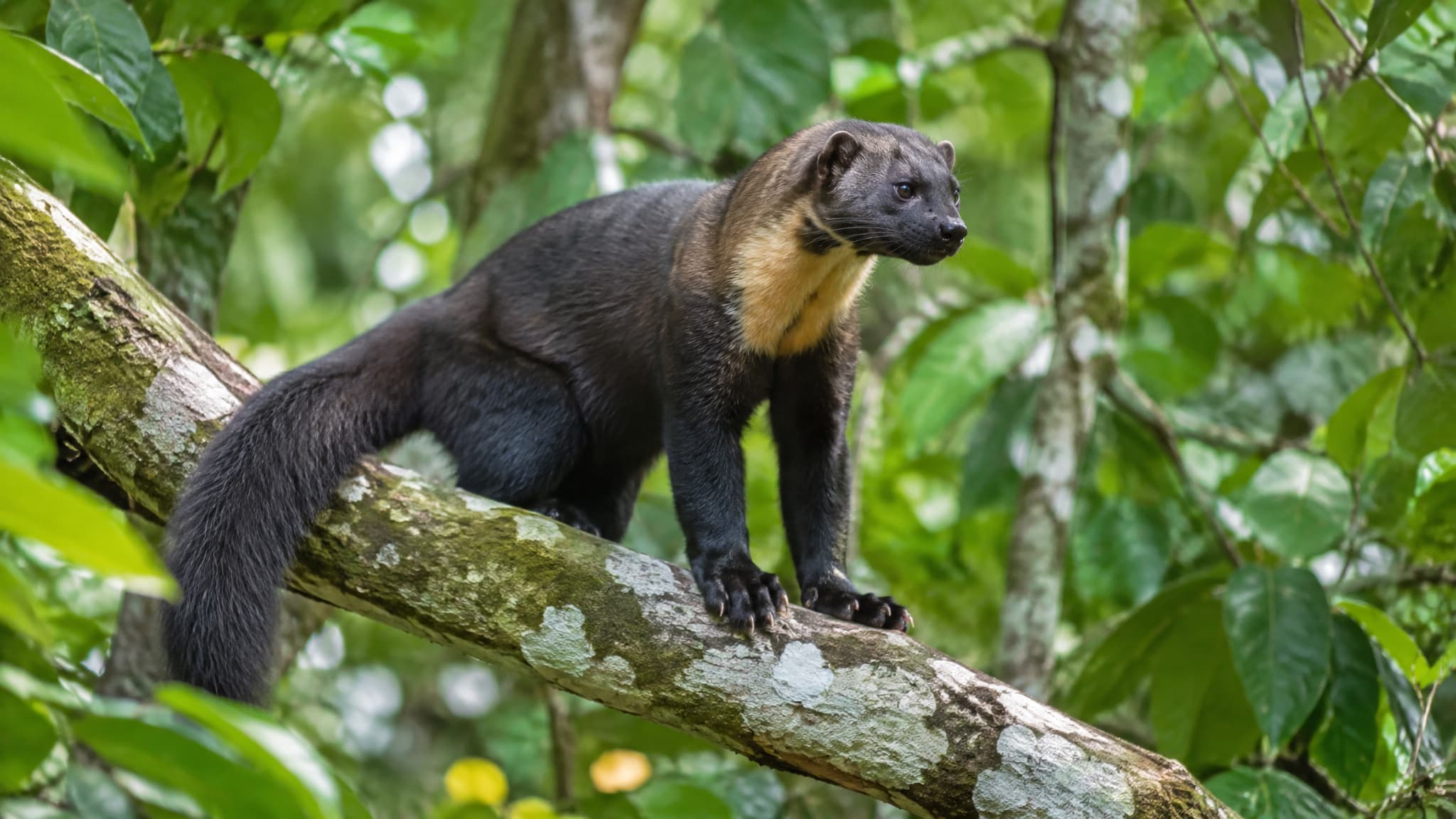
A tayra stands on a moss-covered tree branch in dense tropical forest, facing right. Its dark coat, golden throat patch, rounded ears, long bushy tail, and clawed feet are clearly visible.
Tayra
The tayra (Eira barbara) is a medium-sized member of the weasel family, Mustelidae, native to the Neotropics. It has a long, flexible body, a robust head, rounded ears, relatively long legs with strong claws, and a long bushy tail that helps it balance in trees. Most adults are dark brown to blackish, often with a paler grayish or yellow-brown head and neck. A cream, white, or orange throat patch is common but variable and may be absent. Head-and-body length is roughly 52–71 cm, and adults generally weigh about 2.7–7 kg.
Its range extends from Mexico through Central America and much of South America, reaching northern Argentina; it also occurs on Trinidad. Tayras use a broad range of densely vegetated habitats, including tropical and subtropical forests, gallery forest, secondary growth, forest fragments, plantations, and sometimes areas close to settlements. They are agile both on the ground and in the canopy, taking shelter in hollow trees, burrows, caves, or dense vegetation. They occur from lowlands to around 2,400 m elevation.
An opportunistic omnivore, the tayra eats small mammals, birds and eggs, reptiles, insects and other invertebrates, fruit, and honey. It is usually solitary, though pairs and females with young may be seen. Activity is chiefly diurnal or crepuscular, and its climbing ability allows it to hunt and forage among branches as well as on the forest floor. By preying on small animals and consuming fruit, it participates in food webs as both a mesocarnivore and a potential disperser of seeds.
Reproductive details in the wild remain incompletely known. Reported gestation is about 63–70 days, and litters commonly contain two or three young. The female raises the offspring in a sheltered den; males do not appear to provide parental care. Captive animals have lived about 16–18 years, while wild lifespan is uncertain. Globally, the species is assessed as Least Concern, reflecting its wide distribution and ecological flexibility. Nevertheless, deforestation, conversion to pasture, hunting, and persecution following poultry or crop raids can threaten populations locally; a 2026 Atlantic Forest study found higher occupancy farther from pasture areas.



