Texas Horned Lizard
Phrynosoma cornutum
 AI-generated
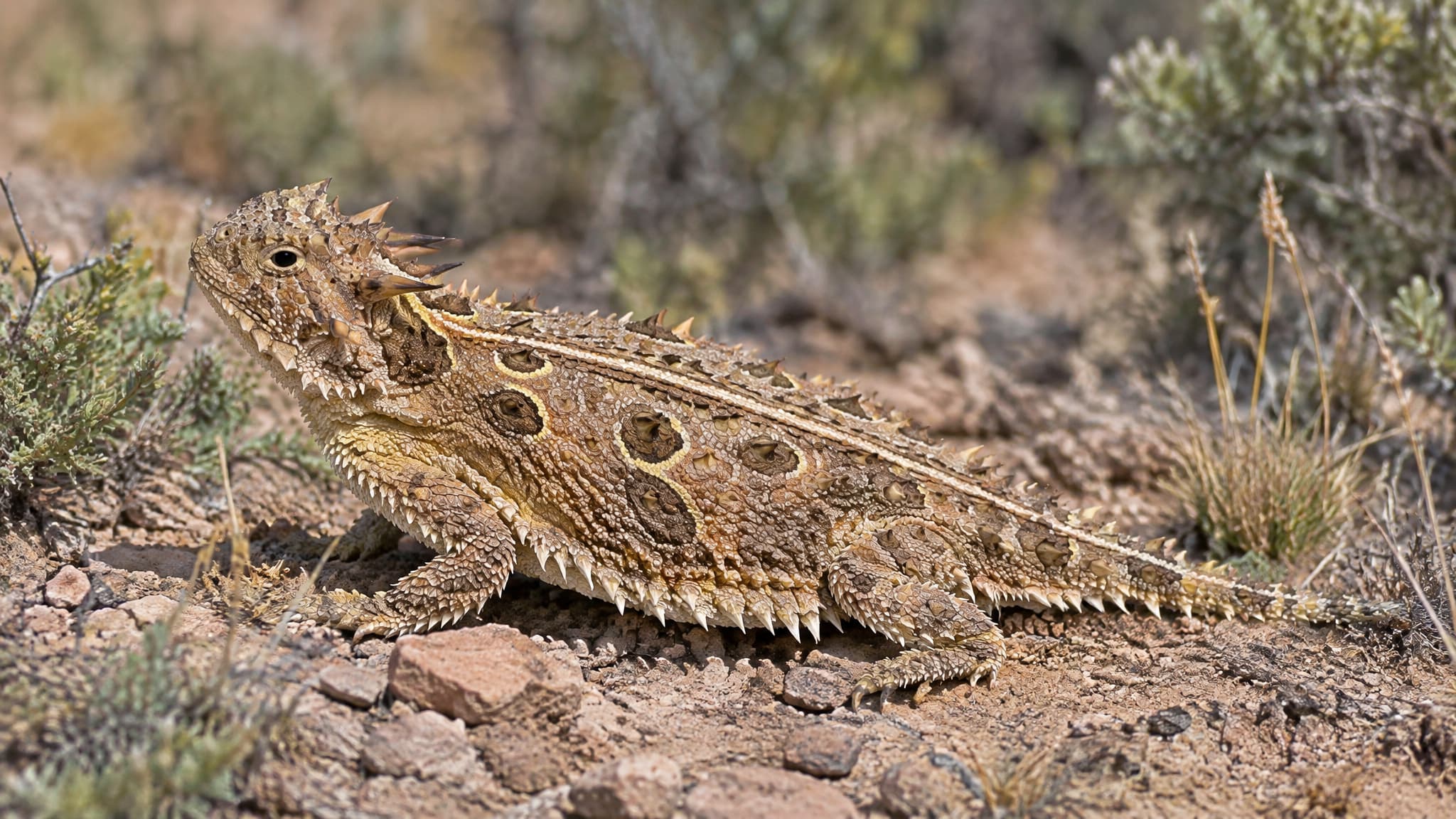
A Texas horned lizard rests in side profile on rocky, sandy ground among low desert shrubs. Its flattened body, prominent head horns, and rows of keeled spines are clearly visible.
The Texas horned lizard (Phrynosoma cornutum) is a squat lizard with a wide, flattened body and a crown of horns on its head. It is the largest-bodied and most widely distributed of the North American horned lizards. Two long horns stand out at the back of the skull, and rows of spiny scales run along its sides. Its coloring blends in well with dry soil. Dark bars run from the eyes toward the horns, and dark blotches with pale edges cover the back. A single light stripe runs down the spine. Females are larger than males and can reach about 14 cm, while males reach about 9–10 cm. Adults weigh roughly 25–90 g.
Distribution and habitat
The species is native to the south-central United States, from Kansas and Oklahoma through Texas and New Mexico, and to northern Mexico. It lives in arid and semi-arid open country with sparse vegetation and loose soil, from Chihuahuan Desert scrub to grassland. Small populations brought in through the pet trade exist in parts of the southeastern United States, usually on sandy coastal dunes.
Diet and behavior
This lizard is an ant specialist. Harvester ants make up about 69% of the prey found in its stomach, and it adds termites, beetles and grasshoppers when it can. One lizard may eat from 30 to more than 100 ants a day. A factor in its blood plasma protects it from harvester ant venom, and it coats swallowed ants in mucus to subdue them. It hibernates underground from about October to late March. Its main defense is camouflage, but it can also puff up its body or squirt blood from its eyes at predators.
Reproduction and lifespan
The species lays eggs, and each female produces one clutch a year. About six weeks after mating, she digs a tunnel and lays 14–37 leathery white eggs, with larger females laying more. She does not guard them. The eggs hatch after about 40–61 days. Captive animals typically live about 7 years, but lifespan in the wild is not well documented.
Ecology and conservation
As a major predator of harvester ants, it is part of a tight ecological link with them. It also hosts a parasitic roundworm whose life cycle passes through those ants. The IUCN lists the species as Least Concern, but it has declined across parts of its range. Texas lists it as a threatened state species. The main threats are habitat loss, pesticides, collection, and invasive red imported fire ants, which push out native harvester ants.