
Thorny Devil
Moloch horridus
 AI-generated
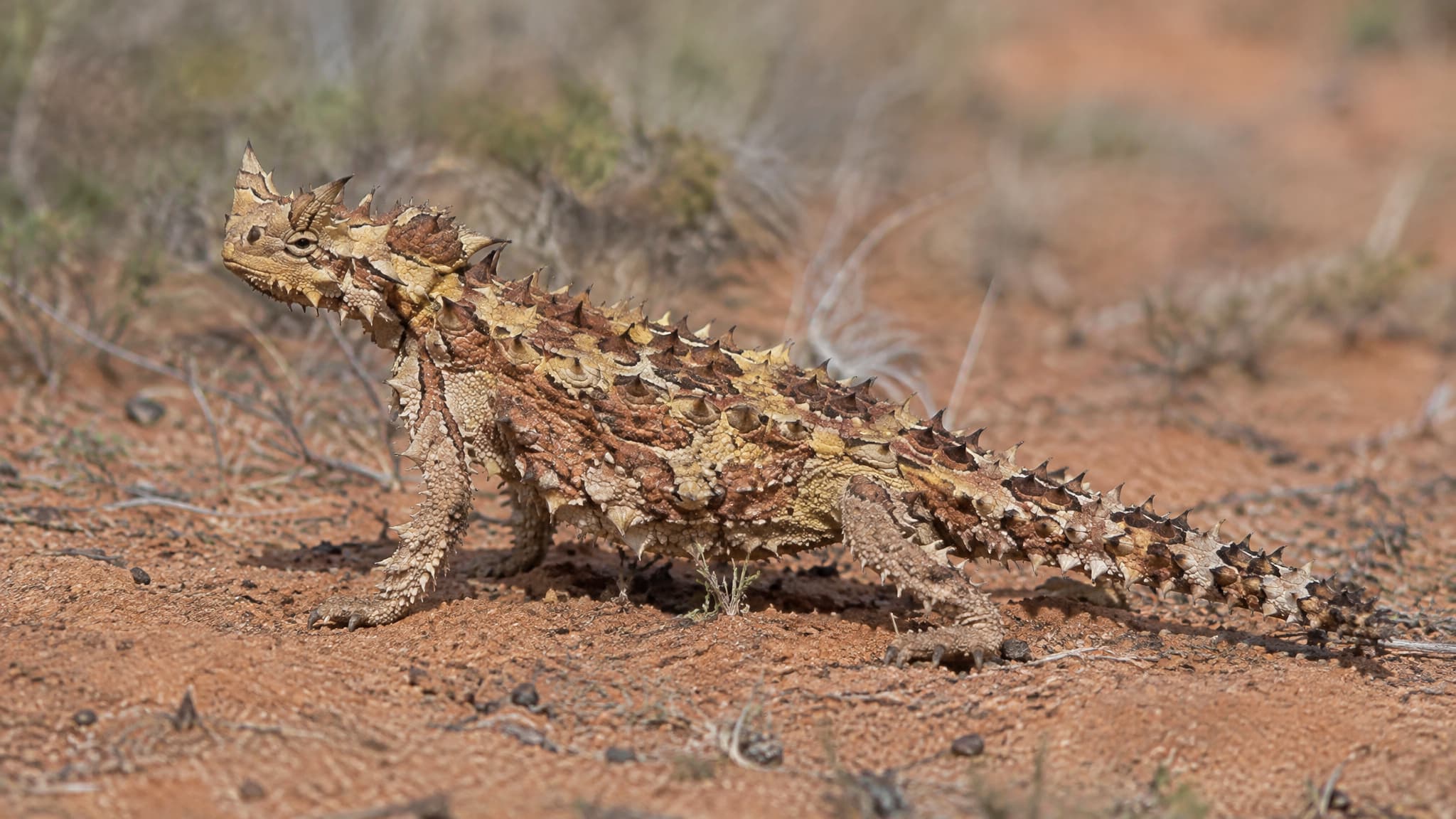
A thorny devil stands in side profile on reddish sandy ground, with its head raised, body covered in prominent conical spines, and a long tapering spiny tail.
The thorny devil (Moloch horridus), also called the mountain devil, thorny lizard or simply moloch, is a small Australian lizard in the family Agamidae. It is the only species in the genus Moloch. Adults reach about 20 cm in total length, and females are generally larger than males. The whole body is covered in conical spines, and the neck carries a large spiny lump. The short legs, short tail and small head give it a squat, unmistakable outline.
Its colors provide strong camouflage in shades of brown, olive, yellow, grey and rich orange-red, and they change with temperature. Individuals tend to be darker or olive in the cool morning and turn paler yellow as the day warms. When it moves, the thorny devil walks with a slow, rocking gait.
The species is endemic to arid and semi-arid Australia. Its range covers much of Western Australia, South Australia, the Northern Territory and parts of Queensland. It lives in sandy deserts and dry scrublands, where finding water is a constant challenge. To drink, it stands on wet sand or in moisture, and capillary grooves between its scales carry the water to the corners of its mouth.
The thorny devil is an obligate ant specialist, and its teeth are adapted to this diet. Because ants are low in nutrients, an adult may eat several hundred ants a day; one estimate is about 750. It usually feeds beside ant trails, picking ants off one at a time. Activity is bimodal, with active seasons in autumn and spring and quieter periods during the hottest and coldest months.
Breeding takes place mainly from late winter to early summer (August to December), once a year. The female digs a burrow up to about 22 cm deep and lays 3 to 10 eggs, with 8 being typical. She then fills the burrow and smooths the surface to hide it. Incubation lasts about 90 to 132 days. Wild individuals live roughly 6 to 20 years.
As a specialist ant predator, the thorny devil is part of the food web of Australia's arid zone, and birds and other predators eat it in turn. Introduced cats and foxes are probably among its predators. Even so, it faces no major known threats, and the IUCN lists it as Least Concern.



