Tokay Gecko
Gekko gecko
 AI-generated
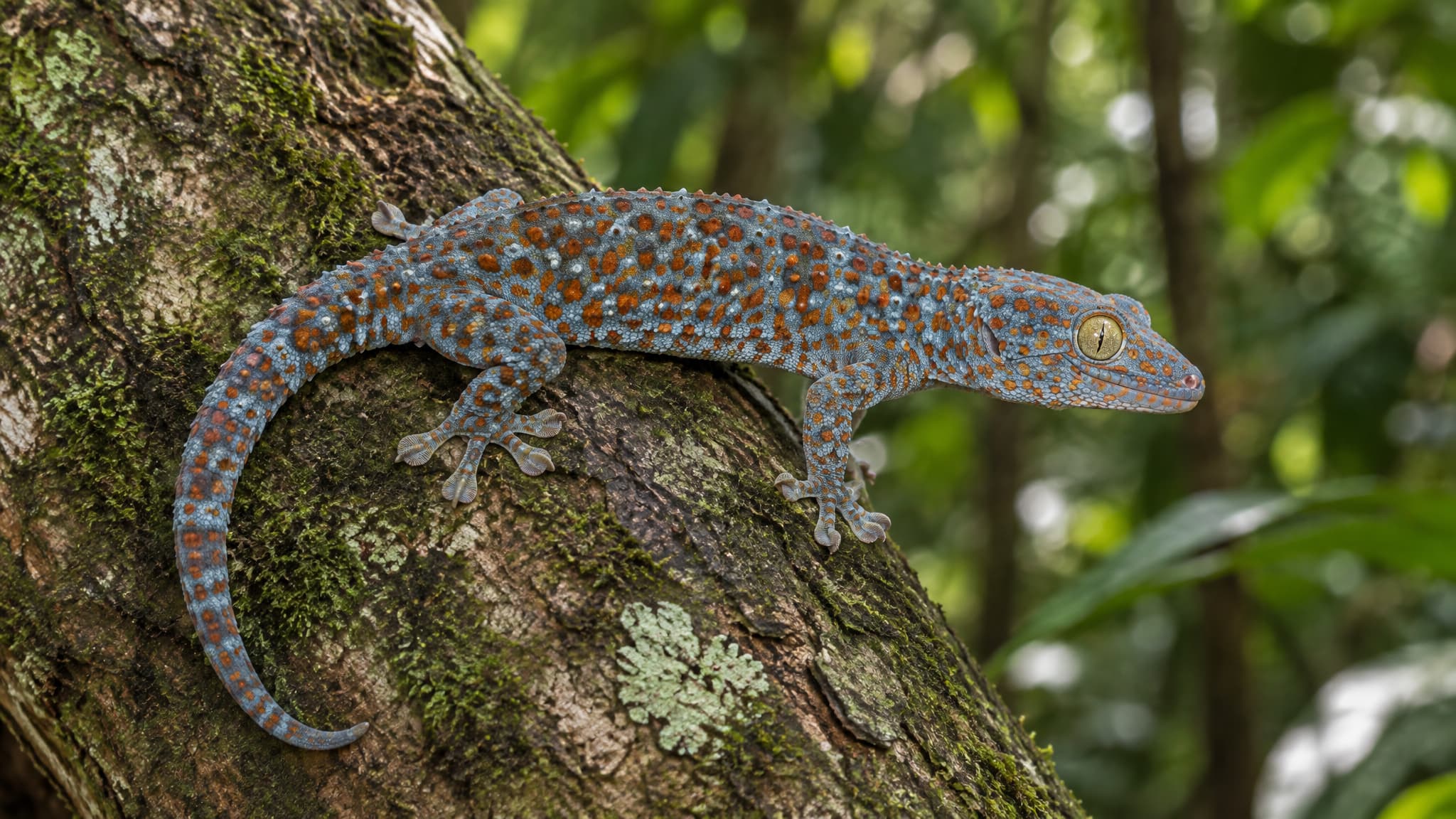
A Tokay Gecko (Gekko gecko) is shown in lateral profile resting on a moss- and lichen-covered tree trunk in a forest setting. Its blue-gray body is covered with orange spots, with a long tail, prominent eye, and broadened adhesive toe pads visible.
The tokay gecko (Gekko gecko) is one of the largest living geckos. Adults usually measure about 25–35 cm in total length. Its body is stout, round in cross-section and slightly flattened on top. It has a large head that stands out from the neck, strong jaws and big eyes with vertical pupils. Like other true geckos, it has no movable eyelids: a clear fused scale protects each eye. The skin is usually bluish grey with orange to red spots, and it can lighten or darken slightly to match the surroundings. Males are more brightly colored than females.
The species is native to South and Southeast Asia, from northeastern India, Nepal, Bhutan and Bangladesh through Indochina to the Philippines, Indonesia and western New Guinea. It lives in tropical rainforest, on tree trunks and rocky cliffs, and often inside villages and houses. People have introduced it to places such as Florida and Hawaii. Its toe pads carry millions of tiny hair-like structures called setae, which let it run up walls and cling upside down.
Tokays are nocturnal ambush hunters. They mostly eat large insects such as cockroaches, crickets, grasshoppers and locusts, and sometimes small vertebrates. They live alone and fiercely defend their territory against other geckos. They are known for a strong bite. The male's loud, barking to-kay call gives the species its name and is used to claim territory and attract mates. When grabbed, a tokay can drop its tail and later grow a new one.
The breeding season lasts about four to five months. During that time, females lay small clutches of usually one or two eggs at intervals of about a month. The eggs are sticky at first, harden, and are glued to bark, rock or walls. Adults may guard them, but the young get no care after hatching. Incubation takes about two to six months, and hatchlings are roughly 5–8 cm long. In captivity, tokays live about 10 years on average, and the recorded maximum is about 23.5 years.
As a predator of insects, the tokay helps control pests in homes and farms, and it is in turn eaten by snakes, birds and other predators. The IUCN lists it as Least Concern because it has a wide range and adapts well to human settlements. However, huge numbers are taken from the wild for traditional medicine and the pet trade. Because of this, the species was added to CITES Appendix II in 2019 to regulate international trade.