Tuatara
Sphenodon punctatus
 AI-generated
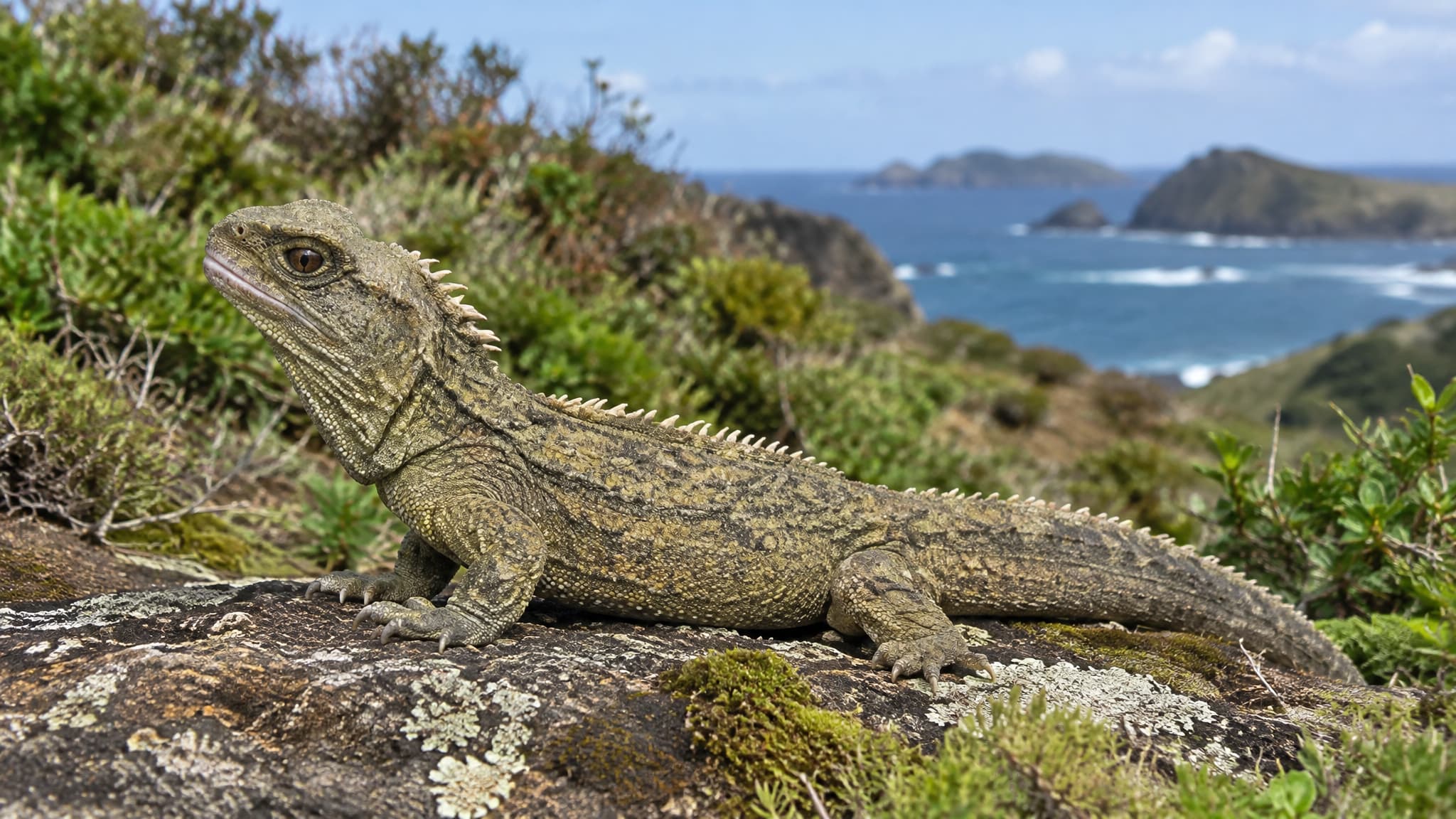
A tuatara rests on a lichen-covered rock in coastal shrubland, shown in side profile with a raised head, stout limbs, clawed toes, and a row of pale spines running from the neck along the back and tail.
The tuatara (Sphenodon punctatus) is a medium-sized reptile endemic to New Zealand and the only living member of the order Rhynchocephalia, a lineage that flourished during the age of the dinosaurs. Although it looks like a lizard, it lacks external ear openings and other features typical of lizards. Its skin ranges from olive-green to brown or orange-red and may change color over a lifetime. Males carry a crest of spines along the neck and back, which they can raise during courtship or disputes. Its jaws hold teeth fused to the bone, with a double row on the upper jaw.
Tuatara once lived across mainland New Zealand, but wild populations now survive mainly on about 30 small offshore islands, including islets off the North Island's northeast coast and in Cook Strait. They occupy coastal forest, shrubland and cliff-bound islands, sheltering in burrows that they dig themselves or share with nesting seabirds such as prions and petrels.
Mostly nocturnal, tuatara also bask in the sun and stay active at cooler temperatures than most reptiles. Their metabolism is very slow, so they feed less often than other reptiles. The diet consists mainly of invertebrates such as beetles, weta and spiders, supplemented by lizards, seabird eggs and chicks, and occasionally smaller tuatara. Adults are territorial and will threaten and bite intruders.
Reproduction is exceptionally slow. Individuals take roughly 10 to 20 years to reach sexual maturity, and females lay eggs only every few years. Eggs are laid in burrows away from the home burrow and need a long incubation; the hatchling may emerge more than two years after conception. Sex is determined by incubation temperature, and young receive no parental care. Tuatara grow slowly, live around 60 years on average, and can exceed 100 years.
As a predator of large invertebrates and a partner of burrowing seabirds, the tuatara is an important part of island ecosystems. It is also a taonga (treasure) for Māori. Introduced mammals, especially the Polynesian rat (kiore) and other rats, caused its disappearance from the mainland.
New Zealand gave the tuatara legal protection in 1895. The IUCN lists it as Least Concern, while New Zealand's Department of Conservation classifies it as At Risk–Relict. Ongoing threats include rodents, habitat loss, poaching and low genetic diversity, and conservation relies on predator-free islands, translocations to fenced sanctuaries and captive egg incubation.