
Fennec fox
Vulpes zerda
 AI-generated
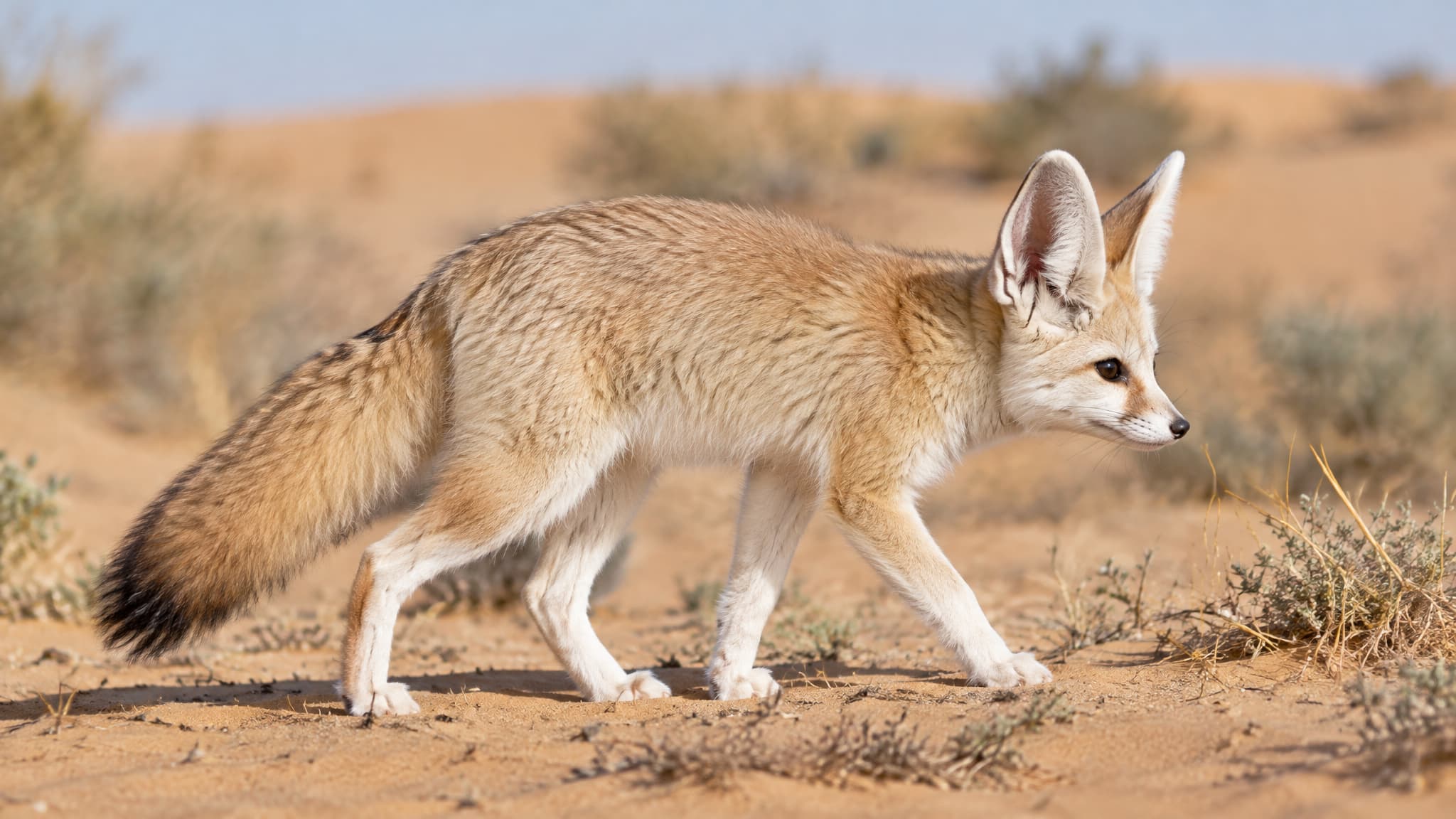
A fennec fox walks across sandy desert terrain with sparse vegetation, shown in side profile. Its very large upright ears, pale coat, pointed muzzle, and full bushy tail are clearly visible.
The fennec fox (Vulpes zerda) is the smallest species of the dog family, Canidae. It has a head-and-body length of 30–40 cm, a bushy tail of 18–30 cm and a weight of about 0.8–1.5 kg. Its most striking feature is a pair of enormous ears, up to about 15 cm long, which help it hear prey moving under the sand and shed body heat. The thick, sand-coloured coat camouflages it against the dunes. First described as Canis zerda in 1780, it was long placed in its own genus, Fennecus, but molecular studies place it in Vulpes, close to Blanford's fox.
The fennec lives across the Sahara, from Morocco, Western Sahara and Mauritania east to northern Sudan, Egypt and the Sinai Peninsula, with records reaching Kuwait. It favours small sand dunes and open sandy ground with sparse grasses, sedges and shrubs, in areas where yearly rainfall is under 100 mm in the north and about 300 mm in the south.
It is mainly nocturnal and spends the hot day in burrows. In compact soil a den can cover up to 120 m² and have up to 15 entrances, while dens in loose sand are simple. Fennecs live in family groups of up to 10 animals and mark territories with urine and feces. They are omnivores: they dig for small rodents, lizards, insects, small birds and eggs, and also eat fruit, leaves, roots and tubers. Moisture from food lets them go without free water for long periods, and they cache surplus food. When overheated, a fennec can raise its breathing rate from 23 to 690 breaths per minute.
Pairs are monogamous. Mating takes place from January to April, and gestation usually lasts 50–52 days. One litter of 1–4 pups is born per year, between March and June. The pups open their eyes after 8–11 days, are weaned at 61–70 days and reach sexual maturity at about 9 months. Fennecs live about 10 years in the wild and up to 14 years in captivity.
In desert ecosystems, the fennec is a predator of small mammals, birds, reptiles and insects. The IUCN Red List classifies it as Least Concern (2015 assessment), and it is listed in CITES Appendix II. Its main threats are trapping for exhibition or sale to tourists, especially in North Africa, and habitat loss from settlements, roads, mining and oil fields. It is legally protected in Morocco, Algeria, Tunisia and Egypt.



