
Walrus
Odobenus rosmarus
 AI-generated
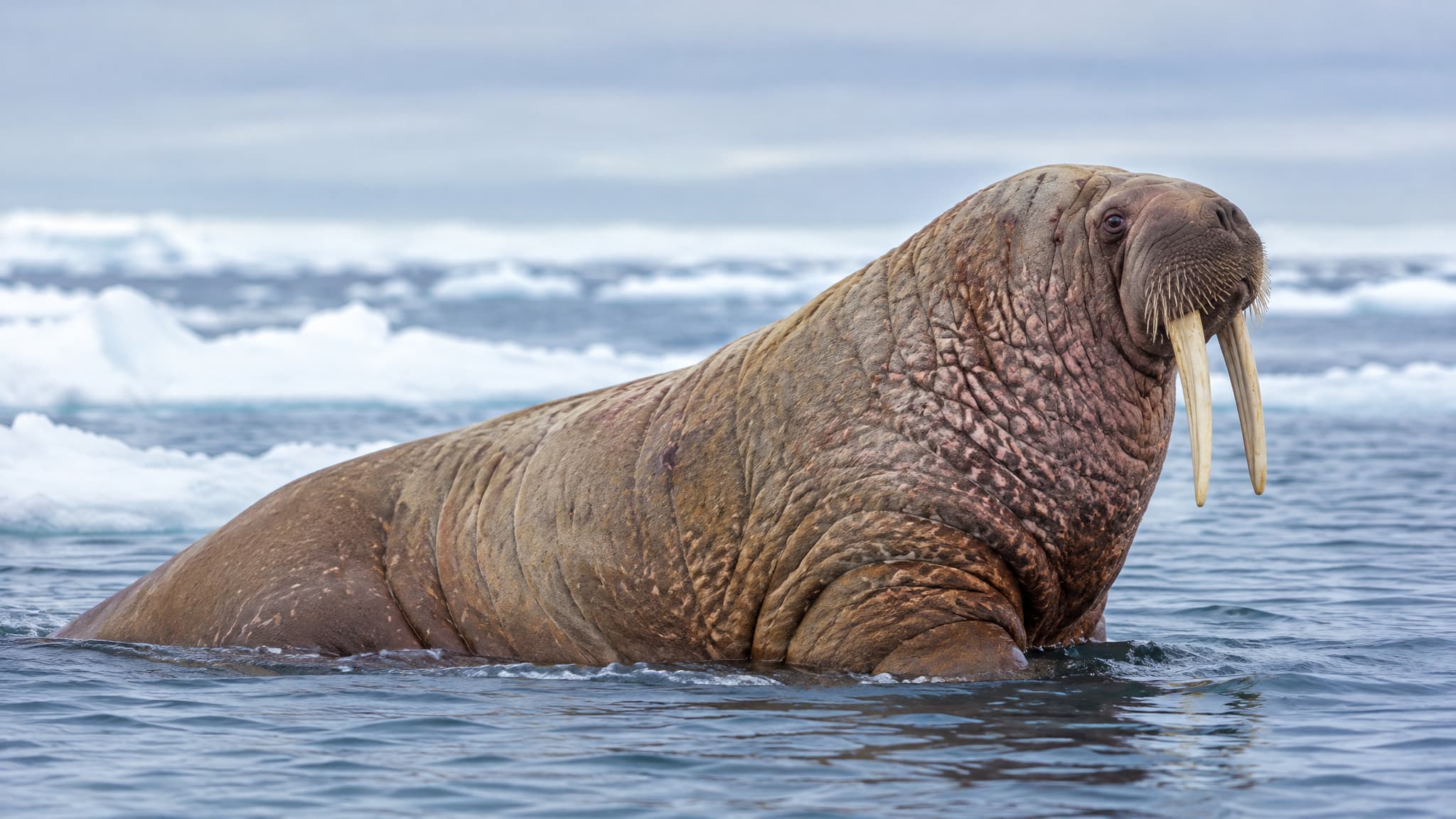
A walrus rests partially submerged in cold seawater, facing forward with its long tusks, whiskered muzzle, and folded, wrinkled skin clearly visible.
The walrus (Odobenus rosmarus) is a massive, flippered marine mammal of the Arctic, classified in the order Carnivora and the family Odobenidae. Adults measure 2.2 to 3.5 m long. Pacific males can reach 2,000 kg, though most weigh 800 to 1,700 kg, while Pacific females average about 800 kg; Atlantic animals are smaller, with males averaging 900 kg and females 560 kg. Its wrinkled skin is 2 to 4 cm thick, and both sexes carry long ivory tusks that can grow up to 1 m and weigh up to 5.4 kg.
The species lives in a discontinuous ring around the North Pole, in the Arctic Ocean and subarctic seas, mostly over shallow continental shelves and often on sea ice. Atlantic walruses (O. r. rosmarus) range from the Canadian Arctic across Greenland and Svalbard to western Arctic Russia, while Pacific walruses (O. r. divergens) spend the summer in the Chukchi and Beaufort Seas and the winter in the Bering Sea. Females tend to stay on the ice, whereas males often haul out on sand or boulder beaches.
Walruses are highly social and gather in herds of hundreds or even thousands, with the sexes usually apart outside the breeding season. They feed on the seafloor, sweeping it with their snout and sensitive whiskers and sucking the soft tissue out of shells. More than 60 genera of marine animals have been recorded in their diet, but bivalves, especially clams, are preferred, and benthic invertebrates make up about 97% of the Pacific walrus diet. Dives usually last 5 to 20 minutes, and seals and seabirds are taken only occasionally. The tusks serve in fights, dominance and display, and can break through ice up to 20 cm thick.
Breeding takes place from January to March, peaking in February. Gestation lasts 15 to 16 months, including 3 to 4 months of delayed implantation, and the single calf, weighing 45 to 75 kg, is born between April and June. Nursing lasts more than a year, and young may stay with their mothers for up to five years. Females give birth at most every two years, the lowest reproductive rate of any pinniped. Males mature at about 7 years but usually do not mate until around 15. Wild walruses live about 20 to 30 years; a captive individual reached 49.
As heavy consumers of seafloor invertebrates, walruses are regarded as a keystone species of the Arctic marine region, and they are hunted by only two natural predators, orcas and polar bears, which mostly target calves. Commercial hunting in the 18th and 19th centuries nearly wiped out the Atlantic subspecies. The IUCN lists the walrus as Vulnerable, with about 112,500 mature individuals estimated in 2018. Today the main threat is the loss of sea ice due to climate change, which reduces resting areas, stresses calves and has been linked to deadly stampedes on crowded Chukchi Sea beaches.



