
White-beaked Dolphin
Lagenorhynchus albirostris
 AI-generated
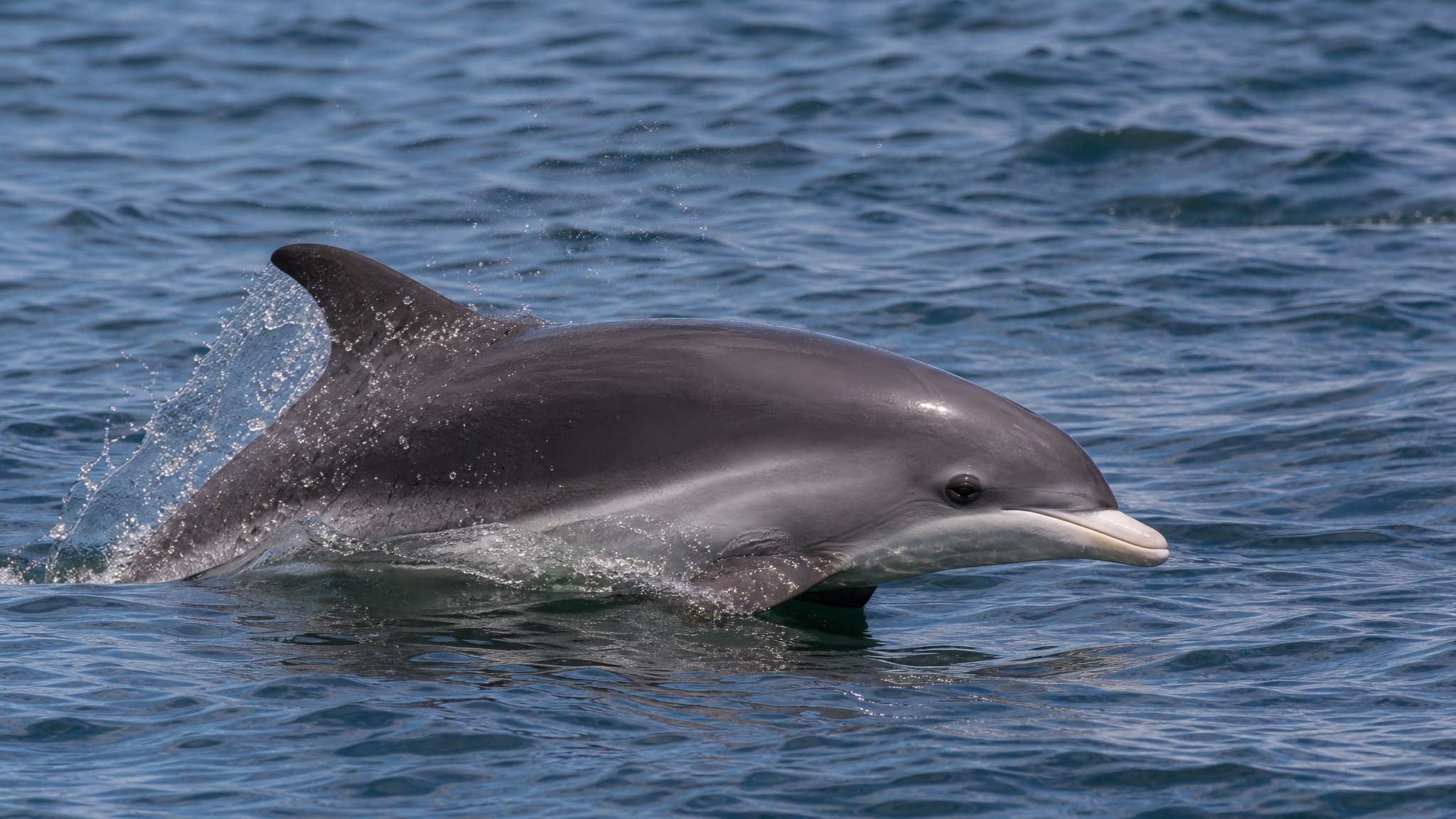
A White-beaked Dolphin surfaces in open blue water, showing its rounded head, pale beak, dark back, eye, dorsal fin, and part of a pectoral fin.
The white-beaked dolphin is a robust, cold-water oceanic dolphin named for its short, thick beak, which commonly has pale or white lips and may be mottled gray. Adults are usually about 2.4–3.2 m long and weigh roughly 180–350 kg; males tend to be larger. Its back is dark gray to black, while irregular light-gray or white areas occur along the flanks, behind the dorsal fin, and on the belly. The tall, curved dorsal fin, dark flippers, and dark tail flukes are useful field marks.
This species occurs across temperate and subpolar parts of the North Atlantic. Its range includes eastern North America from Massachusetts to Newfoundland, Greenland, Iceland, the British Isles, Scandinavia, and the Barents Sea, extending south in European waters to north of Portugal. It favors cool coastal and shelf waters, generally in water shallower than about 200 m, although it also travels offshore. Seasonal movements commonly take animals farther south and offshore in winter, then northward and nearer shore as summer ice recedes.
White-beaked dolphins are energetic, social swimmers, most often encountered in groups of 5–30 but occasionally in much larger gatherings. They leap, breach, and may ride vessel-generated waves. They feed cooperatively at the surface and also forage near the seabed, taking schooling fishes such as cod, herring, haddock, hake, and whiting, as well as squid, octopus, shrimp, and crabs. As a mobile predator, the species helps link pelagic and bottom-associated prey within North Atlantic marine food webs.
Females carry a single calf for about 11 months, with births generally recorded from May through September. Newborns are about 1.1–1.2 m long, and sexual maturity is reached at approximately 7–12 years. A dependable maximum lifespan has not been established. The species is assessed as Least Concern, but its global abundance remains uncertain. Entanglement in fishing gear, directed hunting in parts of the North Atlantic, and vessel, industrial, or military underwater noise are recognized threats; it is protected in U.S. waters under the Marine Mammal Protection Act.



