
White-lipped peccary
Tayassu pecari
 AI-generated
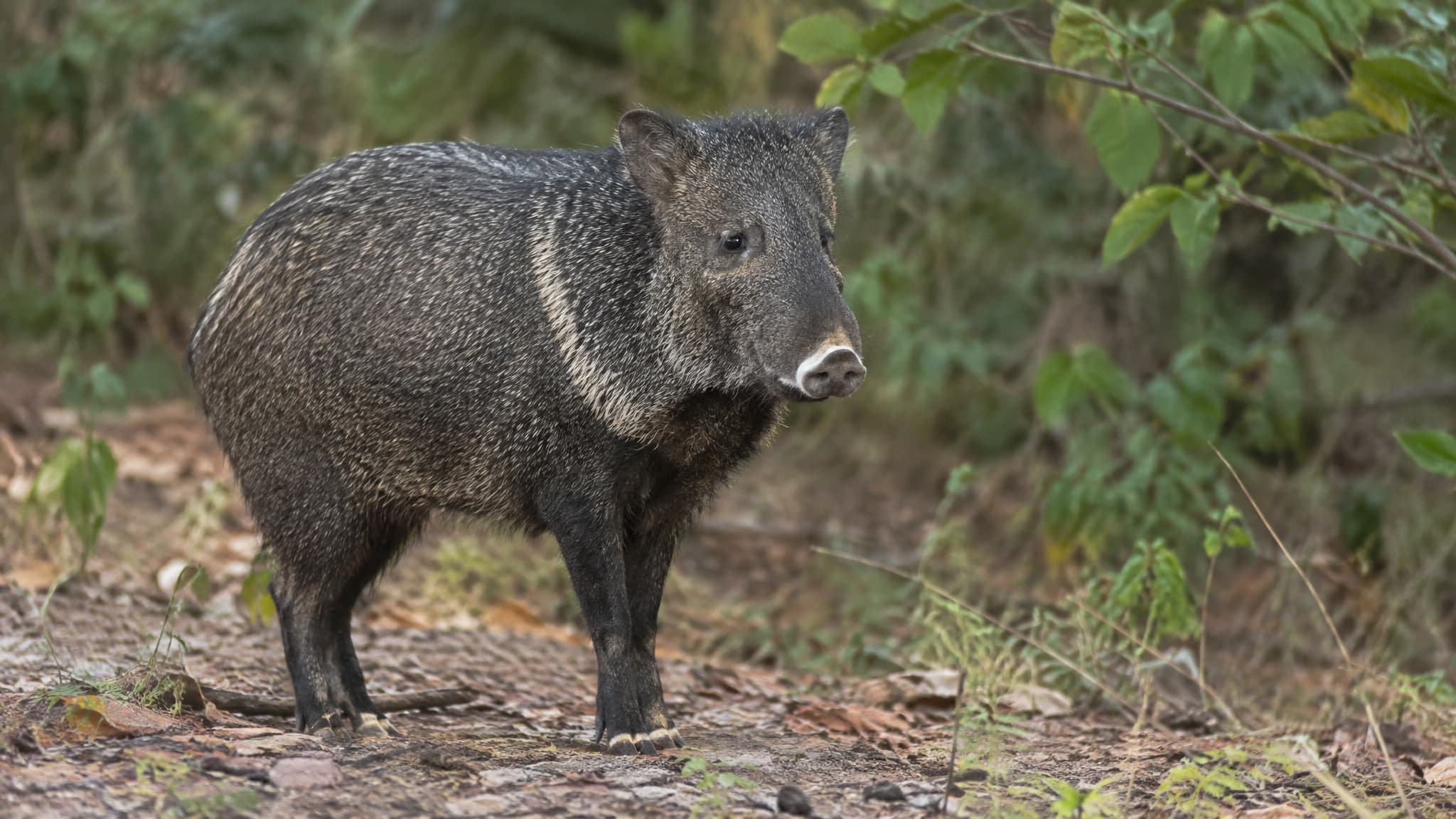
A white-lipped peccary stands facing slightly toward the camera on a leaf-littered forest floor, with a stocky body, coarse dark-and-gray coat, pale throat band, upright ears, and a rounded snout visible.
The white-lipped peccary is a robust, pig-like Neotropical mammal and the only living species in the genus Tayassu. Adults have a large head, elongated snout, short tail, slender legs, and coarse dark-brown to blackish coat. Its defining feature is the pale white band around the lower jaw and cheeks, often accompanied by pale hair inside the ears. Adults commonly weigh about 25–40 kg; juveniles are more reddish-brown and become dark-coated as they mature.
It ranges from southern Mexico through Central America and much of South America to northern Argentina. The species occupies tropical and subtropical forests, seasonally dry woodland, savannas, scrub, and Chaco habitats, generally requiring broad areas of connected cover and dependable water. Dense vegetation, caves, and rocky sites can provide shelter, and fragmentation can isolate herds from the extensive landscapes they need.
White-lipped peccaries are highly social, mobile omnivores. Mixed-sex herds may contain dozens to hundreds of animals and move widely in response to changing food and water availability. They feed chiefly on fruits, seeds, roots, leaves, and fungi, while also taking invertebrates and, occasionally, small vertebrates, eggs, or carrion. Scent glands, vocal calls, and conspicuous tooth-clacking help maintain contact and coordination within a herd; jaguars and pumas are important natural predators.
Females can breed throughout the year, although seasonal peaks occur in some regions. After roughly 156–162 days of gestation, a female usually gives birth to two young; newborns can run within hours and follow their mother soon afterward. Wild longevity averages about 13 years. By rooting, trampling, consuming seeds, and sometimes dispersing small viable seeds, large herds reshape forest-floor conditions and plant recruitment, making the species an important ecosystem engineer.
The white-lipped peccary is globally Vulnerable. Hunting, habitat loss, roads, forest fragmentation, and disease contribute to severe local declines and disappearances. Its reliance on large, connected habitat and its tendency to gather in large, detectable herds can make populations especially susceptible to human pressure. Conserving extensive protected areas, ecological corridors, and effective hunting controls is therefore particularly important.



