Wood turtle
Glyptemys insculpta
 AI-generated
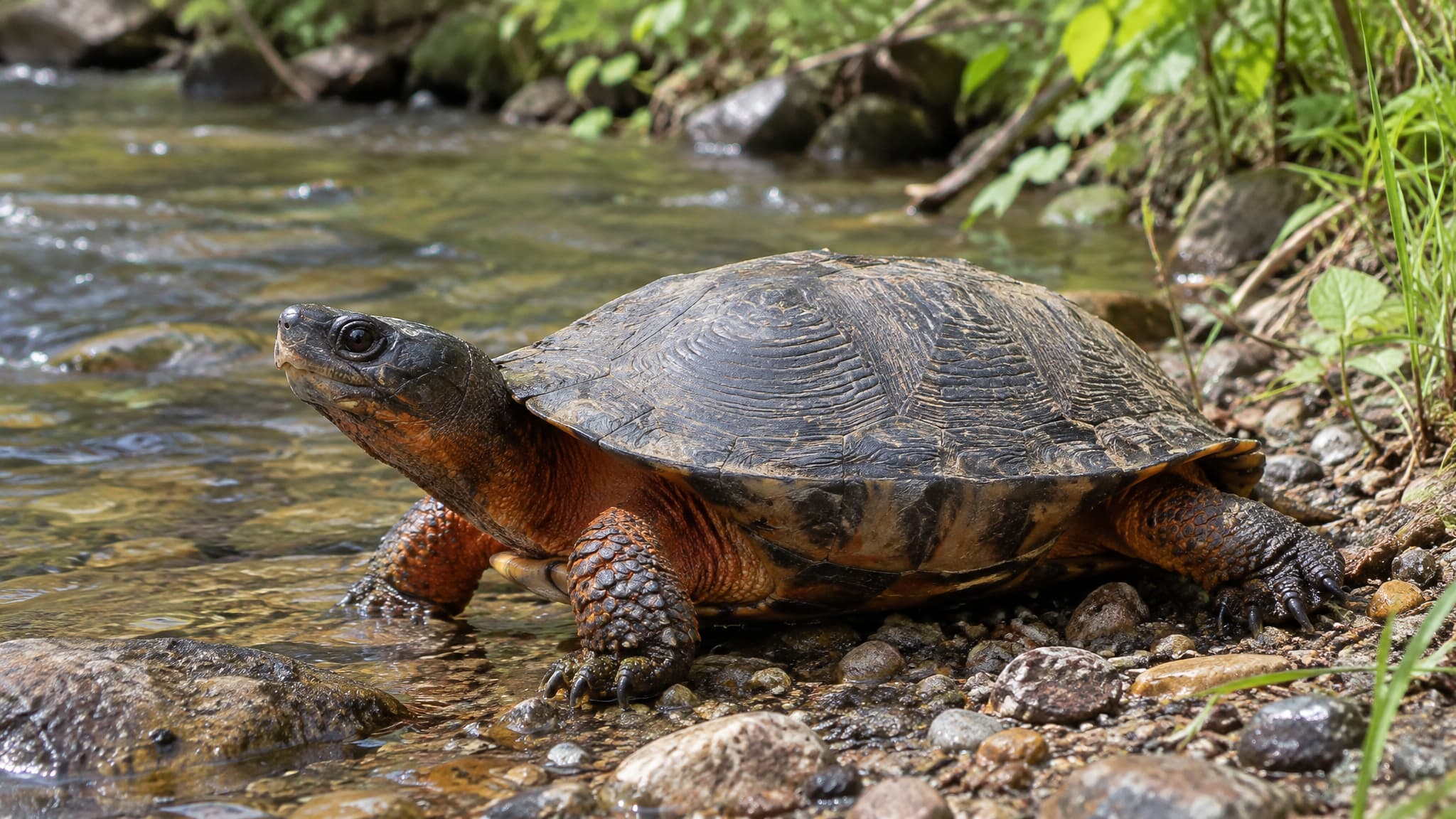
A wood turtle stands partly in a shallow, rocky stream, facing left. Its raised, strongly sculpted carapace, dark head, orange-brown neck, and heavily scaled legs with long claws are clearly visible.
The wood turtle (Glyptemys insculpta) is a semi-aquatic turtle of the family Emydidae, described by John Le Conte in 1830 as Testudo insculpta. Its name comes from the Latin insculptus, "carved", after the deeply sculptured scutes of its shell. The genus Glyptemys holds only two species: this one and the bog turtle (G. muhlenbergii).
The carapace is tan, grayish-brown or brown, with a low keel and rough, pyramid-like scutes marked by growth rings. The head is dark gray to black, while the chin, neck and legs are yellow, orange or red: yellow-orange tones dominate in the west of the range and orange to reddish tones in the east, and males are more vivid. Adults usually measure 14 to 20 cm, with recorded maxima of 24.4 cm for males and 22.5 cm for females, and weigh about 1 kg. Males have wider heads, a concave plastron and longer, thicker tails. Hatchlings measure 2.8 to 3.8 cm.
The species lives in eastern Canada and the northeastern United States, from Nova Scotia and New Brunswick west to Minnesota and south to northern Virginia, with an isolated population in northeastern Iowa; about 30% of the population is in Canada. It is rarely found more than a few hundred meters from clear, flowing streams with sandy or gravelly bottoms, but in summer it also uses riverside forests, thickets, wet meadows, fields and beaver ponds.
The wood turtle is diurnal, spends much time basking and hibernates underwater on stream bottoms where the water does not freeze. It is omnivorous, eating leaves, flowers, berries, mosses and fungi as well as slugs, snails, worms, insects, millipedes, eggs and carrion. Some populations stomp the ground with their forefeet or plastron to bring earthworms to the surface. Individuals keep linear home ranges of about 1 to 6 ha along a stream and show a strong homing ability.
Males form dominance hierarchies, and maturity comes late, at about 14 to 20 years. Females nest in May or June on open, sunny sandy banks, laying one clutch of 3 to 18 eggs a year, and some skip years. Incubation lasts 47 to 69 days, and sex is not set by nest temperature. Wood turtles can live up to 40 years in the wild and 58 years in captivity.
As a consumer of plants and small invertebrates, the wood turtle is part of the stream-edge food web, and its eggs feed raccoons, skunks and foxes; in one Michigan study 70% to 100% of nests were lost each year. It is listed as Endangered on the IUCN Red List and on CITES Appendix II. Habitat loss, roads, farm machinery, collection for the pet trade and raccoon populations boosted by people all threaten it, and its slow reproduction makes losses of adults hard to recover from.