
Yellow-spotted river turtle
Podocnemis unifilis
 AI-generated
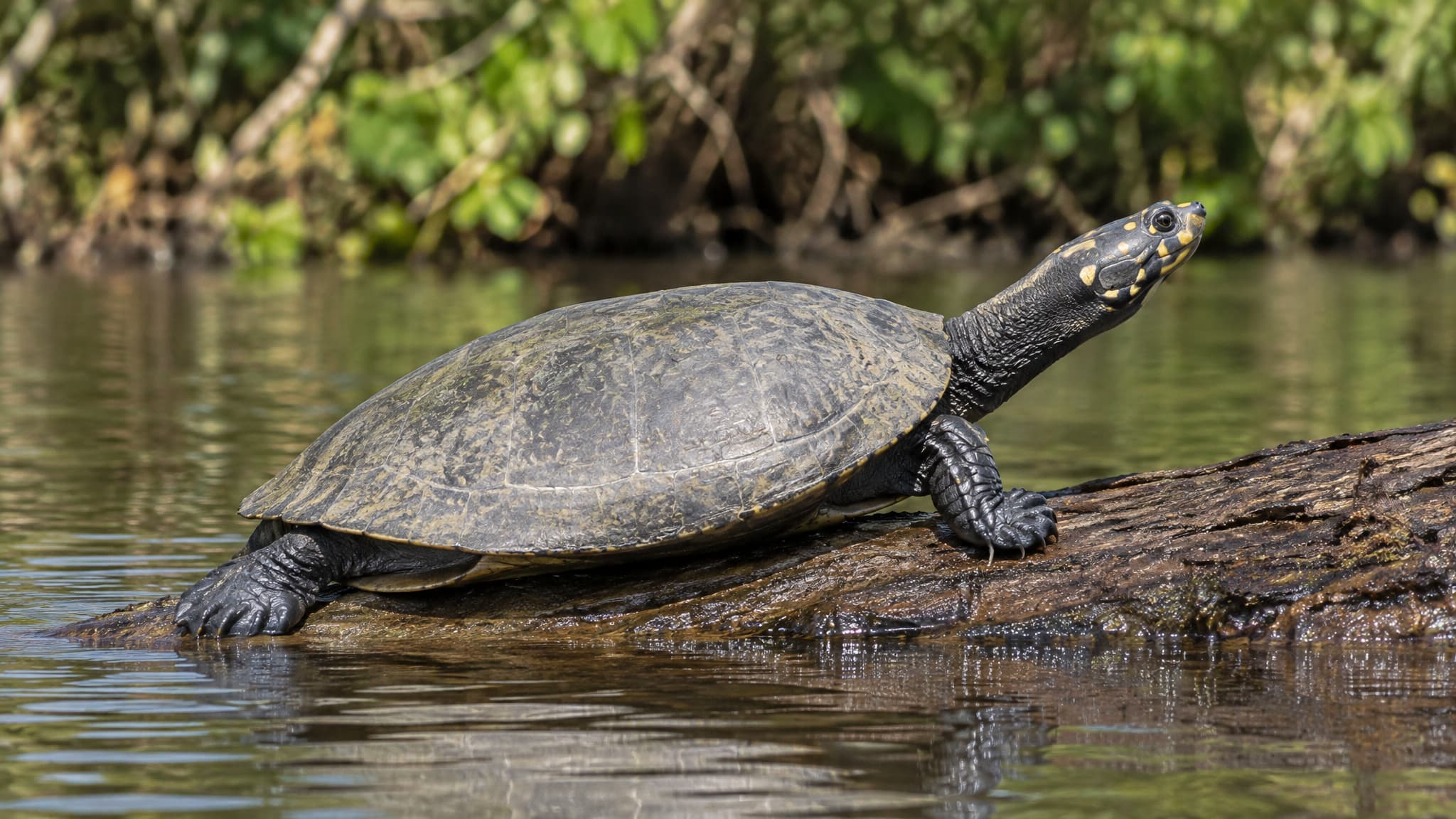
A yellow-spotted river turtle rests on a partially submerged log at the edge of calm forest water, with its head raised and yellow facial markings visible.
The yellow-spotted river turtle (Podocnemis unifilis) is a side-necked turtle of the family Podocnemididae, named for the bright yellow spots on the sides of its head. Like other side-necks, it tucks its head sideways under the edge of the shell instead of pulling it straight back. The oval carapace is brown to black with a low central keel and pale edges, the plastron is yellow and sometimes blotched, and the long olive-to-brown head ends in a distinct snout with a small barbel under the chin. The yellow spots are most vivid in juveniles and tend to fade with age, especially in females.
Females are much larger than males. Adult females reach a carapace length of 38 to 52 cm, while males measure 21 to 39 cm, and large adults can weigh up to 8 kg.
The species lives in the Amazon and Orinoco basins and the rivers of the Guianas, with records from Venezuela, Colombia, Ecuador, Peru, Bolivia, Guyana, French Guiana and the Brazilian Amazon; it occasionally drifts to Trinidad. It prefers calm water in large rivers, tributaries and lakes, moving into flooded forests, swamps and floodplain lakes when the water rises and returning to the river channels in the dry season. Groups often bask together on fallen trees and logs in mid-morning and afternoon.
Adults feed mainly on plants: aquatic and floating vegetation, fruits and seeds that fall into flooded forest, with fish, worms, insects and other small animals taken opportunistically.
Nesting is timed to the flood cycle. In the dry season females dig shallow nests on sandy or earthen riverbanks and lay 4 to 35 eggs; most lay one clutch a year, although some nest twice. The eggs hatch after 66 to 159 days, and incubation temperature sets the sex of the young: nests below 32 °C produce mostly males and warmer nests mostly females. Eggs and hatchlings are eaten by birds, snakes, large fish and mammals. Individuals have lived more than 30 years in captivity.
The IUCN Red List classifies the yellow-spotted river turtle as Vulnerable, and it is listed in CITES Appendix II. The main threat is people: adults are caught by hand or with nets, especially when they come ashore to nest, and both meat and eggs are sold in local markets.



