Bare-faced Curassow
Crax fasciolata
 AI-generated
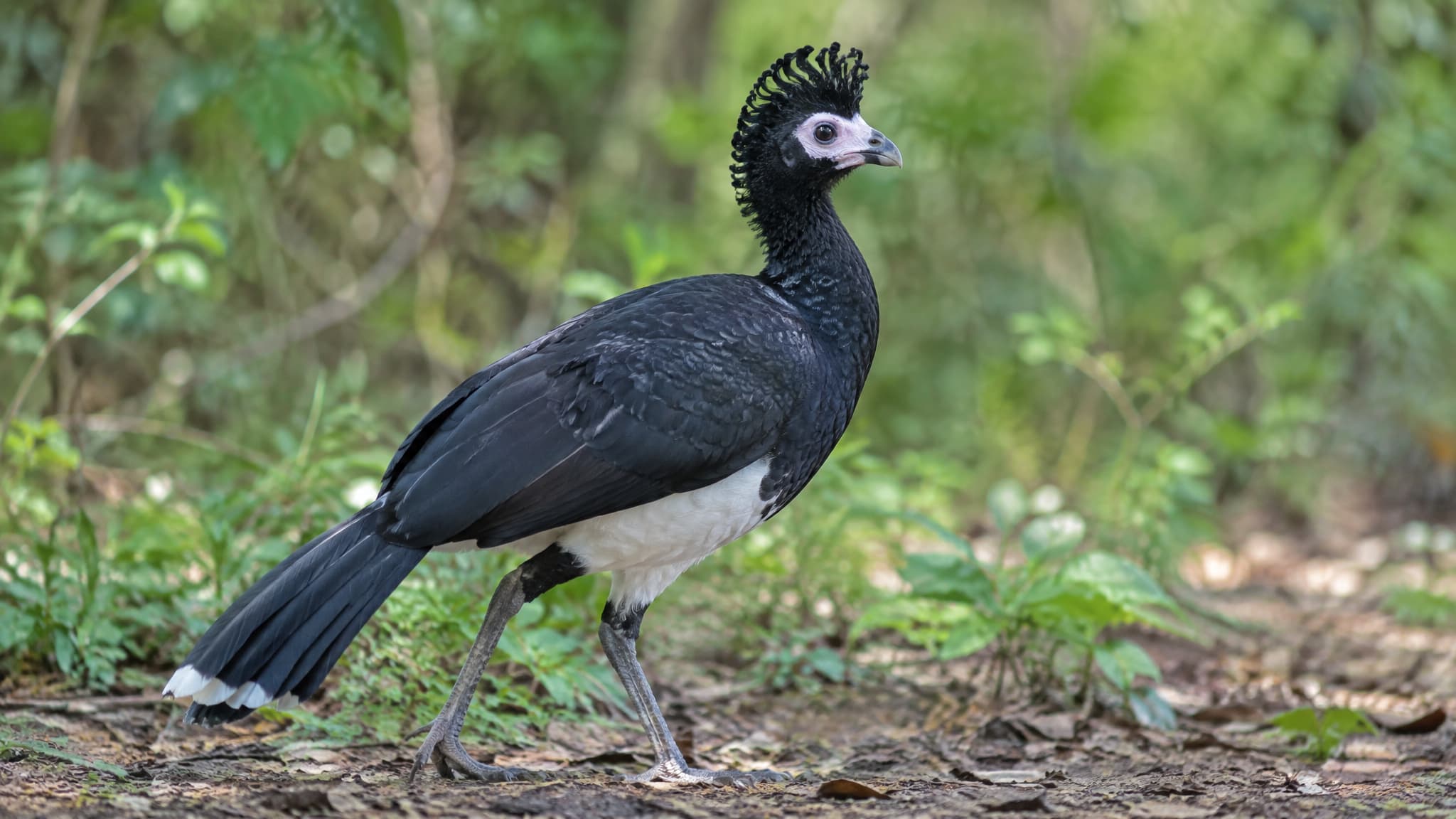
A black-and-white curassow stands in profile on the leaf-littered forest floor, showing a tall curly crest, bare pale facial skin, a long tail, and gray legs.
The bare-faced curassow is a large, heavy-bodied cracid, a forest bird related to guans and chachalacas. Adults are about 83 cm long. Males are mainly glossy black, with a white belly and tail tip, a curled black crest, and a prominent yellow bill; females are more patterned, with pale barring on the upperparts, a cinnamon-toned breast, and a buffish belly. The bare facial skin that gives the bird its English name is dark.
It occurs in central and southern Brazil and extends into eastern Bolivia, Paraguay, and northeastern Argentina. It uses gallery forest, riverine woodland, forest edges, dense woodland, dry forest, and wooded parts of the Cerrado and Pantanal. Although capable of flight, it spends much of its time walking quietly on the forest floor and commonly roosts in trees.
Fruit is an important part of its diet, supplemented by leaves, shoots, seeds, flowers, and small animals such as insects, snails, frogs, and lizards. Birds are usually encountered alone, in pairs, or in small family groups. Their terrestrial foraging and preference for cover can make this conspicuous-sized bird unexpectedly difficult to see.
Breeding nests are placed in trees. The female lays two to three rough-shelled white eggs, and incubation is reported to last about 30 days. Young hatch with their eyes open and remain under parental care for several months. Longevity in the wild is poorly documented; individuals in human care may live for roughly 25 years.
By consuming fruit and moving through wooded habitats, the species likely contributes to seed dispersal. It is globally Vulnerable, with hunting, forest clearing, fragmentation, and degradation of riverine and other forest habitats among its principal threats. Local populations can therefore disappear even within its broad South American range.