Black-necked Aracari
Pteroglossus aracari
 AI-generated
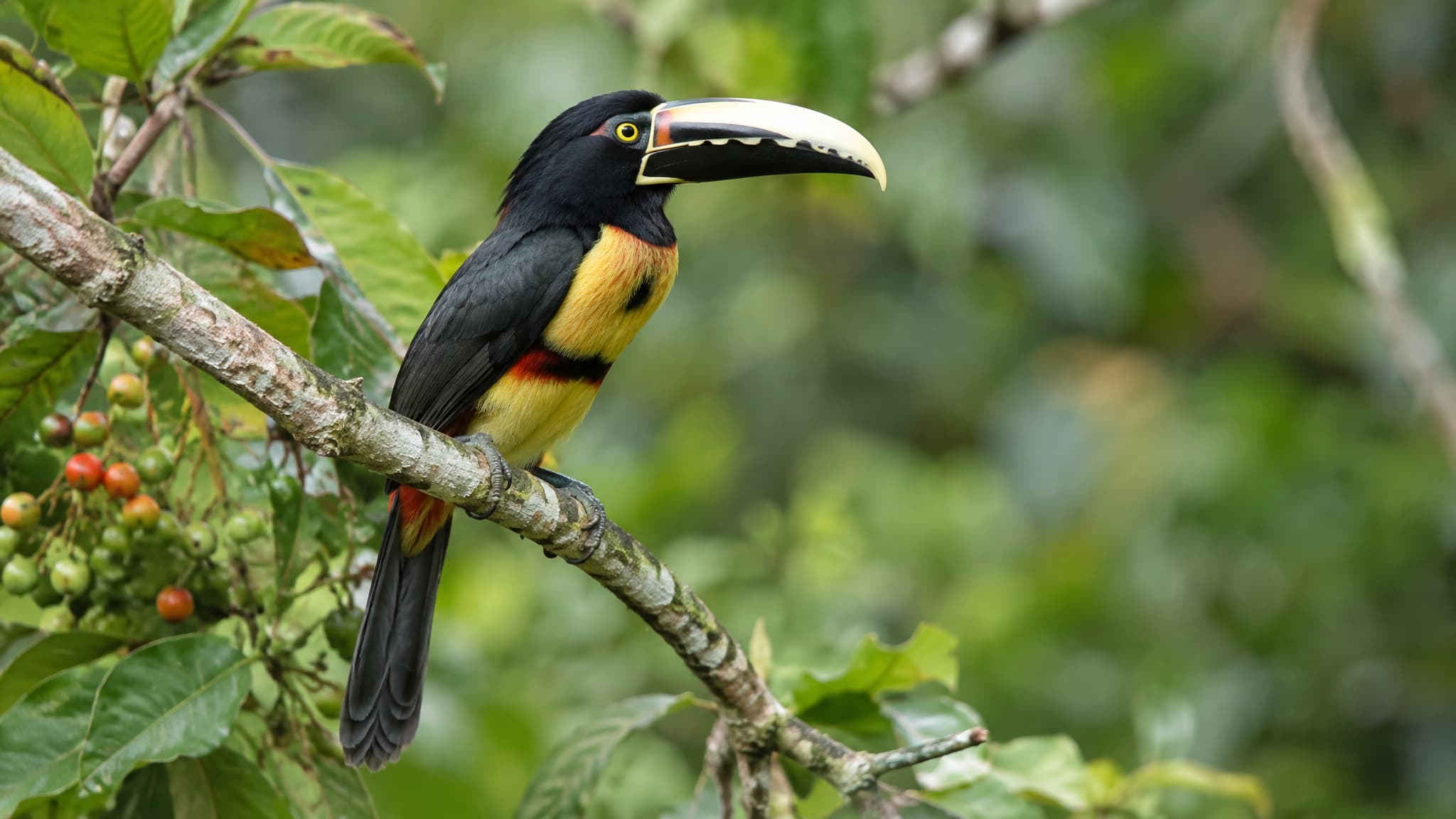
A Black-necked Aracari (Pteroglossus aracari) perches in side profile on a branch amid green foliage and clusters of berries. Its black head, yellow underparts with a red belly band, long tail, and large pale bill are clearly visible.
The black-necked aracari is a medium-sized, brightly patterned toucan relative. It is distinguished by a black head, neck, and throat; green upperparts; a vivid red rump; and a yellow belly crossed by a narrow red band. Its most conspicuous feature is the large bill: the upper mandible is pale ivory to white while the lower mandible is black. Adults are about 43–46 cm long, and females generally have a slightly smaller bill than males.
This species occurs across northern and eastern South America, including Brazil, the Guianas, and Venezuela. In Brazil it is called the araçari-de-bico-branco. It uses the canopy and forest edges of lowland terra-firme forest, seasonally flooded várzea and igapó forest, and some cultivated places near fruiting trees. It is chiefly a bird of lower elevations, though it can occur locally at higher sites.
Fruit is the foundation of its diet, including palm fruits and figs, but it also takes arthropods and other small invertebrates. Aracaris commonly travel in social groups, often of around ten or more birds, moving through openings in the forest in a line. By carrying and passing seeds after feeding, they help disperse forest plants and contribute to regeneration processes.
It nests in tree cavities, frequently using existing holes rather than excavating a nest itself. Incubation lasts roughly 16 days, and the young leave the nest after more than 40 days; in some groups, offspring from a prior year assist the breeding pair with feeding nestlings. A dependable species-specific maximum lifespan is not well documented in the sources consulted.
The black-necked aracari is globally assessed as Least Concern. Nevertheless, local populations can be affected by forest clearance, fragmentation, and the loss of large cavity-bearing and fruiting trees. Its persistence in disturbed edges should not be taken to mean that intact, connected forest is unimportant: mature forest supplies the nesting cavities and diverse fruit crops on which the species depends.