Blue-and-yellow Macaw
Ara ararauna
 AI-generated
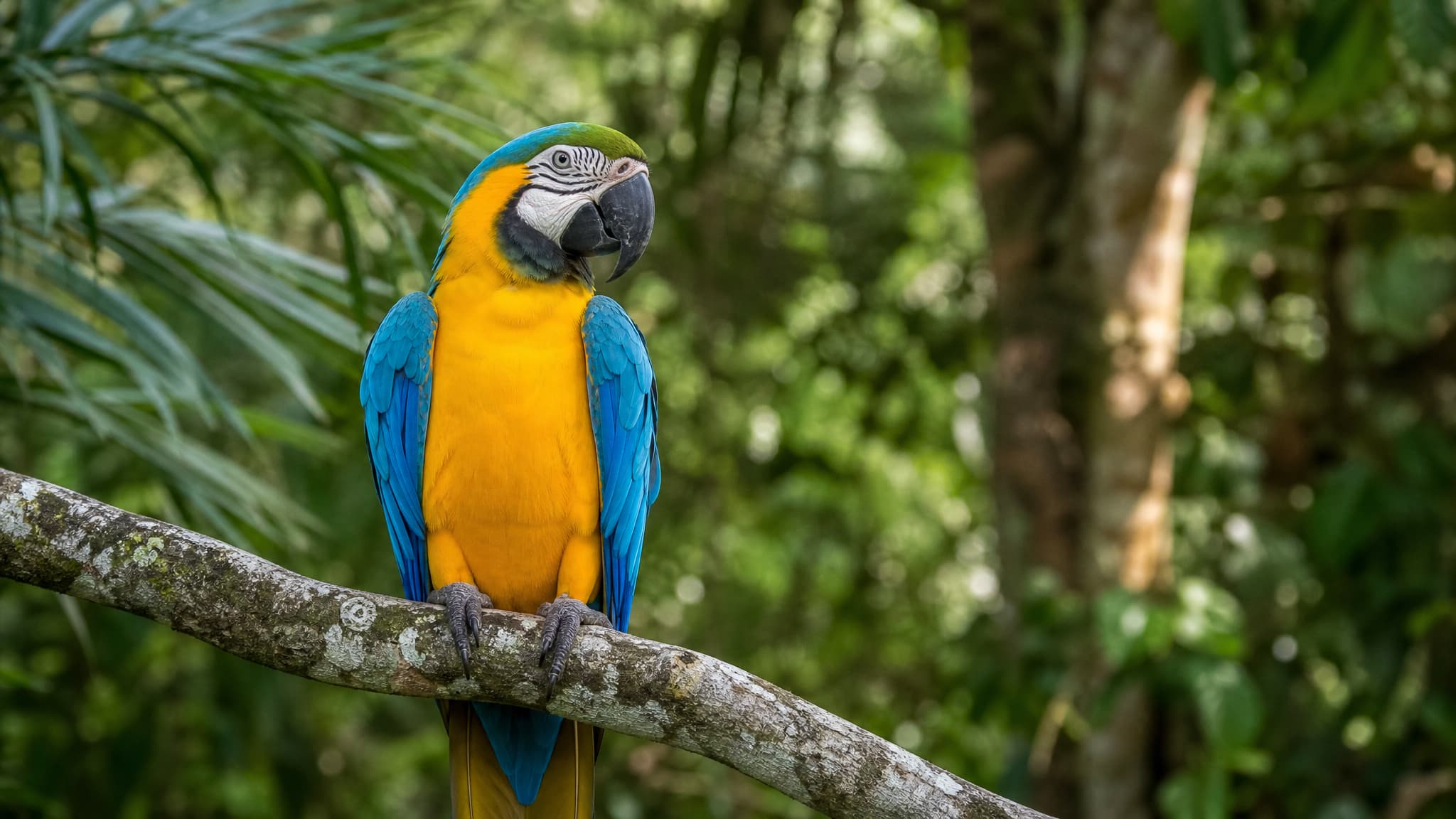
A Blue-and-yellow Macaw perches upright on a lichen-covered branch in a leafy forest, showing its blue wings, golden-yellow chest, barred facial skin, large dark bill, and gripping feet. Its long tail extends downward behind the branch.
The blue-and-yellow macaw is a very large, long-tailed parrot, instantly recognizable by its deep blue upperparts and wings, bright golden-yellow underparts, greenish forehead, and powerful black bill. Bare white facial skin is crossed by delicate black feather lines, while the throat is black. Adults are about 81–91 cm long, and males and females look much alike.
It occurs across much of tropical South America and reaches eastern Panama. Its habitats include rainforest, gallery forest, seasonally flooded and river-edge woodland, palm groves, savannas, and forest borders. It spends much of its time high in the canopy, but may gather at riverside clay banks and visit feeding trees in more open country.
This macaw chiefly eats fruit, seeds, nuts, and palm products, using its exceptionally strong bill to open hard shells. Pairs are usually conspicuous and noisy in flight, though larger flocks can form around food, roosts, or clay licks. By transporting or dropping seeds and consuming fruits, it contributes to plant recruitment and food-web processes in the forests and savannas it inhabits.
Pairs are generally monogamous and may remain together for many years. They nest in cavities in large trees or dead palms; a clutch commonly contains two or three eggs, incubated for about 24–28 days. Both parents protect and feed the young. Wild birds commonly live around 30–35 years and can survive longer, particularly under managed care. The species is assessed as Least Concern globally, but local populations can be affected by forest loss, nest-site destruction, hunting, and capture for the wild bird trade; international trade is regulated through CITES Appendix II.