Buff-necked Ibis
Theristicus caudatus
 AI-generated
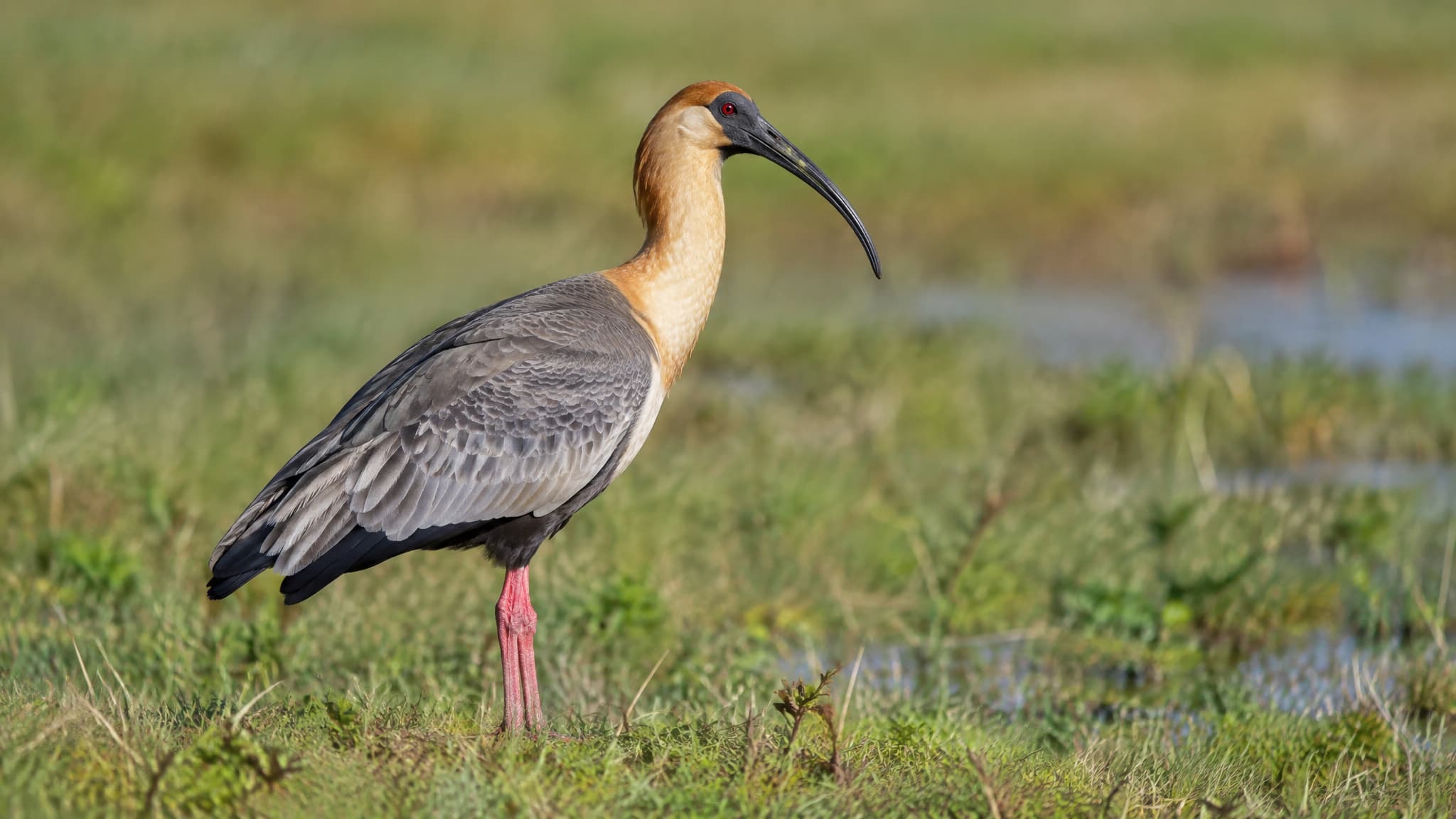
A Buff-necked Ibis stands in profile on grassy wetland vegetation beside shallow water, showing its long downcurved bill, buff-colored neck, dark face, gray patterned wings, and pinkish-red leg.
Buff-necked Ibis
The Buff-necked Ibis is a large, conspicuous ibis of open South American landscapes. It has a long, downward-curving bill, long pinkish legs, a pale buff neck, and a grayish back that can show a greenish sheen. Dark flight feathers and tail contrast with broad pale patches on the upper wings, making the bird especially recognizable in flight. The dark crown, reddish eye, and chestnut-toned breast area complete its distinctive pattern.
It occurs widely across northern and eastern South America, including much of Brazil, where it is known as the curicaca. It favors open country: natural grasslands, savannas, pastureland, seasonally flooded fields, wetlands, and the margins of ponds or marshes. Although it uses wet places, it is not restricted to them and often feeds in dry grassy areas. Birds may be solitary, paired, or gathered in small groups; they commonly roost in trees and can soar high overhead.
This ibis is an opportunistic predator. It walks deliberately through short vegetation or shallow wet ground, probing with its long bill for adult insects and larvae, spiders, centipedes, snails, amphibians, small reptiles, and occasionally small mammals. By consuming abundant invertebrates and small vertebrates in fields and wetlands, it contributes to food-web functioning and can help suppress some agricultural pests.
Breeding birds build twig nests in trees, on rocks, or on cliffs. A clutch usually contains two to four eggs. Information on average longevity in the wild is limited, but a captive individual has been recorded reaching 22 years. The species is classified as Least Concern, reflecting its broad distribution, though conversion of grasslands and wetlands, pesticide exposure, and disturbance near nest sites can affect local populations.