Southern cassowary
Casuarius casuarius
 AI-generated
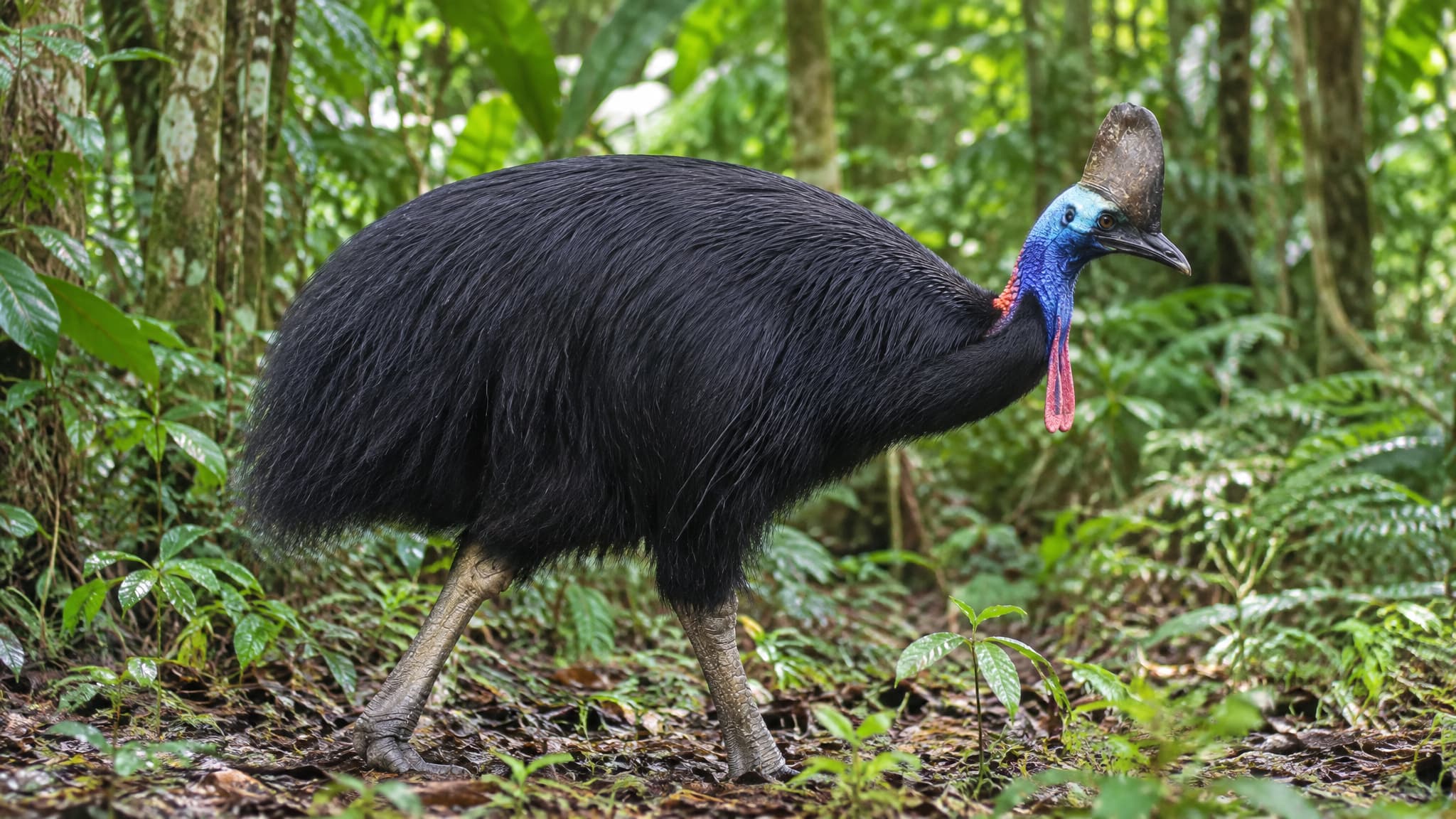
A Southern cassowary walks through dense tropical rainforest, showing shaggy black plumage, a tall casque, a blue neck, red wattles, and sturdy legs.
The southern cassowary is a huge flightless bird of the rainforests of New Guinea and northeastern Australia, and one of the heaviest living birds. Adults usually stand 1.5 to 1.8 m tall, and the largest recorded birds reached about 2 m and 85 kg. Females are larger and dominant: males weigh about 29 to 55 kg, while females reach up to 76 kg. The body is covered in coarse, hairlike black feathers, the bare head and neck are bright blue with a red nape, and two red wattles hang from the throat. A tall horny casque, 13 to 20 cm high, crowns the head, and the inner toe carries a dagger-like claw up to 12 cm long.
The species lives in southern New Guinea, the Aru Islands, Seram and Cape York and other parts of northeastern Queensland. It is mainly a bird of tropical lowland rainforest, in Australia below about 1,100 m, and it also uses nearby eucalypt woodland, savanna, mangroves, swamp forest and fruit plantations.
Cassowaries are solitary and territorial. They feed mostly on fallen fruit picked up from the forest floor, and also take fungi, insects, snails, small vertebrates and carrion. Though shy, they can run at nearly 50 km/h, jump almost 2 m, swim well, and can cause serious injuries with their claws.
Breeding roles are reversed. A female may mate with two or three males in a season and leave each with a clutch, usually of three to five large, bright green eggs weighing roughly 600 g each. The male builds the ground nest, incubates the eggs alone for about 50 days and guards the striped, precocial chicks for about nine months. Adult plumage and casque take several years to develop. Lifespan in the wild is not known; captive birds have lived 20 to 40 years.
The southern cassowary is an important seed disperser of the rainforest. One dung pile can hold up to 1 kg of seeds, and in one study 70 of the 78 plant species found in droppings could still germinate. Globally it is listed as Least Concern, but the Australian population is listed as Endangered. Habitat loss, collisions with vehicles, feral pigs and dogs, and hunting in parts of New Guinea are its main threats.