Common potoo
Nyctibius griseus
 AI-generated
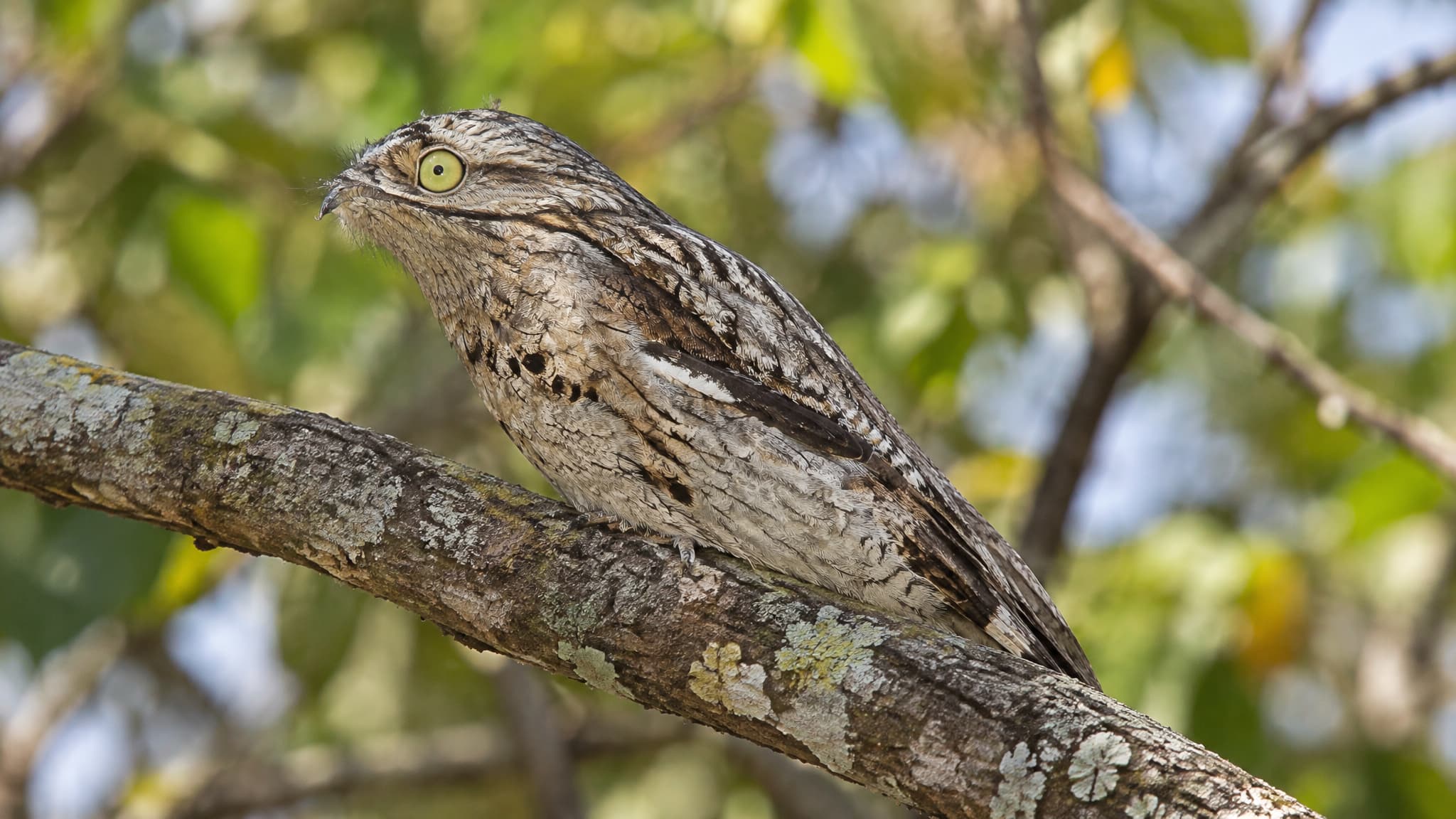
A Common potoo perches lengthwise on a lichen-covered branch in leafy woodland, showing its cryptic mottled plumage, large pale eye, and short broad bill.
The common potoo is a nocturnal bird of Central and South America, famous for spending the day perched upright on a broken branch and looking almost exactly like part of the tree. It measures about 34 to 38 cm and weighs roughly 145 to 202 g. Its plumage, found in grey and brown phases, is mottled and streaked with black, grey and cinnamon, and the long tail is crossed by dark bands. The large eyes are yellow, the short bill is blackish, and the mouth opens remarkably wide. Males and females look alike.
Two subspecies are recognized. N. g. panamensis ranges from Nicaragua and Costa Rica through Panama to western Colombia, Ecuador and northwestern Peru, while the nominate form occupies Trinidad and Tobago and most of South America east of the Andes, south to northern Argentina and Uruguay. It favours forest edges, open woodland, savannah and cerrado, semi-open country with scattered trees, and even well-wooded towns, and it is rarely found above about 1,900 m.
The potoo is an insectivore that hunts from dusk onward. Like a flycatcher, it waits on an exposed perch and sallies out to snatch flying insects such as moths, beetles, termites, ants, grasshoppers and crickets, swallowing them whole. By day it sits motionless with the head and bill raised, so that it blends in with the stump; slits in the upper eyelids let it notice movement even when its eyes look closed. On moonlit nights it gives a loud, melancholy series of descending notes, which has inspired legends across its range.
Pairs are monogamous and build no nest. The female lays a single white egg with lilac markings in a small depression on top of a broken branch or stump, usually 3 to 20 m above the ground. Both parents incubate for about 30 to 33 days. The downy white chick resembles a clump of fungus, is fed by both adults, and adopts the same frozen pose as its parents once it is too large to hide beneath them; it stays on the perch for roughly seven weeks to two months.
As a common nocturnal predator of flying insects, the potoo helps keep populations of moths and other insects in check. It is classified as Least Concern by the IUCN thanks to its very large range, although the population is thought to be slowly declining, probably because of habitat destruction.