Dusky-legged Guan
Penelope obscura
 AI-generated
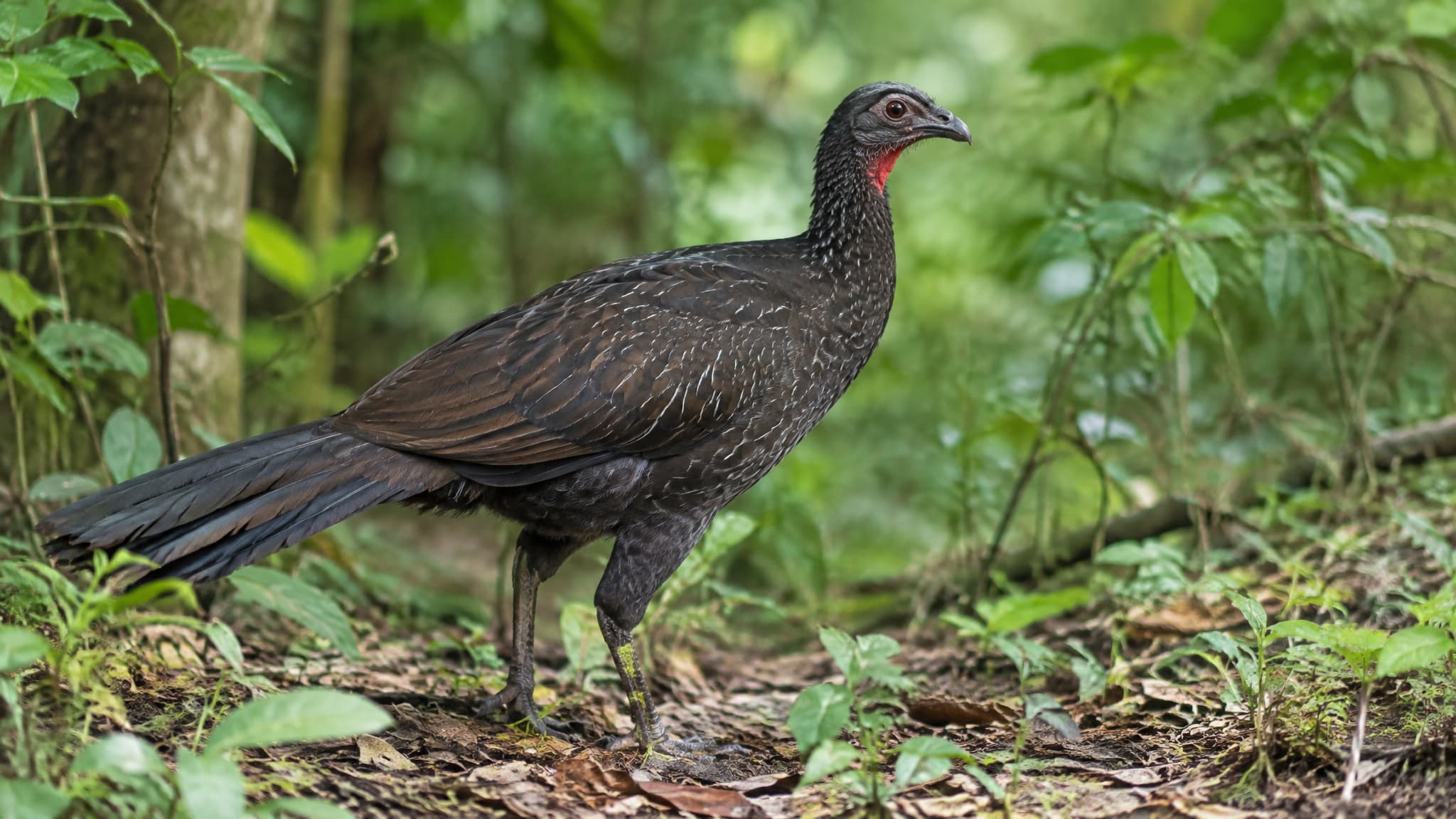
A Dusky-legged Guan stands in profile on the leafy forest floor, showing dark, finely streaked plumage, a long tail, a curved bill, and a red throat patch.
The Dusky-legged Guan is a large, forest-dwelling cracid, a group of Neotropical birds that includes guans, chachalacas, and curassows. It is usually 68–75 cm long and has a robust, turkey-like outline, a long rounded tail, and broad wings. Its plumage is predominantly dark greenish-bronze, with fine pale streaking on the neck and breast. Bare facial skin and the legs are dark, while a red throat wattle is conspicuous at close range. Males commonly have red irises and females browner irises. In flight it can produce a strikingly loud wing-rattle.
This resident of southeastern and southern South America occurs chiefly in Brazil, extending into Paraguay, northeastern Argentina, and Uruguay. It uses Atlantic Forest and associated wooded landscapes, including mature and secondary forest, riparian woodland, gallery forest, forest edges, and dense regrowth. It can also persist in fragmented landscapes where adequate tree cover and food remain, but extensive clearing isolates populations and reduces suitable habitat.
Fruit makes up much of its diet, supplemented by flowers, buds, leaves, grains, and small invertebrates. Birds forage both in trees and on the ground, often in pairs or small family groups. By swallowing fruits and depositing intact seeds away from parent plants, the species contributes to forest regeneration and plant dispersal. Research in Serra do Japi, Brazil, found that birds receiving human-provided food moved less and dispersed a markedly less diverse set of native seeds, illustrating why feeding wild guans can disrupt their ecological role.
Breeding information remains less complete than basic natural-history data. Pairs are reported to be monogamous and build relatively loose nests in trees, vines, or tangled vegetation; clutches generally contain two or three white eggs. Incubation is reported at about 28 days, mainly during the austral spring and summer. A reliable maximum lifespan in the wild is not well documented in the consulted references. Globally, the species is assessed as Least Concern, but local populations can be harmed by deforestation, forest degradation, fragmentation, and hunting.