Great hornbill
Buceros bicornis
 AI-generated
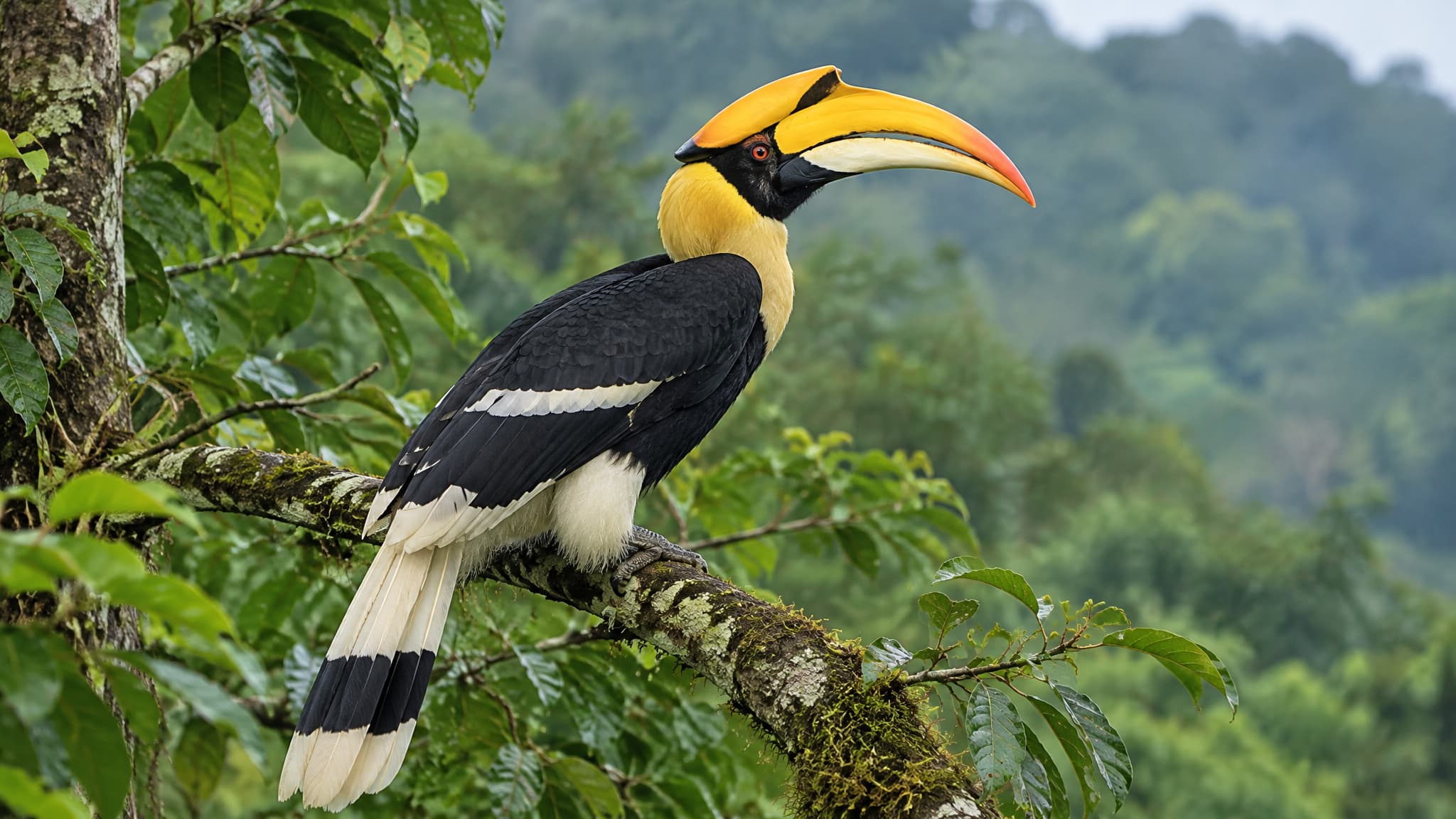
A Great hornbill perches on a moss-covered branch in lush mountain forest, showing its black-and-white plumage, yellow casque, and long curved bill.
The great hornbill (Buceros bicornis) is the heaviest hornbill in Asia and one of the most striking birds of its forests. It measures 95–130 cm in length, has a wingspan of 151–178 cm and weighs 2–4 kg, with males averaging about 3 kg. Its plumage is boldly black and white, and its huge curved bill is topped by a hollow, bright yellow and black casque that looks U-shaped from the front, with a concave top and two ridges ending in points. The sexes are easy to tell apart up close: males have red eyes and a casque that is black underneath, while the smaller females have bluish-white eyes, pinkish skin around the eye and a casque that is reddish at the back.
The species lives in India, Bhutan, Nepal, mainland Southeast Asia, the Malay Peninsula and Sumatra, with an outpost at Ujung Kulon on Java; in the Western Ghats and the Himalayan foothills its range is fragmented. It depends on large stretches of dense, old-growth evergreen forest, mostly in hilly country between about 600 and 2000 m, and needs tall emergent trees for nesting.
Great hornbills feed mainly on fruit, and figs make up most of what they eat through the year. During the breeding season they also seek lipid-rich fruits such as nutmegs, and they take small mammals, birds, reptiles, amphibians and large insects from time to time. Their home range covers about 3.7 to 14.7 km2, smaller during breeding and larger the rest of the year.
Pairs are monogamous and usually stay together for life. When nesting, the female seals herself inside a tree hollow with a plaster made mainly of droppings, leaving a narrow slit through which the male passes food. She lays 1 or 2 eggs and incubates them for 38–40 days, and both parents feed the young until they become independent at about 15 weeks. The casque takes five years to develop fully. Wild birds live about 35–40 years, and captive birds have reached nearly 50 years.
By swallowing large fruits whole, great hornbills carry seeds that smaller birds cannot, which makes them important seed dispersers for trees such as wild nutmegs. The species is listed as Vulnerable by the IUCN and on CITES Appendix I. Its main threats are the loss of old-growth forest and nesting trees and hunting for meat, fat, feathers and casques.