Great Kiskadee
Pitangus sulphuratus
 AI-generated
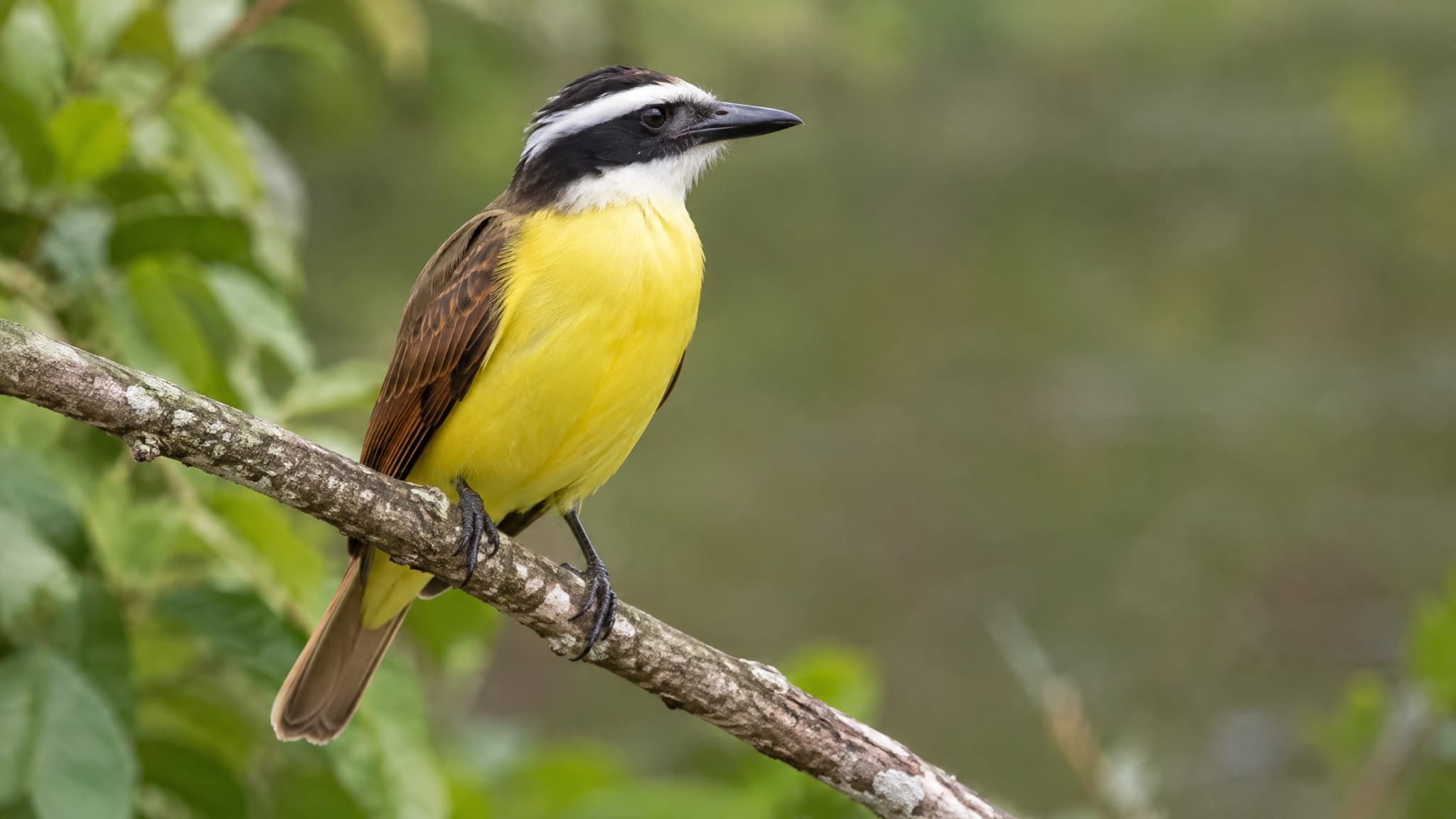
A Great Kiskadee (Pitangus sulphuratus) perches on a lichen-covered branch, showing its bold black-and-white head, long dark bill, brown wings, and bright yellow underparts.
The Great Kiskadee (Pitangus sulphuratus) is a large, conspicuous tyrant flycatcher whose emphatic “kis-ka-dee” call inspired its English name. It is also called the derby flycatcher; in Brazil it is the familiar bem-te-vi. Adults are stocky, roughly 24 cm long, with a hefty straight bill, a black head marked by a broad white eyebrow and white throat, bright yellow underparts, and warm rufous-brown wings and tail. Males and females look much alike.
This species ranges from southern Texas and Mexico through Central America and much of South America, reaching central Argentina. It is absent from extensive closed rainforest but thrives in open woodland, forest edges, scrub, savanna, riversides, marshy places, plantations, parks, suburbs, and towns. It is especially often encountered near water or clearings, where an exposed perch provides a good view of potential food.
Although placed among the flycatchers, the Great Kiskadee is an adaptable omnivore. It sallies from a perch to seize flying insects, but also takes fruits, spiders and other invertebrates, and opportunistically small vertebrates such as fish, tadpoles, lizards, or nestlings. Its broad diet helps it occupy altered landscapes. By consuming insects it can contribute to insect control; by eating fruit it may also disperse seeds, while its predation can affect smaller animals and birds.
Pairs are generally monogamous and vigorously defend breeding areas. The bulky, enclosed nest is usually built in a tree and has a side entrance; it is made from plant material and lined with softer matter. Clutches commonly contain two to five pale, spotted eggs, and both adults feed the young. A banded individual in Texas survived for at least 6 years and 11 months, though individual longevity in the wild can vary.
The Great Kiskadee has a very extensive distribution and is classified as Least Concern globally. It remains widespread and often common, including in human-modified habitats, and in some places has benefited from open habitat and suburban development. Nonetheless, local populations can still be affected by the loss or degradation of wooded edges, wetlands, and nesting sites.