Greater rhea
Rhea americana
 AI-generated
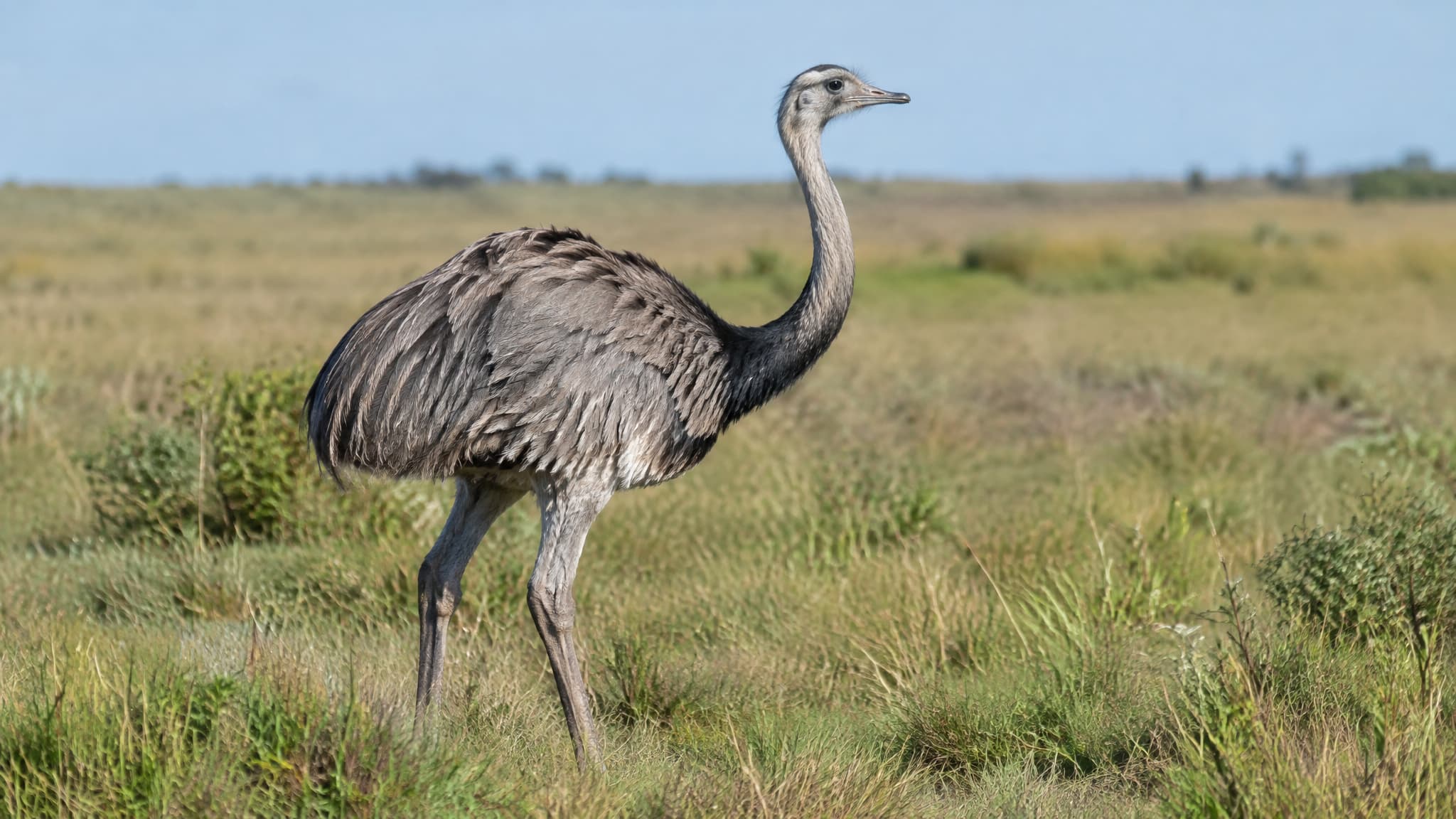
A Greater rhea stands in profile in an open grassy field, with its long bare neck, small head, broad shaggy plumage, and long legs clearly visible.
The greater rhea is a large, flightless South American bird and the largest bird native to the continent. In Brazil it is called ema; other regional names include nandu, nhandu, guaripé, and xuri. It has a long neck and long, powerful legs, with mostly gray-brown plumage and paler underparts. Though it cannot fly, its broad wings are important for balance and rapid changes of direction while running. Unlike ostriches, which have two toes per foot, rheas have three.
This species occurs across eastern and southeastern South America, including Brazil, Bolivia, Paraguay, Uruguay, and Argentina. It is associated chiefly with open country: grasslands, pampas, savannas, semiarid scrub, marsh edges, and agricultural landscapes. During the breeding season, it commonly uses areas near rivers, lakes, or wetlands, while its ground nests are placed where vegetation can provide some cover.
Greater rheas are mobile, mostly daytime foragers that may feed alone or in groups outside the breeding period. They are omnivores, but plant material makes up most of their diet: leaves, grasses, seeds, grain, legumes, fruits, and cultivated crops. They also take insects and small vertebrates such as lizards, frogs, snakes, fish, or small birds. By consuming both native and cultivated plants as well as small animals, they are a prominent part of open-habitat food webs.
Their breeding system features unusually extensive paternal care. A male courts several females, excavates and lines a shallow ground nest, and receives eggs from more than one female. He incubates the communal clutch and then defends and tends the chicks, sometimes aggressively. Incubation is reported at roughly five to six weeks, young become independent at about six months, and sexual maturity is reached near two years. Captive individuals are known to live for about 13 years, while maximum wild longevity is not established.
The greater rhea is globally listed as Near Threatened. Habitat conversion and fragmentation, hunting, egg collection, and pressures associated with agricultural development have contributed to declines in parts of its range. Protecting extensive native grasslands and wetlands, reducing illegal killing, and maintaining connected open landscapes are important for the species’ future.