Guianan Cock-of-the-rock
Rupicola rupicola
 AI-generated
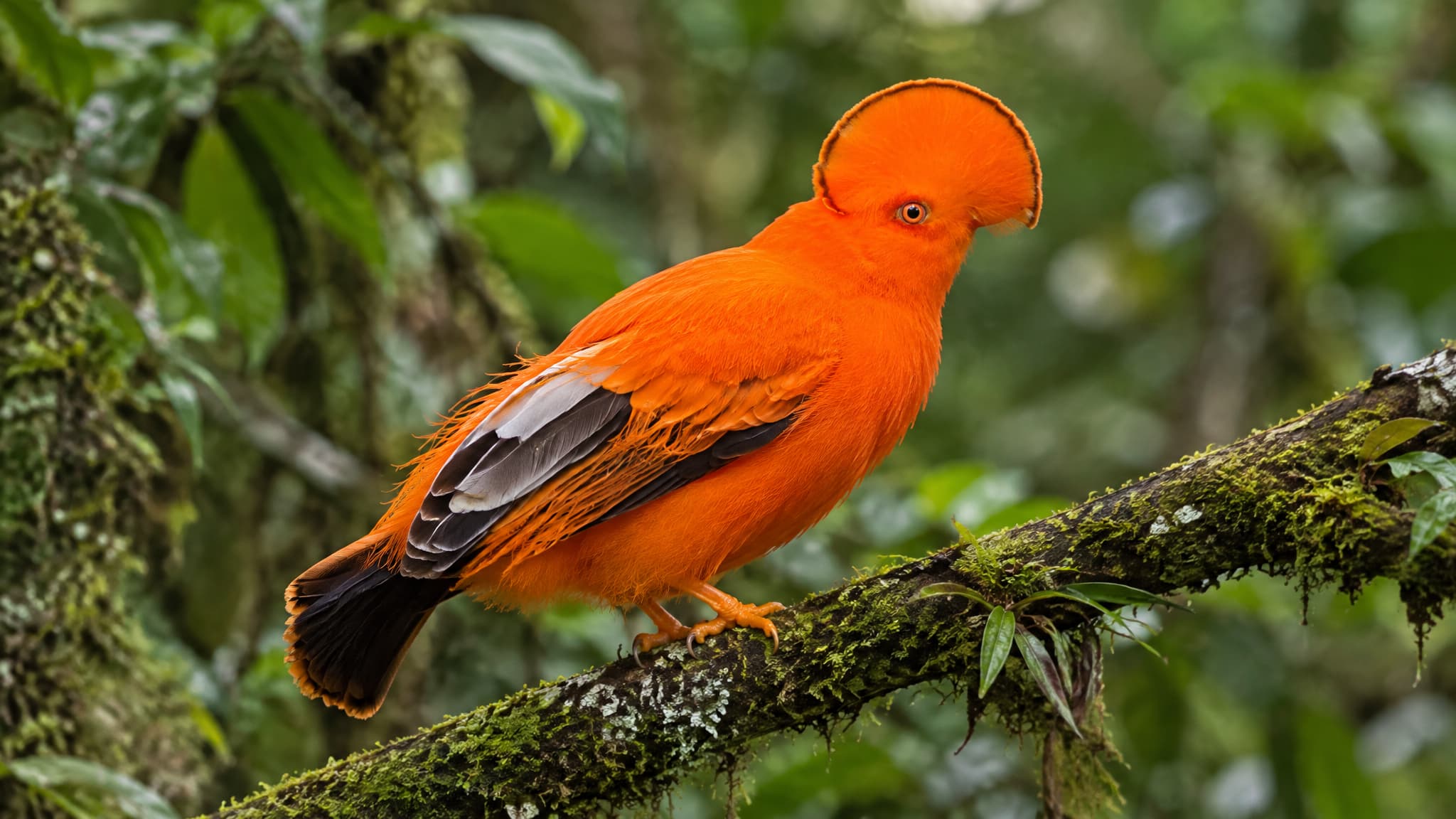
A bright orange male Guianan Cock-of-the-rock perches side-on on a moss-covered branch in dense tropical forest, showing a prominent rounded crest, dark wings, and a dark tail. The bill is not clearly visible beneath the crest.
The Guianan cock-of-the-rock is a stocky cotinga of northern South America, roughly 28 to 30 cm long and weighing around 195 g. Adult males are unmistakable: their plumage is a blazing orange, topped by a half-moon crest that fans forward until it nearly hides the bill, and the black tail has pale tips. Females are a dull dark brown with a much smaller crest and yellowish bill and feet, colors that keep them hidden at the nest. Young males look like females at first, gain orange patches in their second year and reach full adult plumage at about three years old.
The species lives east of the Andes and north of the Amazon, in the Guianas, Venezuela, Colombia and northern Brazil, where it is found locally along the border ranges from Amapá to the upper Rio Negro and around Presidente Figueiredo in Amazonas. It favors humid, shaded forest on hills and escarpments, often near streams and rock outcrops, and keeps to the lower and middle layers of the forest. It is a resident, non-migratory bird.
Cocks-of-the-rock are mainly fruit eaters, taking drupes, berries and palm fruits such as açaí and bacaba, and the carotenoids in this diet supply the pigments behind the male's orange color. They also catch insects and occasionally small lizards and frogs. Males gather at leks, communal display grounds near rocks, where each one defends a small cleared patch of ground. There they call, bob their heads, snap their bills and show off their plumage while females watch and choose a mate.
The breeding season runs from roughly November or December to April. After mating on the ground, the female leaves and raises the brood alone. She builds a cup of mud and plant material stuck to a rock face or eroded bank in damp, shaded forest, away from the lek, and lays usually two spotted eggs, which she incubates for about 27 to 28 days. Males take no part in nesting and begin to breed at around four years of age. Little is known about lifespan in the wild; birds in captivity have been recorded living about seven years.
Because the birds feed, display and nest in different places, they scatter seeds widely: one study found seeds of 111 plant species beneath male perches, making them important seed dispersers. Their predators include eagles, hawks, forest-falcons and boas. The IUCN lists the species as Least Concern, although its population is thought to be decreasing because of urban expansion and disturbance from tourists, and it is listed in CITES Appendix II, which regulates international trade.