Hoatzin
Opisthocomus hoazin
 AI-generated
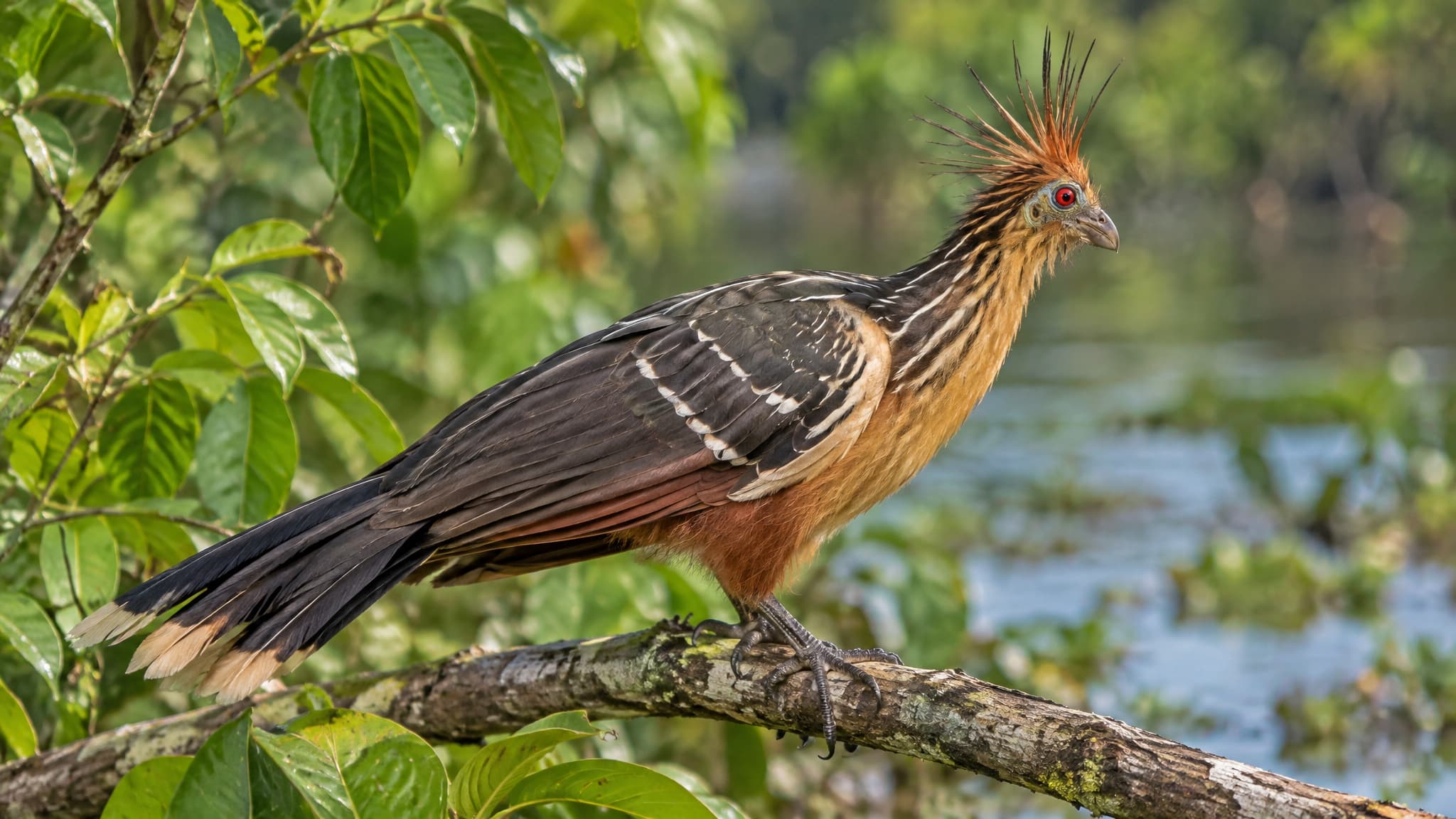
A Hoatzin in side profile perches on a branch beside forested water, showing its tall crest, red eye, patterned wings, warm buff breast, and long tail.
The hoatzin (Opisthocomus hoazin) is a large, unmistakable bird of South American wetlands and the only living member of its family, Opisthocomidae, and its order, Opisthocomiformes. It is about the size of a pheasant, roughly 61 to 66 cm long and weighing about 700 to 900 g, with a small head on a long neck. The bare face is bright blue, the eyes are maroon and a ragged, spiky rufous crest stands on the crown. The long tail is sooty brown, the underparts are mostly buff, and chestnut flight feathers and flanks show mainly when the wings open.
Hoatzins live in the Amazon and Orinoco basins of tropical South America. They keep to swamps, freshwater marshes, mangroves, gallery and riverside forest and the banks of rivers, lakes and streams, seldom far from water. In Brazil they occur in parts of Amazonia and along the upper Paraguai river. In Guyana the species is known as the Canje pheasant and is the national bird.
The hoatzin is a leaf-eater. One study in Venezuela found a diet of about 82% leaves, 10% flowers and 8% fruit, and birds can eat leaves from more than 50 plant species while usually relying on fewer than 12. It is the only bird known to digest food by foregut fermentation: bacteria break down plant matter in a huge two-chambered crop, much as in the stomach of a cow, and can digest up to about 70% of the fibre. A meal may take up to 45 hours to pass through. The fermenting leaves give the bird a manure-like smell, which earned it the name stinkbird. Hoatzins are noisy, social birds with hoarse calls that clamber through branches to feed, using a leathery bump on the crop to keep their balance.
Breeding takes place in the rainy season, often in small colonies. A pair builds a platform of sticks in a branch over the water, about 1.8 to 4.6 m above the surface, and usually lays two or three eggs, which hatch after about 32 days. Young birds from earlier broods often stay for a couple of years and help parents raise chicks and defend the territory. Chicks are fed regurgitated, fermented food and leave the nest after two to three weeks, but may take up to about 70 days to fly. Hoatzins may live up to about 10 years in the wild.
Nestlings carry two claws on each wing, a trait unique among living birds that disappears in adults. When monkeys, hawks or snakes threaten the nest, chicks drop into the water, swim underwater and then use these claws to climb back up through the vegetation.
The IUCN Red List classes the hoatzin as Least Concern. Clearing of Amazonian forest and wetlands is likely reducing its numbers, and local people sometimes take eggs and adults, although the meat is said to taste bad and is rarely eaten.