Hyacinth Macaw
Anodorhynchus hyacinthinus
 AI-generated
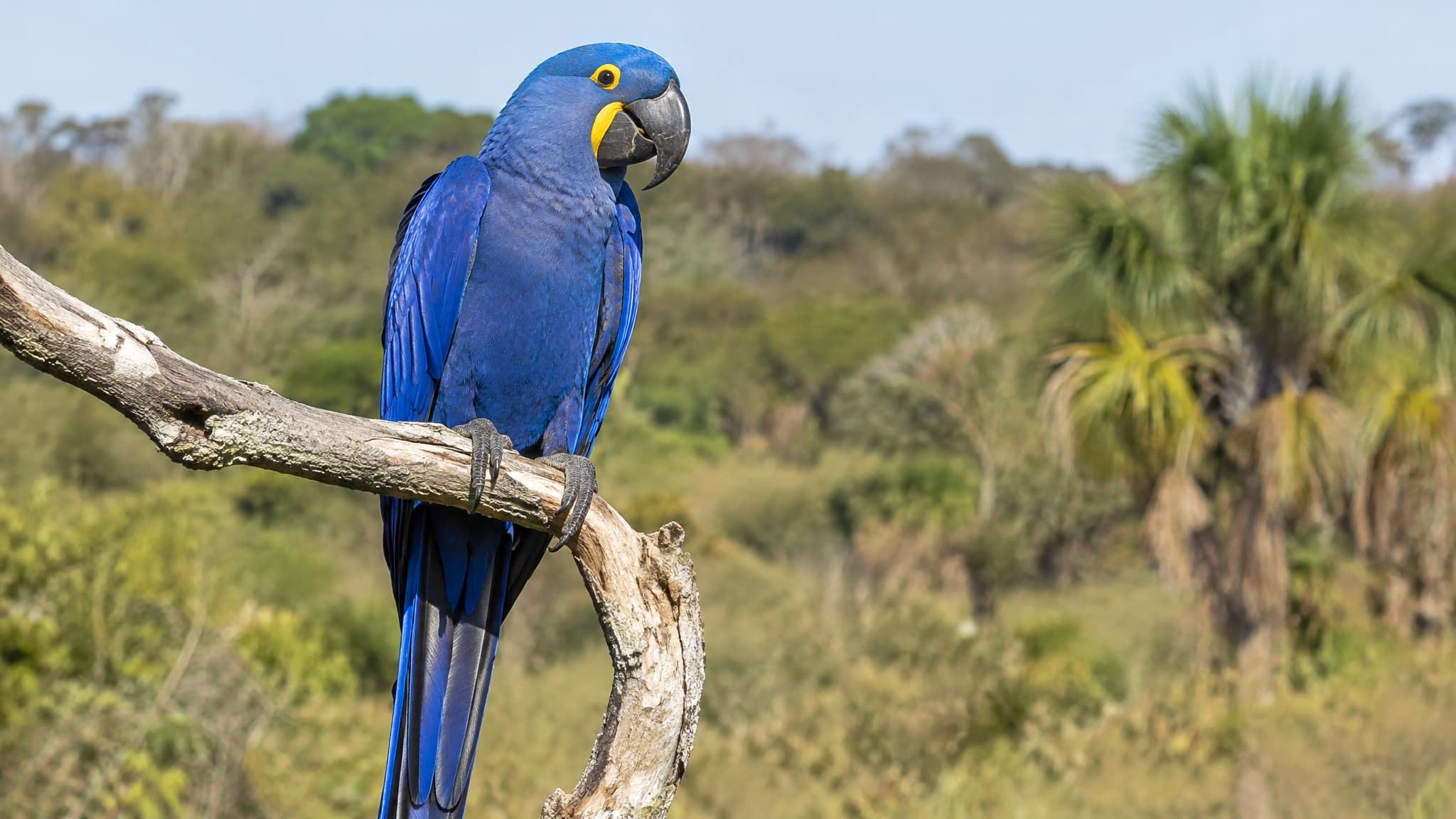
A Hyacinth Macaw perches upright on a bare branch, showing its vivid cobalt-blue plumage, long tail, yellow facial skin, and large dark bill. Blurred woodland vegetation and palms form the background.
The hyacinth macaw is an unmistakable, exceptionally large South American parrot. Its plumage is an intense cobalt to ultramarine blue, set off by bare golden-yellow skin around the eye and at the base of the lower mandible. It has a massive black hooked bill, powerful enough to open very hard palm nuts, and a long tail that accounts for much of its roughly 95–100 cm total length. Males and females look alike.
This species is native to central and eastern South America, with resident populations in Brazil, Bolivia, and Paraguay. It is strongly associated with semi-open landscapes containing palms: cerrado, palm groves, seasonally dry woodland, gallery forest, wetlands, and the Pantanal. Brazilian populations occur especially in the Pantanal and Cerrado, with additional, more separated areas in Amazonian and northeastern/interior regions.
Hyacinth macaws are social, vocal, diurnal birds, commonly seen in pairs, family groups, or flocks traveling between communal roosts and feeding sites. Their diet is dominated by the fruits, seeds, and exceptionally tough nuts of palms; they may also take other plant material and occasional invertebrates. By carrying, dropping, and consuming palm fruits over wide areas, they contribute to seed movement within their ecosystems.
Pairs are generally long-term and nest in large cavities in living or dead trees, or in rock faces where suitable tree hollows are scarce. Clutches are usually small, commonly one or two eggs; incubation lasts about 25–30 days. Young remain dependent on their parents long after fledging, and sexual maturity is delayed, helping explain the species’ relatively slow reproductive rate. Individuals can live for several decades, with about 50 years often cited as an estimate.
The hyacinth macaw is globally listed as Vulnerable. Illegal capture for the wildlife trade, loss and fragmentation of nesting and feeding habitat, and fires remain important pressures. Protection of nesting trees, palm-rich habitats, and local conservation programs—particularly in the Pantanal—are therefore central to its conservation.