Indian peafowl
Pavo cristatus
 AI-generated
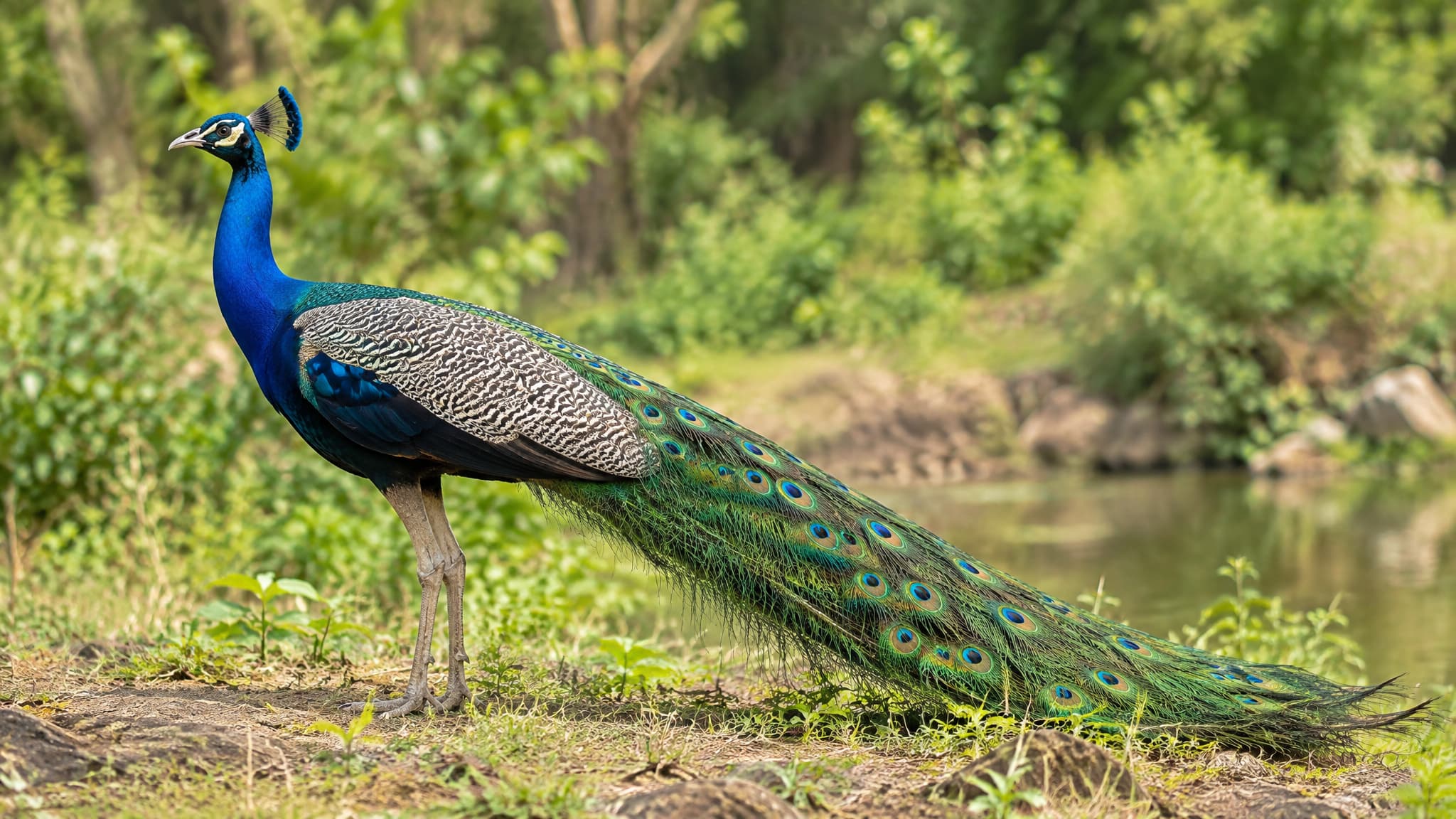
An Indian peafowl stands in side profile on the ground beside a pond in a leafy woodland, displaying its vivid blue neck, crest, patterned wing coverts, and long folded train with eye-spots.
The Indian peafowl (Pavo cristatus), also called the blue peafowl, is a large member of the pheasant family and one of the most recognizable birds in the world. Males, known as peacocks, measure 100–120 cm from bill to tail and 200–230 cm with a fully grown train, and weigh 4.1–5.2 kg. They have a metallic blue crown and neck, a fan-shaped crest and a long train formed by elongated upper tail coverts marked with eyespots. Females, or peahens, are about 97 cm long and weigh 2.7–4.1 kg; they have a crest and a rufous-brown head, a brownish back, a metallic green lower neck and whitish underparts, but no train. The wingspan is about 1.4–1.6 m.
The species is native to most of India and to Sri Lanka, from the Indus valley to Assam and from the Himalayas to the southern tip of India. In India it occurs up to about 1,500 m in the north and 1,800 m in the southern mountains, while in Sri Lanka it lives mainly in the drier lowlands. It uses forests, hills, scrub near water, farmland and villages, and has been introduced to many other parts of the world.
Indian peafowl are omnivores that feed on the ground on grass, seeds, flower buds, fruit, insects such as termites, and small reptiles; they also raid crops like rice, peanuts and tomatoes. Outside the breeding season they forage in small groups, often one male with three to five females. They rarely fly, usually escaping on foot, take dust baths and roost high in tall trees at night. Their loud call is a familiar sound across the range.
Breeding is tied to the monsoon. Males gather at leks, where each holds a small territory and displays his raised train to visiting females, and one male may mate with several. The female alone incubates 3–8 eggs for 28–30 days. Chicks are precocial and become independent at about 7–10 weeks, and birds reach maturity at 2–3 years. Wild birds are thought to live about 15 years, and captive birds up to 23 years.
Peafowl help control insects, lizards and snakes, and they are preyed upon by tigers, leopards, dholes, jackals and civets. The species is listed as Least Concern by the IUCN. It is the national bird of India and is protected by law there and in Sri Lanka, although poaching for meat and feathers and poisoning by pesticide-treated seed still occur.