Jabiru
Jabiru mycteria
 AI-generated
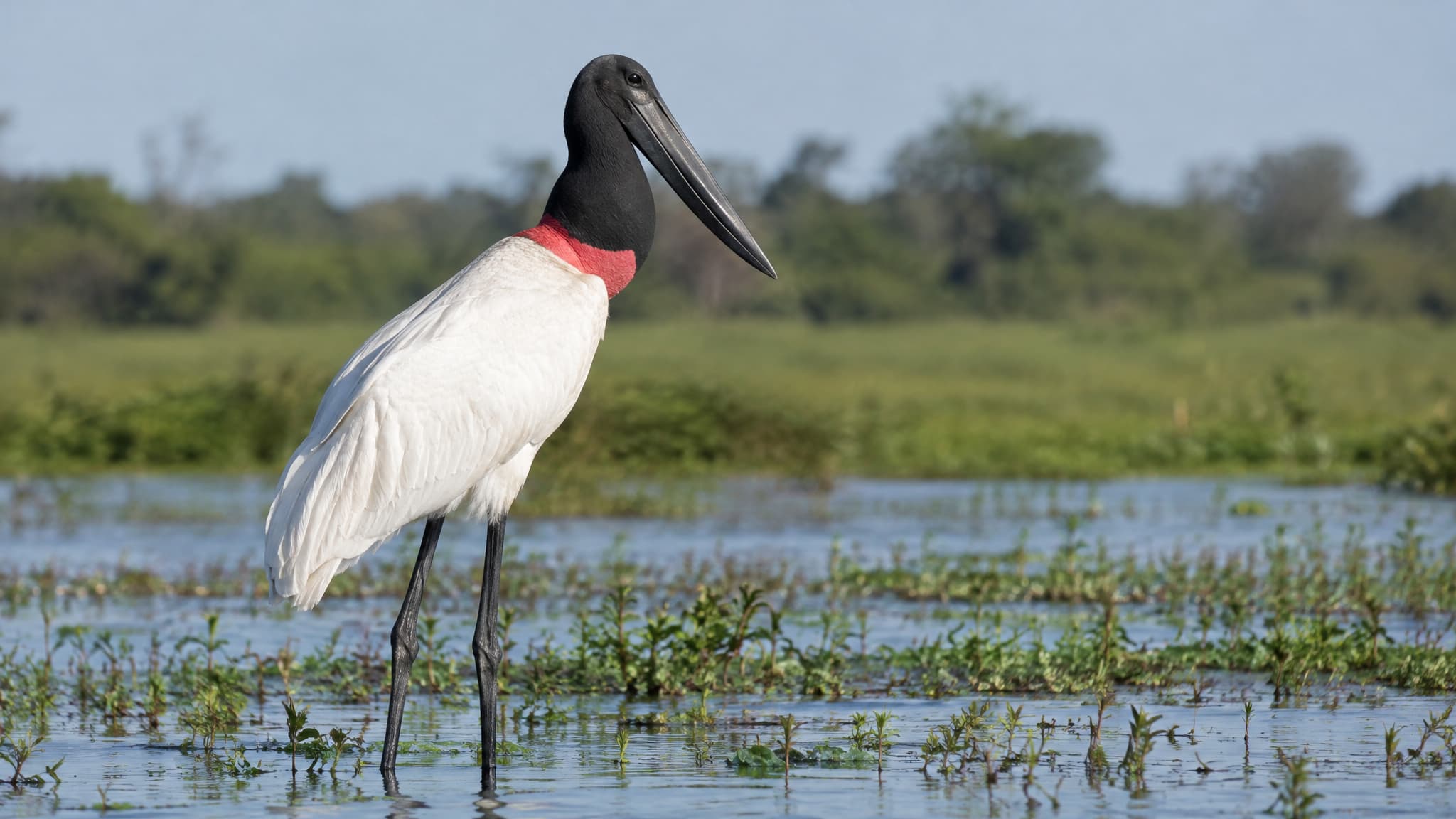
A Jabiru stands in shallow, plant-filled wetland water in side profile, showing its black head and neck, red throat band, white body, long dark legs, and broad pointed bill.
The jabiru (Jabiru mycteria) is an enormous Neotropical stork and the sole living species in its genus. In Brazil it is widely known as the tuiuiú. Adults are unmistakable: their bodies and wings are predominantly white, contrasting with a bare black head and upper neck, a broad upturned black bill, and a conspicuous red, inflatable band at the base of the neck. Males are generally larger than females. With a height around 1.15 m and a wingspan that can approach 2.6 m, it is among the most imposing wetland birds in the Americas.
Its range extends from Mexico through Central America and much of South America to northern Argentina, chiefly east of the Andes. Jabirus are especially associated with expansive lowland wetlands, including flooded savannas, marshes, ponds, river margins, and seasonally inundated grasslands. Brazil and Paraguay hold important concentrations. Although they can travel widely in response to water levels and food availability, they are not regarded as long-distance migratory birds.
A patient daytime hunter, the jabiru walks slowly through shallow water or probes with its powerful bill for fish, amphibians, mollusks, crustaceans, and other small aquatic animals. It may also take carrion, including fish left after droughts or die-offs. By removing carrion and preying on wetland animals, jabirus help recycle nutrients and participate in the food-web dynamics of marshes and floodplains. They are usually quiet, but pairs communicate prominently through visual displays and rapid bill-clattering.
Pairs construct very large stick nests high in isolated, tall trees near wetlands, sometimes in loose nesting neighborhoods. Both parents incubate the usual clutch of two to five eggs and feed and guard the young; fledglings remain dependent after leaving the nest. Breeding activity may occupy much of a year, which can limit successful breeding in consecutive seasons. Individuals may live roughly 30 years in the wild, with longer lives recorded in captivity. The IUCN lists the species globally as Least Concern, but healthy populations still depend on the protection of extensive wetlands, nesting trees, and reliable seasonal water regimes.