Kakapo
Strigops habroptilus
 AI-generated
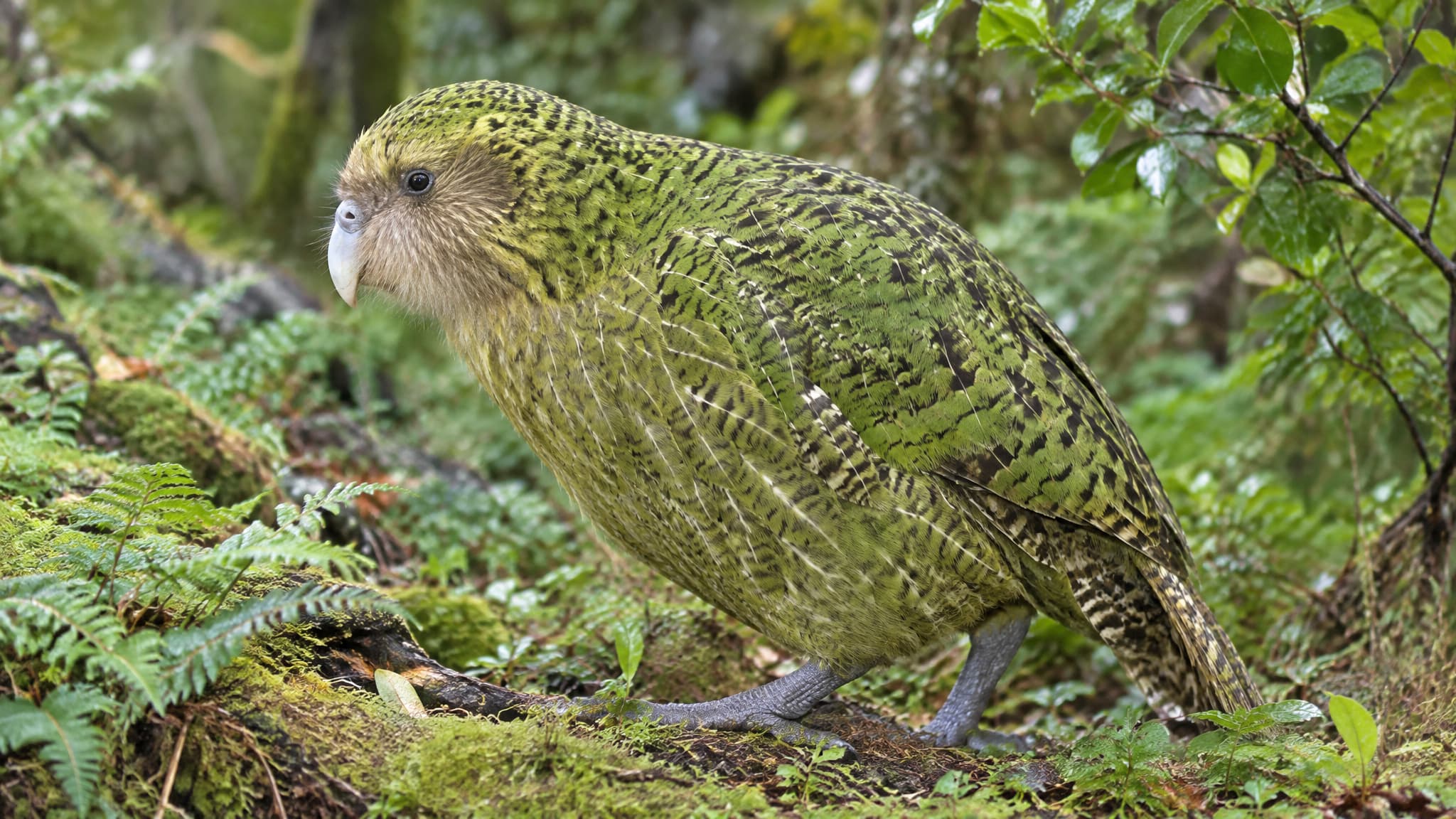
A kakapo stands in side profile on a moss-covered fallen log in a lush forest, showing mottled green plumage, a rounded body, facial bristles, and a pale curved beak.
The kakapo (kākāpō in Māori) is a large, flightless, nocturnal parrot found only in New Zealand and the sole living member of the family Strigopidae. Its soft moss-green plumage is mottled with yellow and black, which camouflages it against the forest floor, and its pale, owl-like facial disc gives the genus its name. Adults measure 58–64 cm long. Males weigh 2–4 kg and females 1–2.5 kg, making it the heaviest parrot in the world.
Once widespread across New Zealand, from tussock grassland and scrub to podocarp and beech forest, the kakapo vanished from the North Island by about 1930 and from Fiordland by the late 1980s. Today every known bird lives on predator-free offshore islands such as Whenua Hou (Codfish Island), Anchor Island and Hauturu (Little Barrier Island), or in a fenced mainland sanctuary.
The species is entirely vegetarian. It eats leaves, buds, flowers, fern fronds, bark, roots, rhizomes, fruit and seeds, and often leaves chewed crescents of fibre on plants it has browsed. Kakapo are solitary and active at night, keep the same home range for many years and climb high into trees. Their wings are too small for flight, so they walk, climb and, at most, flap down in a controlled plummet. When threatened they freeze and rely on camouflage, a defence that worked against birds of prey but fails against mammals that hunt by smell.
The kakapo is the only parrot known to breed in a lek. In breeding years males gather at display sites, dig shallow bowls and give deep booming calls below 100 Hz that can carry at least 1 km on still nights. Breeding happens only when food is abundant, on the southern islands when rimu trees fruit heavily, roughly every 2 to 4 years. The female raises the chicks alone: she lays 1–4 eggs, incubates them for about 29 days, and the young leave the nest at about 70 days. Kakapo are exceptionally long-lived, with an expected lifespan of 60–90 years.
Introduced cats, stoats and rats, together with hunting and forest clearance, drove the kakapo to about 50 birds in the mid-1990s. Its low genetic diversity reduces fertility, and disease is a further risk. Intensive management by the Department of Conservation's Kākāpō Recovery programme, with every bird monitored, has raised the population to 325. The IUCN lists the kakapo as Critically Endangered, and in New Zealand it is classed as Nationally Critical.