North Island brown kiwi
Apteryx mantelli
 AI-generated
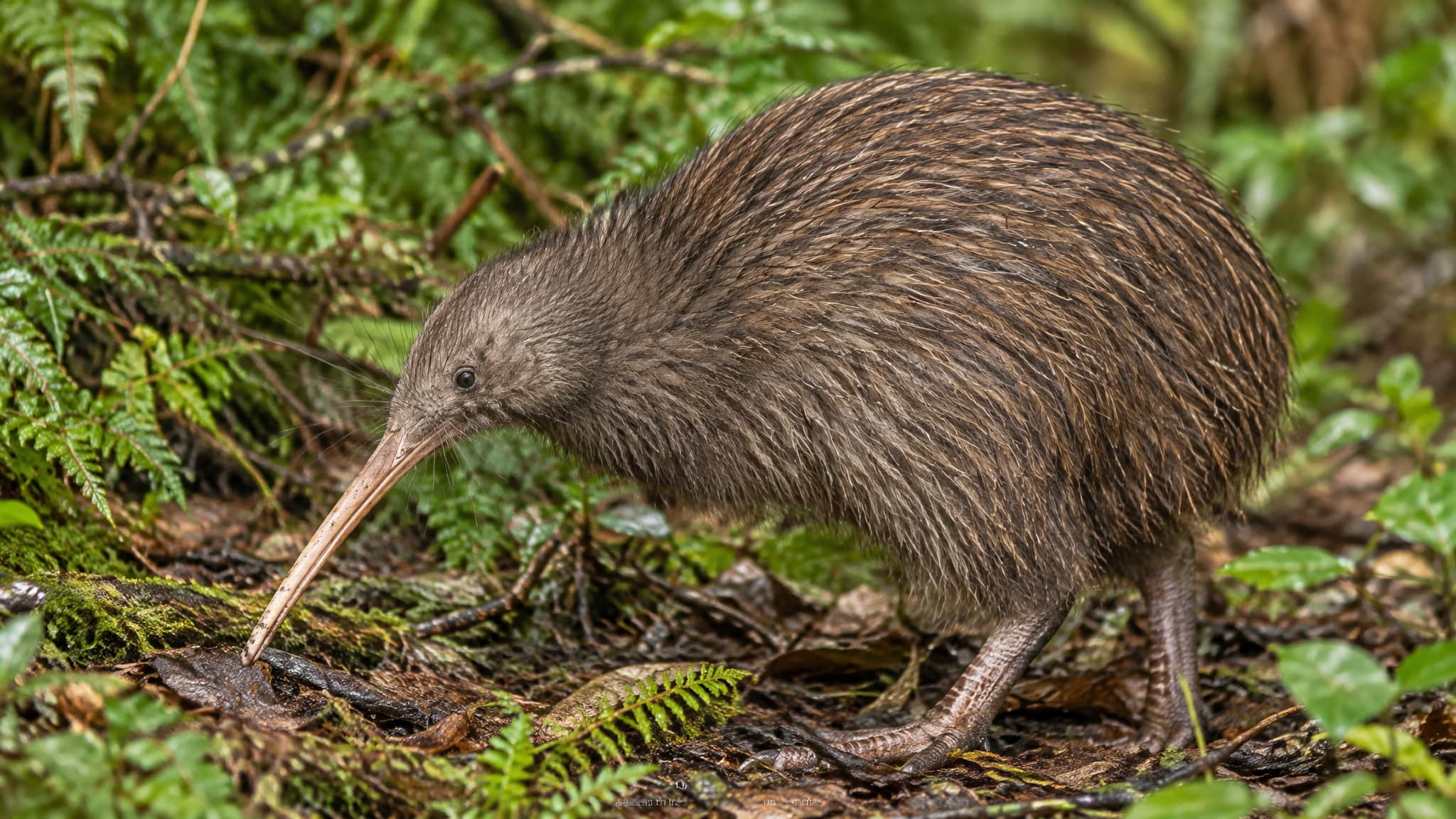
A brown kiwi stands on the mossy forest floor, probing the leaf litter with its long slender bill. Its shaggy brown plumage, small eye, facial bristles, and stout scaly legs are clearly visible.
The North Island brown kiwi is a flightless, tailless bird about 40 cm long, covered in loose, spiky dark feathers streaked with reddish brown and black. It has a long, pale bill, short dark legs and strong claws. Females are clearly larger than males: males weigh about 1.44–3.06 kg and females about 2.06–3.85 kg.
It is the only kiwi living wild on New Zealand's North Island, where it is spread across the northern two-thirds of the island and is most numerous in Northland. It favours dense native lowland and coastal forest, but also lives in exotic pine plantations, scrub, regenerating forest and rough farmland, from sea level up to 1400 m.
The kiwi is nocturnal and territorial. By day it rests in burrows, hollow logs or thick vegetation, and at night it probes the ground for food. Invertebrates make up 85–95% of its diet, especially earthworms and the larvae of beetles, cicadas and moths, along with spiders, centipedes and weta; fallen fruit and leaves complete the menu. Males and females call to each other with distinct whistles and cries, and rivals fight with their claws.
The species is famous for laying enormous eggs for its size, weighing around 430 g. A clutch holds 1–2 eggs, and only the male incubates them, for 75–90 days. Chicks hatch fully feathered, leave the nest to feed at about five days old and are never fed by their parents. Birds usually first breed at 4 years. Banded wild birds have lived 21 years, and the maximum lifespan is estimated at 40 years.
The North Island brown kiwi is listed as Vulnerable. Introduced mammals are the main problem: stoats cause about half of chick deaths on the mainland, and dogs are the greatest danger to adults. Where pests are not controlled, one study found 94% of chicks died before reaching breeding age, and DOC reports that only 10% of unmanaged chicks reach six months. About 26,600 birds were estimated in 2015, and predator control, egg rearing and predator-free crèches now help sustain the population.