Red-breasted Toucan
Ramphastos dicolorus
 AI-generated
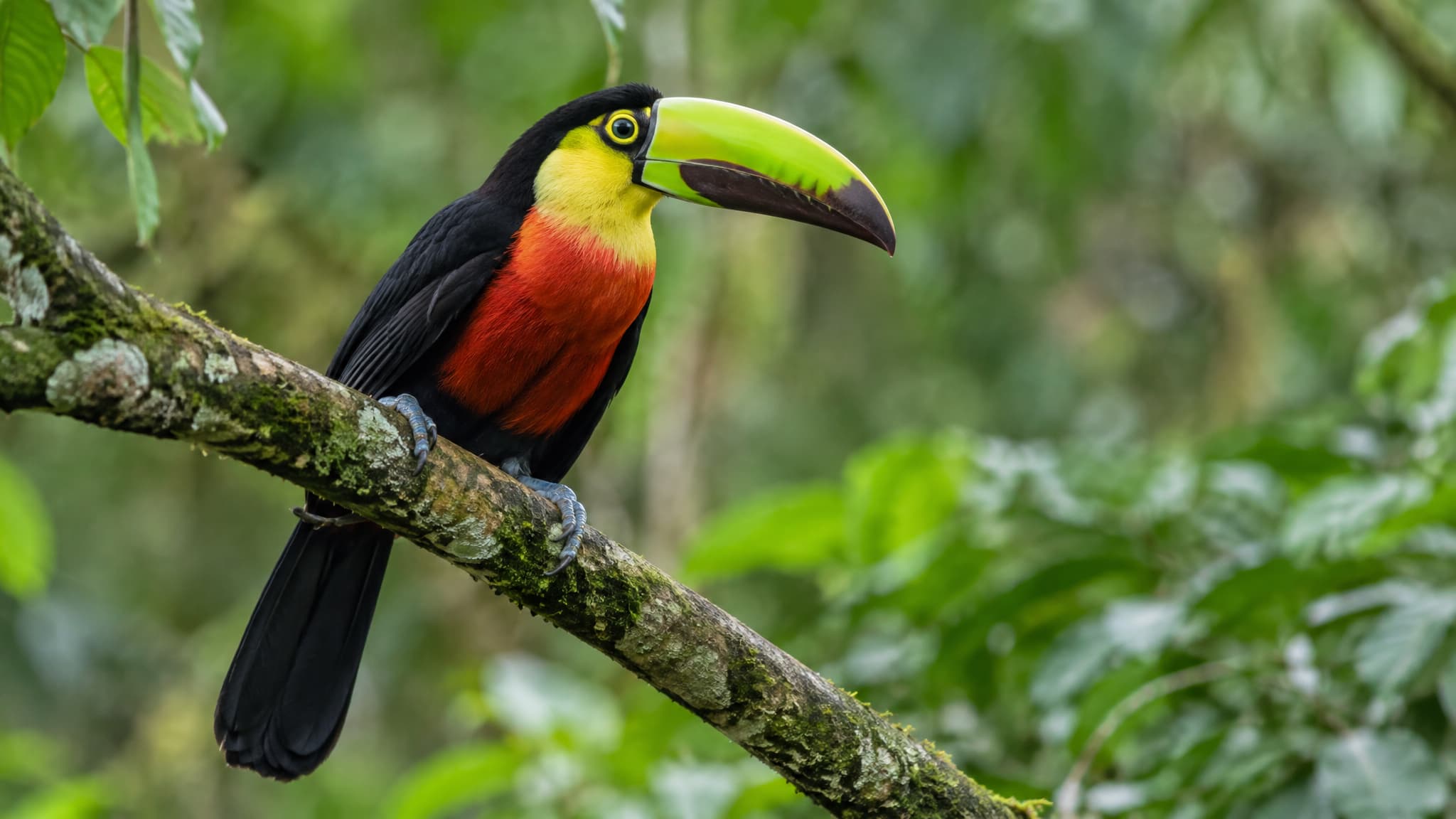
A red-breasted toucan perches on a moss- and lichen-covered branch in a lush forest, facing right. Its black plumage, vivid red breast, yellow throat, and large green bill with a dark tip are clearly visible.
The red-breasted toucan is a large, unmistakable South American toucan, also called the green-billed toucan. It measures roughly 42–48 cm long, much of that length accounted for by its outsized but lightweight bill. Its plumage is principally black above, while the throat is yellow with an orange central area and the breast and upper tail coverts are red. The bill is predominantly green, marked by a black basal line and red around the cutting edge; a pronounced angle at the base of the lower mandible is a useful identifying feature.
It is chiefly associated with the Atlantic Forest and adjoining wooded landscapes. Its range extends through southern and southeastern Brazil—from Goiás, Minas Gerais, and Espírito Santo south to Rio Grande do Sul—and continues into eastern Paraguay and northeastern Argentina. It occupies the canopy and forest edges of primary and secondary forest, from lowland coastal areas to upland and montane forest. It can also occur in wooded urban settings and near forest fragments, provided suitable trees and food are available.
Fruit forms the core of its diet. Studies of Atlantic Forest toucans show that Ramphastos species are strongly frugivorous and can swallow fruits of varied sizes; the red-breasted toucan also takes arthropods and small vertebrate prey, including eggs and nestlings of other birds. By carrying fruits and passing viable seeds away from parent plants, it can contribute to seed dispersal in forest ecosystems. Its broad diet may help it use altered landscapes, but it does not remove its dependence on mature trees and connected woodland.
This species is an obligate cavity nester, using holes formed by decay or originally excavated by woodpeckers. Observations in southeastern Brazil found clutches of three or four white eggs, shared incubation by both parents for about 17 days, and a nestling period averaging about 43 days. Adults regurgitate seeds onto the cavity floor, apparently creating a substrate that helps the female remove waste. It is assessed as Least Concern globally, although habitat loss, fragmentation, hunting, and the loss of large cavity-bearing trees can affect local populations. A reliable species-specific wild lifespan estimate was not established in the consulted sources.