Red-legged Seriema
Cariama cristata
 AI-generated
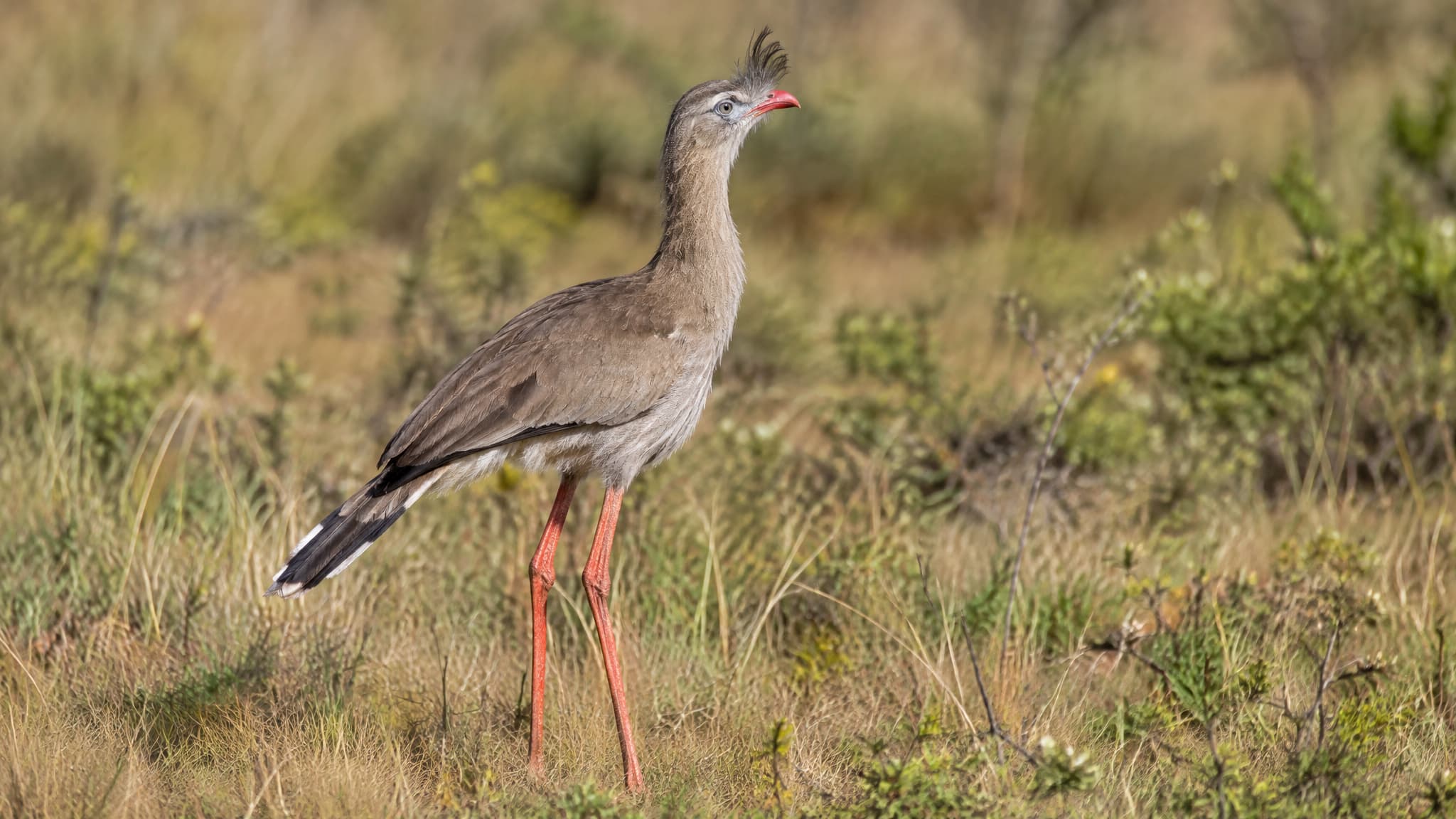
A Red-legged Seriema stands upright in dry grassland and scrub, facing right, with its raised crest, red curved bill, long red legs, and banded tail clearly visible.
The red-legged seriema is a tall, mainly ground-dwelling South American bird with long reddish legs, a reddish bill, pale gray-brown to buff plumage, and a conspicuous forward-pointing crest of stiff feathers above the bill. Adults are usually about 75–90 cm tall. Its long neck, alert posture, powerful feet, and excellent eyesight suit a life spent walking and running through open country; it flies, but generally does so only when necessary.
It occurs from central and eastern Brazil into eastern Bolivia, Paraguay, Uruguay, and north-central Argentina. In Brazil it is especially associated with the Cerrado and also uses campos, pastureland, savanna, scrub, and open woodland. It favors habitats with open ground for detecting prey and scattered shrubs or trees for shelter, roosting, and nesting.
Although it may eat fruit, seeds, and other plant material, the seriema is a strongly predatory omnivore. Insects and other arthropods, lizards, frogs, snakes, rodents, eggs, and small birds can all be taken. It searches while walking alone, as a pair, or in small family groups, and may strike larger prey against the ground to subdue it or break it apart. Its far-carrying calls help maintain contact and advertise territory.
Pairs breed in the rainy season in much of their range and construct bulky stick nests in low trees or shrubs. Clutches commonly contain two or three eggs; both parents can incubate and feed the young, which leave the nest after roughly two weeks but remain dependent for a time. By consuming numerous small animals, it is an important predator in open-land food webs. It is listed as Least Concern globally, though local populations can be affected by hunting and the loss or fragmentation of suitable habitat. Captive birds may live about 20–25 years; wild longevity is less well established.