Resplendent quetzal
Pharomachrus mocinno
 AI-generated
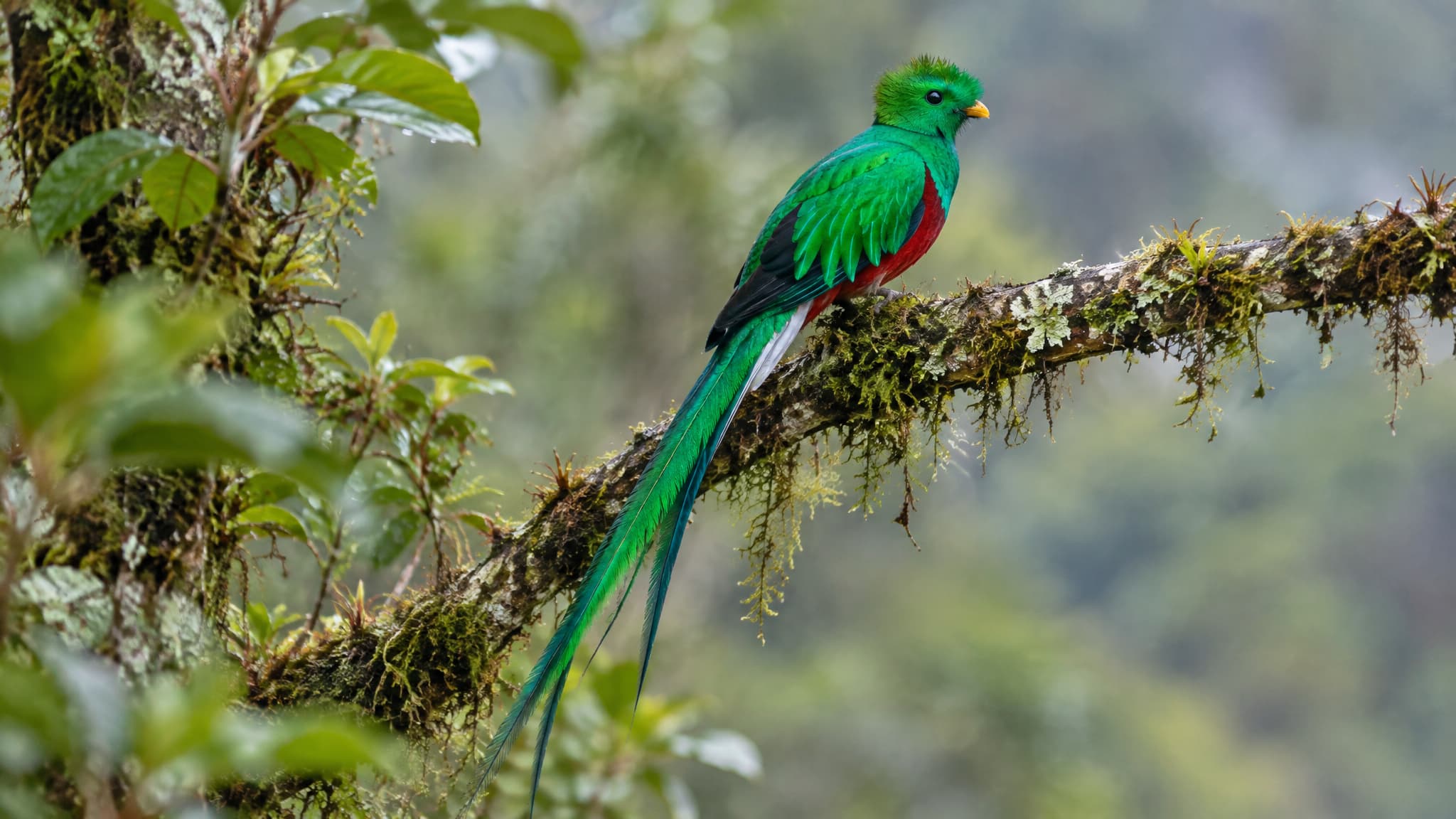
A resplendent quetzal perches side-on on a moss-covered branch in a lush, misty montane forest. Its iridescent green plumage, red breast, yellow bill, and exceptionally long tail feathers are clearly visible.
The resplendent quetzal is the largest member of the trogon family, measuring 36 to 40 cm in length and weighing about 210 g. Males are unmistakable: iridescent green upperparts and head with a helmet-like crest, a red lower breast and belly, a yellow bill and long green tail streamers that reach 31 to 100.5 cm, with a median of 75 cm. Females are duller, with a bronze-green head, grey lower breast and belly, a grey bill and a much shorter tail. Two subspecies are recognized, the nominate P. m. mocinno and the slightly smaller P. m. costaricensis.
The species lives in the montane rainforests and cloud forests of Central America, from southern Mexico (Oaxaca and Chiapas) through Guatemala, Honduras, El Salvador and Nicaragua to Costa Rica and western Panama. It is found mainly between 900 and 3,200 m of elevation, where it keeps to the canopy and subcanopy, and it moves up and down the mountains with the seasons.
Quetzals are fruit specialists, feeding on 41 to 43 kinds of fruit, more than half of them from the laurel family (Lauraceae). They usually pluck fruit in flight and also take insects, frogs, lizards and snails, especially when fruit is scarce. They are rather inactive birds, most vocal at dawn and on misty afternoons, and males defend their territories with calls.
Pairs nest in cavities dug into decaying trees or old woodpecker holes. The female lays 1 to 3 pale blue eggs, often in two clutches a year, and both parents incubate them for 17 to 19 days, the male by day and the female by night. Chicks are first fed mainly insects and later fruit and small vertebrates. Nest failure is high, between 67% and 78%, and males take up to three years to grow their full tail plumes. Lifespan in the wild is not well documented.
By swallowing laurel fruits and passing the seeds, quetzals act as important seed dispersers for cloud-forest trees. The species is listed as Near Threatened by the IUCN, with an estimated 20,000 to 49,999 individuals, and is on CITES Appendix I. Its main threats are deforestation and forest fragmentation, along with hunting and capture for the illegal bird trade. The quetzal is the national bird of Guatemala, appears on its flag and coat of arms, and gives its name to the country's currency.